Hajdú-Bihar County: Debrecen and the Puszta
Travel guide · editorialWide skies, sweep wells, and Hungarian Grey cattle: a vacation in Hajdú-Bihar County takes you into the classic Puszta of eastern Hungary. This is also home to Debrecen, the country's second-largest city, and Hajdúszoboszló, one of the best-known spa towns in Central Europe.
The Hortobágy Puszta
Hortobágy National Park, founded in 1973 as Hungary's first national park, protects one of the largest contiguous expanses of steppe in Europe. Since 1999, this pastoral landscape has been a UNESCO World Heritage Site. On the pastures you'll see Hungarian Grey cattle with their wide-sweeping horns, Mangalica woolly pigs, and Racka sheep with their spiral-twisted horns. The Nine-Arch Bridge, built in the 19th century, is the landmark of the Puszta, and a traditional csárda stands right beside it. In autumn, tens of thousands of cranes rest here, a spectacle that draws bird-watchers from all over Europe. At riding demonstrations, the Csikós, the mounted horse herders, show how they gallop standing on two horses at once.
Sights in Debrecen
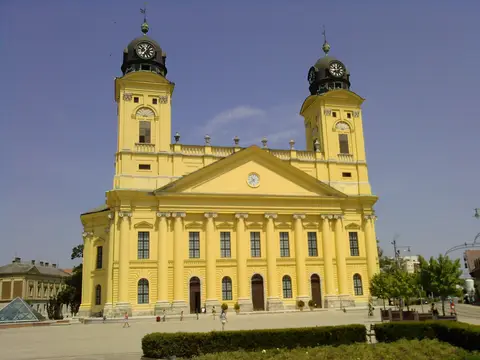
From the 16th century on, Debrecen was a center of Calvinism, and it is still known today as the Calvinist Rome. The yellow Reformed Great Church on the main square is the largest Protestant church in Hungary; in 1849, Lajos Kossuth proclaimed Hungary's independence from the Habsburgs here. Behind it lies the Reformed College with its historic library. The Déri Museum displays the Christ Trilogy by the painter Mihály Munkácsy. The Great Forest, a city park with a zoo, thermal bath, and amusement park, is the city's local recreation area. Every year on August 20, the Flower Carnival moves through the streets with floats made of hundreds of thousands of blossoms.
Baths and the Hajdú Towns
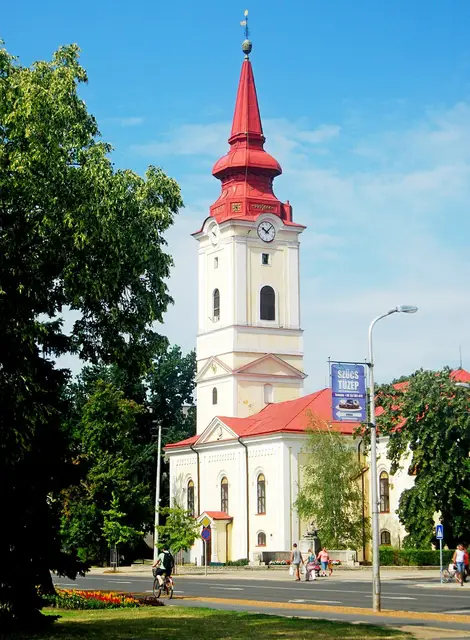
Hajdúszoboszló became famous through a test drilling for oil in 1925, when workers struck hot water rich in iodine and bromine. Today, with its wave pool, slides, and therapeutic pools, the bath is one of the largest bathing complexes in Europe. The so-called Hajdú towns such as Hajdúböszörmény and Hajdúnánás go back to the Hajduks, free cattle drovers and mercenaries whom Prince István Bocskai rewarded with land in 1605. Their towns are often laid out in a circle, with a church square at the center. Nádudvar is known for its black, glossy polished pottery, which is still made in family workshops today. In the southeast, in the Bihar Plain along the Romanian border, the landscape becomes wetter, with meadows, oxbow lakes, and small villages where the rural way of life of the Great Plain has been well preserved.
Food and Drink
Debrecen sausage, a lightly smoked paprika sausage, is famous far beyond Hungary. In the csárdas of the Puszta, you'll find goulash cooked in a cauldron, shepherd's dishes with lamb, and Hortobágy-style crêpes, filled with meat and covered in paprika sauce. These are served with pálinka, often made from plums. In Debrecen itself, a lively dining scene has developed in recent years, with wine bars and bistros around Piac Street, the main axis of the city center.
Getting There and Best Time to Visit
Debrecen Airport is served by several low-cost airlines and has connections to a number of European cities. From Budapest, the drive on the M35 and M3 highways takes about two and a half hours. The best time to visit is between May and September; for the crane migration, October and early November are best.