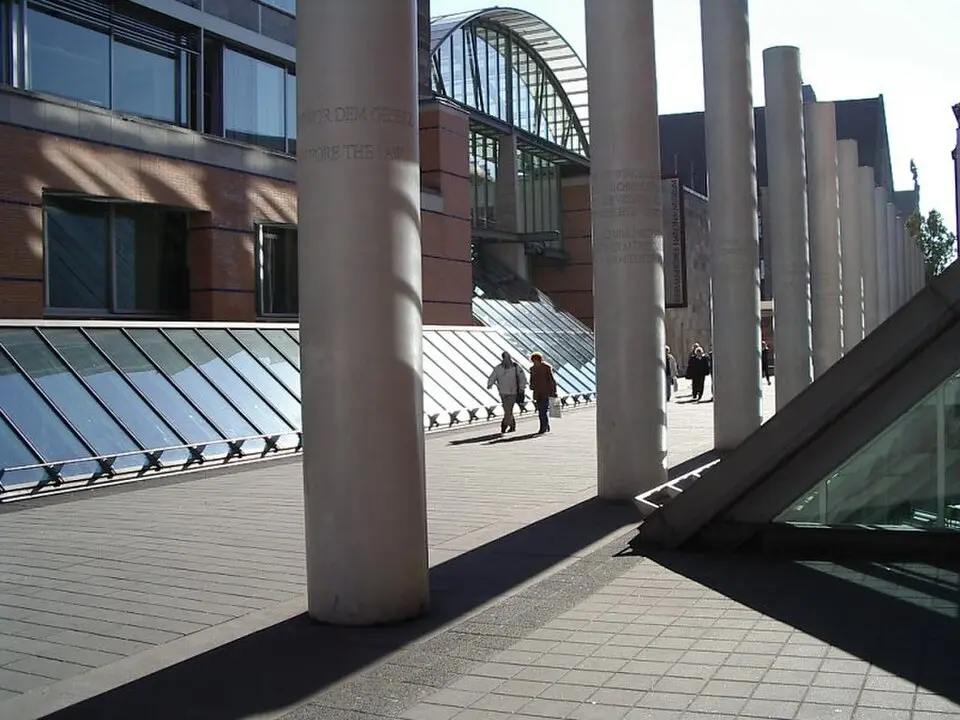
About Germanisches Nationalmuseum
The Germanisches Nationalmuseum (Germanic National Museum) in Nuremberg is the largest museum of cultural history in the entire German-speaking world. A foundation under public law, it is jointly supported by the Federal Republic of Germany, the Free State of Bavaria, and the city of Nuremberg, and as a research institution it belongs to the Leibniz Association. The museum's name goes back to its founding in 1852 and reflects the idea of the time of a linguistically and culturally defined region whose close ties reached beyond the political fragmentation of the German states. Today the museum sees itself as a research and educational institution that presents cultural history across a wide range of disciplines. A central guiding principle is respect for all cultures, along with the effort to make cultural connections accessible to everyone, regardless of background, age, or education.
The museum's history began with an initiative by Baron Hans von und zu Aufseß, who conceived of it as a comprehensive inventory of significant objects. After the official founding in Dresden, the Kingdom of Bavaria and the city of Nuremberg gave the museum the former Carthusian monastery as its home in 1857. This late medieval building remains the architectural core of the complex to this day. Over the centuries, the grounds were expanded several times. While hardly any of the original additions from the second half of the 19th century survive, the buildings added in the first quarter of the 20th century, such as the Old Entrance and the Lapidarium, shape the look of the site. After World War II, in which the buildings were badly damaged, the architect Sep Ruf designed new annexes. One major expansion was the so-called Carthusian Building (Kartäuserbau), completed in the 1980s and 1990s to designs by Jan Störmer and other architects.
Inside the museum, you will encounter a collection of around 1.3 million objects, of which about 25,000 are on permanent display. The holdings range from prehistoric times to the present day, making the museum one of the most visited in Germany. A particular highlight is the Behaim Globe, created by Martin Behaim in 1492. The oldest surviving depiction of the Earth in the form of a sphere, it was inscribed in UNESCO's international "Memory of the World" Register in 2023. The globe is one of the scientific instruments that, together with clocks, telescopes, and other devices, document the history of science in the German-speaking world.
The Department of Prehistory and Early History presents archaeological finds from Central Europe that trace the development of humankind from hunter-gatherers to complex state formation. Among the most important exhibits in this collection is the Golden Hat of Ezelsdorf-Buch from the Bronze Age, whose decorations suggest a calendrical meaning. Also of great historical importance is the Domagnano eagle fibula, a piece of jewelry belonging to a wealthy Ostrogothic woman of the 6th century. The golden ornament, with Byzantine influences, symbolizes both Roman state power and the god Wodan, and in 1952 it served as the motif for a special issue of a German coin.
Another focus is sculpture. With around 2,600 works, the collection offers a comprehensive overview of the development of sculpture in the German-speaking world from the Middle Ages to modern times. Particularly noteworthy are works from Nuremberg, which was an important artistic center in the late Middle Ages and the late Renaissance. One well-known piece is the so-called Brunnenhansel, a 14th-century bronze cast that originally served as a fountain figure at the Holy Spirit Hospital. The figure group "Raphael and Tobias" by Veit Stoß from 1516 also testifies to the high quality of the arts around 1500 and impresses with its masterful carving and dynamic composition.
The museum's painting collection spans works from late antiquity to the modern era, with a special focus on late medieval and early modern art from Nuremberg. Here you can marvel at masterpieces by Albrecht Dürer, Hans Baldung Grien, Lucas Cranach the Elder, and other significant artists of the period. The collection shows not only religious themes but also portraits and genre scenes that reflect the social life of the time. The paintings are complemented by an extensive stained-glass collection that includes works from the 13th century onward and is partly integrated into the permanent medieval exhibition.
At a glance
- Category
- Museum › History museums
- Rating
- no reviews yet · write a review
- Address
- Kartäusergasse 1
90402 Nuremberg, Germany - District
- Altstadt, St. Lorenz
- Phone
- +4991113310
- Website
- www.gnm.de
- socialmedia@gnm.de
- Coordinates
- 49.44857° N · 11.07541° E
- Data quality
- confidence 1.00
- Identifier
- ID b7907558-8b3…
Location & surroundings
Toggle layersRatings & comments
none yetNear Germanisches Nationalmuseum
closest 5 per category · 2 kmSights
Restaurants
Museums
Hotels
More:Museums in Altstadt, St. Lorenz (23)All museums in Nuremberg (71)
271 places within 2 km loaded.
Don't miss in Nuremberg
All sights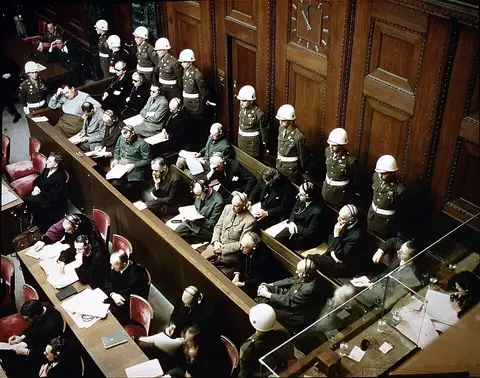 Historic sites01
Memorium Nürnberger Prozesse
Bärenschanzstraße 72 · Nuremberg● Website● Phone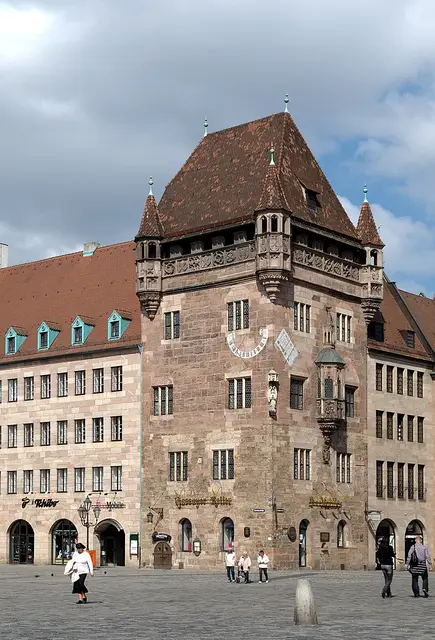 Historic sites02
Nassauer Haus
Karolinenstraße 2 · Nuremberg● Website● Phone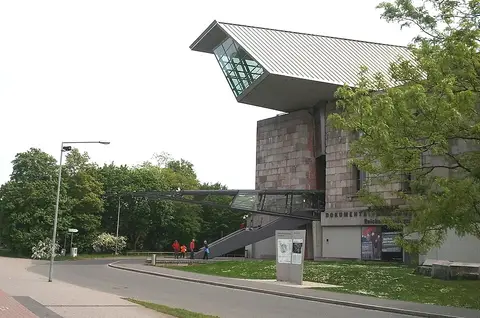 Historic sites03
Dokumentationszentrum Reichsparteitagsgelände
Bayernstraße 110 · Nuremberg● Website● Phone Monuments04
You need a free account to leave reviews and photos – that keeps comments genuine and lets you edit them later.
One of the largest museum of art and crafts in the German-speaking countries, with a collection ranging from pre-historic artefacts to 20th century art. Allow at least half a day.
Source: Wikivoyage, „Nuremberg“ · authors per page history · CC BY-SA 4.0 · as of 5/10/2026