About Memorium Nürnberger Prozesse
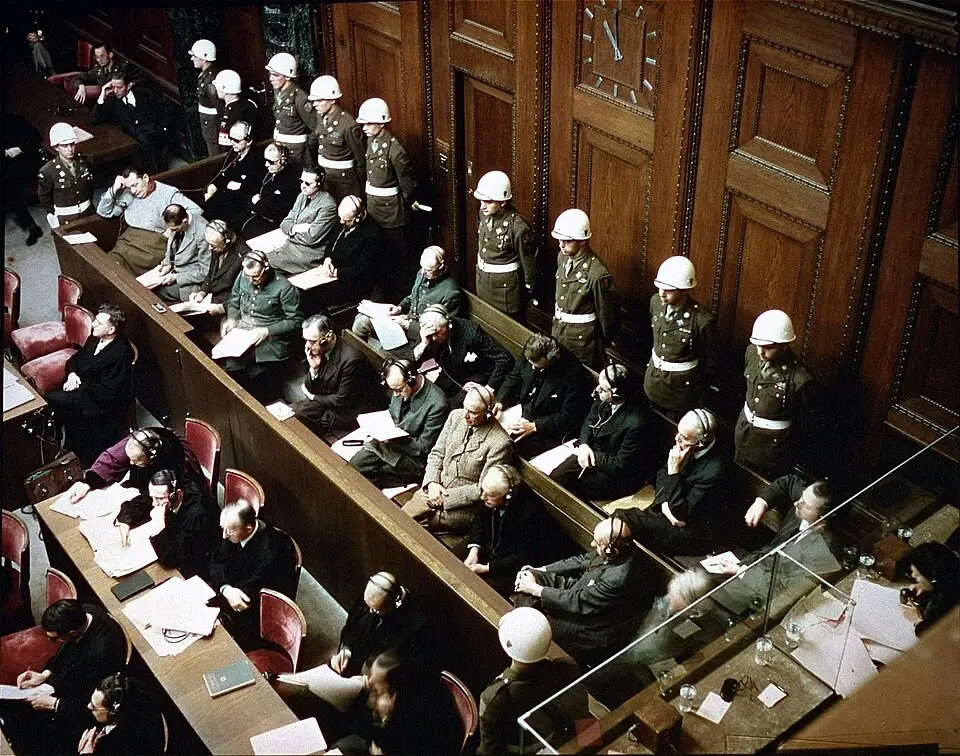
The Memorium Nuremberg Trials is a museum run by the city of Nuremberg, located in the historic Courtroom 600 of the Palace of Justice on Fürther Straße. The site is world-famous because the Nuremberg Trial of the major war criminals took place here between November 20, 1945, and October 1, 1946. It was the first and only trial in which German politicians, military leaders, and Nazi officials were held accountable before an international ad hoc tribunal for planning and waging World War II as well as for the gravest crimes against humanity. The courtroom was not returned to the German judicial authorities until 1961, and since the completion of a replacement building in 2020 it has been permanently open to the public as a museum. The entrance to the Memorium is at Bärenschanzstraße 72.
The choice of Nuremberg as the venue had both practical and symbolic reasons. The Palace of Justice had remained largely undamaged during the war, and the adjoining prison had room to hold the defendants and witnesses. In addition, Nuremberg had been the site of the Nazi Party rallies and the proclamation of the racist Nuremberg Laws, and the Nazis had deliberately used the city for their propaganda. This historical significance gave the trial a special symbolic power, even though the Soviet Union had originally favored Berlin as the venue.
Courtroom 600 housed the international bench, where judges from the four victorious powers (the United States, Great Britain, France, and the Soviet Union) took their seats. British judge Sir Geoffrey Lawrence presided. The prosecution was represented by four chief prosecutors, who drew on a large legal staff. The trial followed the pattern of American criminal procedure, which included cross-examination and allowed defendants to testify as witnesses. Proceedings were conducted in four working languages, which required interpreters on a large scale.
The Nuremberg Trials are considered the birthplace of modern simultaneous interpreting. Since the consecutive interpreting that had been customary until then would have dragged the trial out unreasonably, special equipment was used. IBM provided a simultaneous interpretation system that was already twenty years old at the time. Teams of interpreters worked in glass booths, translating without interruption for the court, the defendants, the lawyers, and the witnesses. Using colored lights, the interpreters could signal speakers to slow down, speak more clearly, or repeat passages.
The charges covered four main areas: conspiracy to commit crimes against peace, the planning and waging of wars of aggression, war crimes against soldiers and civilians in occupied territories, and crimes against humanity. The latter included the murder, enslavement, and deportation of civilian populations. The Holocaust was prosecuted as a crime against humanity, although certain acts, such as the murder of Jewish citizens on Polish territory, also counted as war crimes. The prosecution relied heavily on documentary evidence, including thousands of files from German archives, as well as the testimony of hundreds of witnesses.
The documentary films shown by the prosecution attracted particular attention. Soviet and American film crews had recorded footage of the destruction and of the crimes committed in the concentration camps. These films served as evidence to illustrate the scale of the atrocities, which was hard to convey in words alone. They were also meant to educate the German public. Numerous witnesses appeared in court, including survivors of the extermination camps and Rudolf Höß, the commandant of Auschwitz, as well as representatives of victims from various occupied countries, who reported on the persecution and murder of their compatriots.
The defense of the 24 defendants often invoked superior orders or a lack of personal knowledge of the crimes. Some defendants pleaded not guilty, while others tried to downplay their roles. The defense attorneys submitted a joint memorandum questioning the legal basis of the trial, arguing that international criminal law had not yet been fully codified at the time. The presiding judge rejected these objections and pointed to the Kellogg-Briand Pact, which outlawed war as an instrument of policy.
At the end of the trial, twelve defendants were sentenced to death, seven to prison terms, and three were acquitted. Two proceedings were discontinued, since one defendant had committed suicide and another was unfit to stand trial for health reasons. The verdicts were final and could not be appealed. Ten of those sentenced to death were executed in the Nuremberg prison, while one of the condemned had committed suicide shortly before and another had been sentenced in absentia. Those sentenced to prison terms were later transferred to Spandau war criminals' prison in Berlin.
Today, the Memorium Nuremberg Trials allows visitors to step into the historic courtroom and get a sense of the atmosphere of that era. The exhibition documents the course of the trial, the roles of those involved, and the legal significance of the proceedings. It shows how the Allies sought to deal with the crimes of National Socialism through the courts and to set new standards in international criminal law. The Nuremberg Trials are regarded as a milestone because they held individuals criminally responsible for acts of state and laid the groundwork for later international tribunals.
The historical significance of the Nuremberg Trials reaches far beyond the trial itself. They influenced the development of international criminal law and led to the establishment of the International Criminal Court in The Hague. In postwar Germany, the past was initially repressed, but the documentation of the trials, including the so-called Blue Series containing the complete transcripts, later served the work of historical reckoning. Today the records have been digitized and are available online, which supports research and public interest in this chapter of history.
A visit to the Memorium is an important stop for anyone interested in the history of National Socialism and the prosecution of war crimes. Courtroom 600 stands as a silent witness to historical responsibility and to the necessity of punishing crimes against humanity. The architecture of the courtroom, the arrangement of seats for judges, prosecutors, defense attorneys, and defendants, and the technical equipment for interpreting give you a sense of the complexity and gravity of the proceedings at the time. It is a place of remembrance that invites you to draw lessons from history and to reflect on the importance of law and humanity.
At a glance
- Category
- Sight › Historic sites
- Rating
- no reviews yet · write a review
- Address
- Bärenschanzstraße 72
90429 Nuremberg, Germany - District
- Bärenschanze
- Phone
- +4991132179372
- Website
- www.memorium-nuernberg.de
- memorium@stadt.nuernberg.de
- Coordinates
- 49.45433° N · 11.04813° E
- Data quality
- confidence 1.00
- Identifier
- ID cf22086f-f85…
Location & surroundings
Toggle layersFAQ about Memorium Nürnberger Prozesse
quick answersWhat is the Memorium Nuremberg Trials?
The Memorium Nuremberg Trials is a museum run by the City of Nuremberg in the historic Courtroom 600 of the Palace of Justice on Fürther Strasse. This is where the Nuremberg Trial of the major war criminals took place from November 20, 1945, to October 1, 1946. It was the first and only trial in which German politicians, military leaders, and Nazi officials were held accountable before an international ad hoc tribunal. Since a replacement building was completed in 2020, the courtroom has been permanently open to visitors as a museum.
Where is the entrance to the Memorium Nuremberg Trials?
The entrance to the Memorium Nuremberg Trials is at Bärenschanzstraße 72 in Nuremberg. The museum is part of the Palace of Justice on Fürther Strasse in the Bärenschanze district. Nearby, travelguide195 lists around 27 restaurants within 500 meters.
Why were the Nuremberg Trials held in Nuremberg of all places?
Nuremberg was chosen as the venue for the Nuremberg Trials for both practical and symbolic reasons. The Palace of Justice had survived the war largely undamaged, and the adjoining prison had room for defendants and witnesses. Nuremberg was also the site of the Nazi Party rallies and the proclamation of the Nuremberg Laws, which gave the trial added symbolic weight. The Soviet Union had originally favored Berlin as the venue.
What is the significance of Courtroom 600 in Nuremberg for simultaneous interpreting?
Courtroom 600 in the Memorium Nuremberg Trials is considered the birthplace of modern simultaneous interpreting. Because the proceedings were conducted in four working languages and consecutive interpreting would have stretched the trial out unreasonably, IBM provided a simultaneous interpretation system that was already twenty years old at the time. Teams of interpreters worked in glass booths and could signal speakers with colored lights to slow down, speak more clearly, or repeat passages.
What can you see around the Memorium Nuremberg Trials?
Several other historic sites lie near the Memorium Nuremberg Trials in Nuremberg. travelguide195 lists, among others, the Ludwig Railway Monument about 390 meters away and the Old Jewish Cemetery about 410 meters away. If you'd like to see more of Nuremberg, the tour "Nuremberg Compact: Old Town, Imperial Castle, and Memorium in One Day" combines the Memorium with the Old Town and the Imperial Castle.
Ratings & comments
none yetNear Memorium Nürnberger Prozesse
closest 5 per category · 2 kmSights
Restaurants
Museums
Hotels
More:Historic sites in Nuremberg (96)All sights in Nuremberg (121)
202 places within 2 km loaded.
Don't miss in Nuremberg
All sights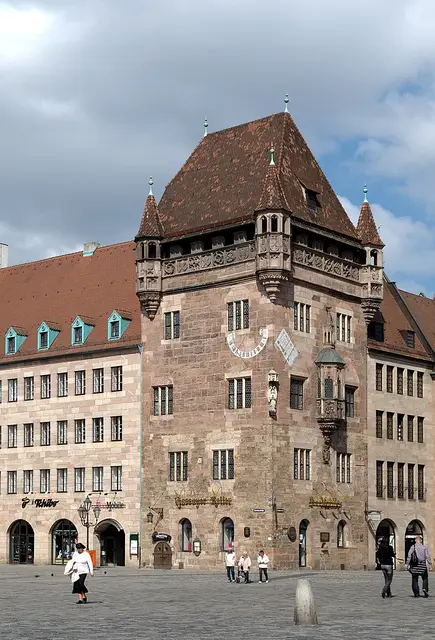 Historic sites01
Nassauer Haus
Karolinenstraße 2 · Nuremberg● Website● Phone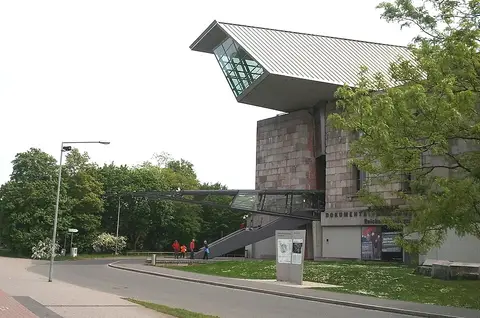 Historic sites02
Dokumentationszentrum Reichsparteitagsgelände
Bayernstraße 110 · Nuremberg● Website● Phone Monuments03
Fernmeldeturm Nürnberg
Hansastraße 1 · Nuremberg● Website○ Phone Monuments04
You need a free account to leave reviews and photos – that keeps comments genuine and lets you edit them later.