About Kunst Der Gegenwart
The Hamburger Kunsthalle is one of the most important public art collections in Germany and sits in the heart of the city, right next to the main train station and the Alster. Across more than 13,000 square meters, the museum presents works spanning eight centuries, from the Middle Ages to the contemporary scene. There has traditionally been a strong focus on nineteenth-century art, while separate departments cover the Old Masters and Classical Modernism. A separate building complex was constructed for modern and contemporary art, complementing the historic holdings. In addition to its painting collection, the Kunsthalle houses an extensive Kupferstichkabinett (cabinet of prints and drawings) with more than 130,000 sheets, as well as a library with more than 175,000 volumes, including numerous illustrated works. Many of these holdings have been digitized and can be viewed online, which makes the collection accessible to people who can't visit in person. In 2024, it was the most-visited art museum in Germany.
The Kunsthalle complex is an architectural ensemble of three connected construction phases. The oldest part is the Altbau (Old Building), built between 1863 and 1868. It was followed by the Erweiterungsbau (Extension), with construction beginning in 1909 and finishing between 1912 and 1921. The newest part is the Galerie der Gegenwart (Gallery of Contemporary Art), built from 1993 to 1996. The museum entrance is in the Altbau, opposite the Galerie der Gegenwart. Its location on the former Bastion Vincent of Hamburg's ramparts gives the site special historical significance.
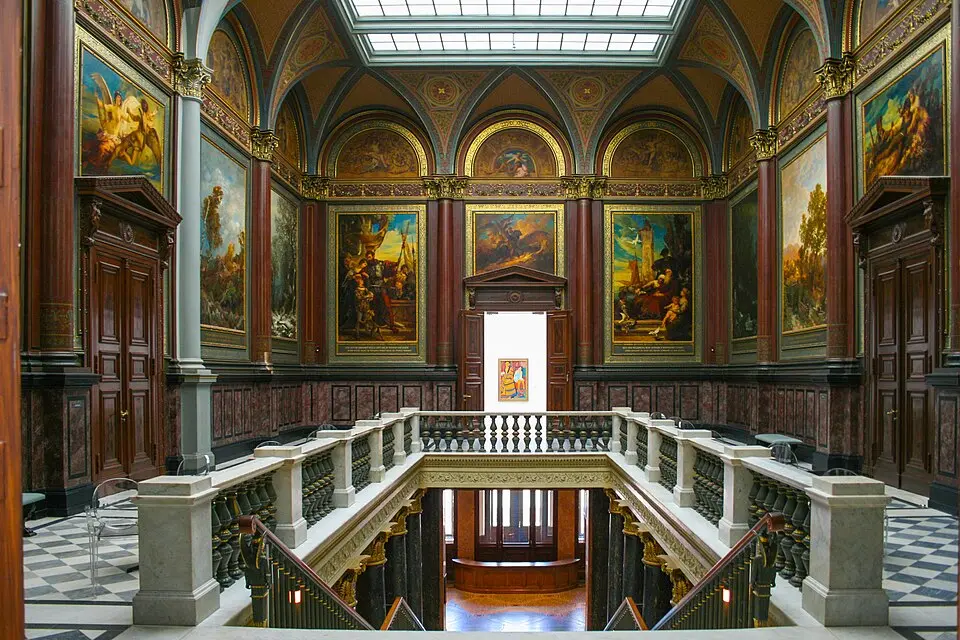
The Altbau was designed by Georg Theodor Schirrmacher and Hermann von der Hude in the style of the Berlin Schinkel school. The facade reflects the elegant style of the Italian Renaissance, executed in brick and decorated with terracotta portraits of artists. Thirty-six medallions adorn the edges of the central building and the corner structures. Life-size sandstone figures representing painting, sculpture, architecture, and engraving were originally planned, though their execution depended on financial support from Hamburg's citizens. The figures of Michelangelo and Raphael on the main facade form the starting point of a complex arrangement system. As in many museum buildings of this era, glass roofs were installed to bring daylight into the galleries. This design created ideal lighting conditions, since the light was spread evenly through milky glass ceilings without dazzling visitors or damaging the paintings. However, the solution also had drawbacks: the rooms were only fully lit on sunny days, and the roof was difficult to insulate. Over time the roofs also began to leak, leading to condensation and corrosion of the steel structure.
In the early twenty-first century, the Altbau underwent a comprehensive renovation. The historic glass ceilings were replaced to restore the building's clear architecture and symmetry. During the renovation, care was taken to use a neutral color scheme for the walls, intended to sharpen the eye for the subtleties of the artworks. The building's technical systems were modernized, including a new fire protection concept and a ventilation system that regulates air quality in the galleries. More than 1,000 meters of copper pipes were laid in the walls to heat the rooms evenly and control humidity.
The Erweiterungsbau stands apart from the Altbau with its plain neoclassical facade of shell limestone. A domed rotunda is a defining feature of this section. Skylights were installed here as well, though without the problematic glass ceilings of the Altbau. The entrance was originally moved from the Altbau to the new building facing the station, before being returned to the Altbau after a later renovation. The building was designed by Fritz Schumacher and considerably increased the exhibition space.
The Galerie der Gegenwart was built to designs by Oswald Mathias Ungers. The structure consists of a base of red Swedish granite and a cube of light Portuguese limestone. The five-story building is broken up by a central hall, and even details such as the muntin windows and square floor tiles underscore the architect's characteristic devotion to the cube form. In 2012, the café-restaurant "The Cube" opened, offering seating both indoors and outdoors.
The history of the collection goes back to 1850, when the Chamber of Commerce opened Hamburg's first public picture gallery. The foundation consisted of donations and bequests from Hamburg merchants. With the appointment of Alfred Lichtwark as the first director in 1886, the systematic building of the collection began. Lichtwark emphasized the museum's educational role and oversaw the acquisition of important works, including medieval art such as the Grabow Altarpiece by Master Bertram. A focus was placed on nineteenth-century art, with works by artists such as Max Liebermann, Lovis Corinth, and Caspar David Friedrich. Under his leadership, the Kupferstichkabinett and a collection of Dutch painters were also established.
After Lichtwark, Gustav Pauli took over and expanded the collection with Expressionist works, including pieces by Oskar Kokoschka and Franz Marc. His tenure ended in 1933 when the Nazis dismissed him for his commitment to modern art. During the Nazi era, the Kunsthalle lost more than a thousand modern works that were deemed "degenerate" and were confiscated or destroyed. After World War II, the collections were gradually restored and expanded. In the 1970s, a series of spectacular art thefts saw valuable paintings stolen, including works by Edgar Degas and Auguste Renoir.
Today the permanent exhibition is divided into several areas. The ground floor houses the sculpture collection with twentieth-century works, the Kupferstichkabinett, and the "Café Liebermann." The first floor holds the departments for Old Masters, nineteenth-century art, and Classical Modernism. Here you can see works by artists such as Rembrandt, Rubens, Canaletto, Caspar David Friedrich, Max Liebermann, and Edvard Munch. Classical Modernism includes works by Max Beckmann, Paul Klee, Emil Nolde, and Pablo Picasso.
In addition to its permanent exhibitions, the Kunsthalle regularly presents special exhibitions, often featuring international loans. More recently, new spaces have been created for contemporary artists, including the Hubertus Wald Forum and the lower level of the Galerie der Gegenwart. These exhibitions cover a wide range of themes, from Pop Art to Surrealist and Romantic art. The Kunsthalle is not only a place of preservation but also an active space for dialogue about art and culture, drawing hundreds of thousands of visitors every year.
At a glance
- Category
- Museum › Modern art
- Rating
- no reviews yet · write a review
- Address
- Ferdinandstor 1
20095 Hamburg, Germany - District
- Altstadt
- Phone
- +4940428131200
- Website
- www.hamburger-kunsthalle.de
- —
- Coordinates
- 53.55588° N · 10.00171° E
- Data quality
- confidence 0.95
- Identifier
- ID f2314646-8e6…
Part of the tour
Hamburg's Great Art Museums in One Day →Location & surroundings
Toggle layersRatings & comments
none yetNear Kunst Der Gegenwart
closest 5 per category · 2 kmSights
Museums
Hotels
More:All museums in Hamburg (149)
280 places within 2 km loaded.
You need a free account to leave reviews and photos – that keeps comments genuine and lets you edit them later.