About Hamburger Kunsthalle
The Hamburger Kunsthalle is one of the most important public art collections in Germany and sits in the heart of the Hanseatic city. Across more than 13,000 square meters, the museum presents artworks spanning eight centuries of art history, from the Middle Ages to the contemporary present. Traditionally, there is a special emphasis on nineteenth-century art, while separate departments are devoted to the Old Masters and Classical Modernism. A separate building complex houses modern and contemporary art and complements the historic fabric of the main building. Alongside its paintings and sculptures, the Kunsthalle holds an extensive collection of prints and drawings with more than 130,000 sheets, as well as a library containing more than 7,000 illustrated books and over 150,000 volumes in total. Many of these holdings can be consulted in the on-site study and reading rooms, and large parts of the collection have also been digitized and are accessible online. In 2024, the institution was the most visited art museum in Germany.
Architecturally, the Kunsthalle complex is made up of three interconnected parts: the Altbau (original building), the Erweiterungsbau (extension), and the Galerie der Gegenwart (Gallery of Contemporary Art). The ensemble stands on Glockengießerwall, right next to the main train station and the Alster, on the site of the former Bastion Vincent of Hamburg's ramparts. The entrance is at the Altbau, which faces the Galerie der Gegenwart across the way. This arrangement creates an exciting contrast between historic buildings and modern architecture, each complementing the other.
The Altbau was built between 1863 and 1868 to designs by Georg Theodor Schirrmacher and Hermann von der Hude. Its brick facade in the Italian Renaissance style is decorated with terracotta portraits. A total of thirty-six medallions line the edges of the central building and the corner pavilions. The life-size sandstone figures, which represent the genres of painting, sculpture, architecture, and engraving, were created by unknown sculptors. Their arrangement follows a complex system, with the full-relief figures of Michelangelo and Raphael on the main facade, set off by framing aedicules, serving as the starting point.
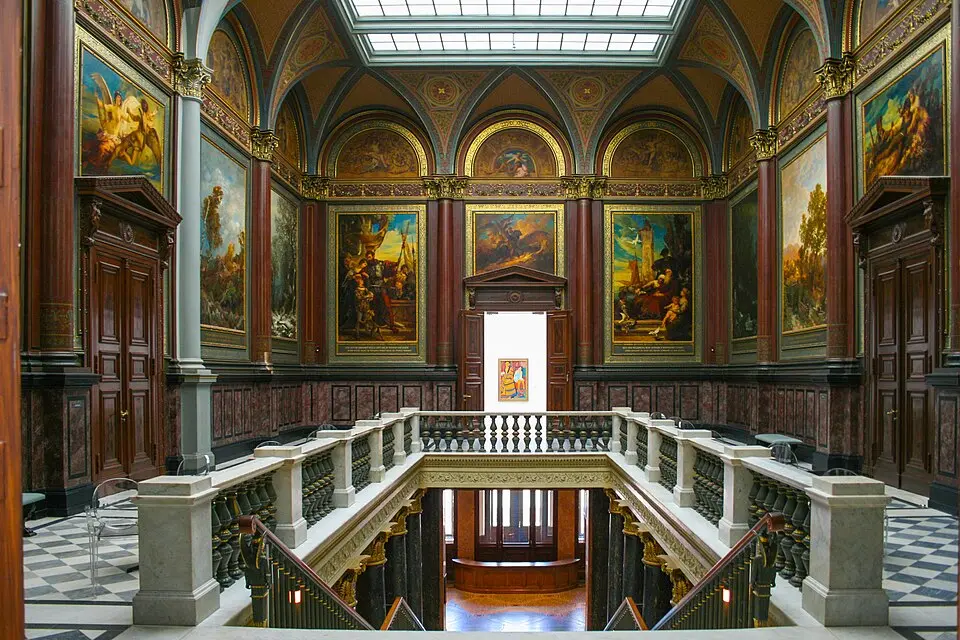
Inside the Altbau, the historic glass roofs dominate, typical of nineteenth-century museum buildings. This construction made it possible to direct daylight onto frosted glass ceilings, creating ideal lighting conditions for the artworks without dazzling visitors or sacrificing wall space to windows. Since gas lamps or candles could have damaged the works, this solution was necessary. The glass roofs did have drawbacks, however: they were hard to insulate and over time became permeable to water and air. During the extensive renovation at the beginning of the twenty-first century, the glass ceilings were painstakingly restored. The walls were given a light, soft gray with subtle blue and aubergine undertones to show off the colors and forms of the artworks at their best in daylight. The building's technical systems were also modernized, including a new ventilation system and temperature control to protect the artworks.
The Erweiterungsbau, completed by Fritz Schumacher between 1912 and 1921, stands out from the Altbau with its unadorned neoclassical shell limestone facade and its domed rotunda. The first designs for this addition were originally drawn up by Albert Erbe and Alfred Lichtwark. The building significantly increased the exhibition space and for a time moved the entrance toward the train station. Skylights were also installed inside, though without the complex glass-ceiling systems of the Altbau.
The Galerie der Gegenwart, designed by Oswald Mathias Ungers, was built from 1993 to 1996. The structure consists of a sloped base of red Swedish granite and a five-story cube of light Portuguese limestone. The architecture is strongly shaped by the cube form, which is echoed in the muntin windows and the square floor tiles, laid so that none had to be cut. At the center of the building lies a large hall that breaks open the cube. Since 2012, the plateau level has been home to the café-restaurant "The Cube," which offers seating both indoors and outdoors.
The history of the collection goes back to 1850, when the Chamber of Commerce opened Hamburg's first public picture gallery. The core of the collection consisted largely of donations and bequests from Hamburg merchants. These works were moved in 1869 to the newly opened Kunsthalle on Glockengießerwall. A decisive turning point came with the appointment of Alfred Lichtwark as the first director in 1886. Lichtwark built up the collection systematically and saw the museum as an active institution for the artistic education of the public. He brought important medieval works such as Master Bertram's Grabow Altarpiece back to Hamburg and focused on nineteenth-century art.
Under Lichtwark's leadership, important holdings of paintings from Hamburg were assembled, by artists such as Max Liebermann, Lovis Corinth, and Edouard Vuillard. He made works by Philipp Otto Runge and Caspar David Friedrich accessible to a wide public and, through his pioneering exercises in looking at artworks, founded museum education. His successor Gustav Pauli expanded the collection to include Expressionist artists, among them Oskar Kokoschka and Franz Marc. Pauli was dismissed in 1933 for political reasons, marking the beginning of a difficult period for the museum.
During the Nazi era, the Kunsthalle suffered heavy losses. As part of the "Degenerate Art" campaign, more than a thousand works of modern art were confiscated, including masterpieces by Kokoschka, Marc, Picasso, Nolde, and Kirchner. Many of these works were sold abroad or deliberately destroyed. Only after World War II could the collection gradually be rebuilt and expanded. In the following decades, directors such as Carl Georg Heise, Alfred Hentzen, and Werner Hofmann continued its development.
Today, the collections have been rearranged following the renovation. The ground floor includes the sculpture collection in the rotunda, which shows twentieth-century works by artists such as Georg Kolbe and Paul Hamann. The print room is also located here and offers insights into graphic art from the fifteenth century to the present. On the first floor are the departments for the Old Masters, nineteenth-century art, and Classical Modernism. Works by Rembrandt, Rubens, Canaletto, Caspar David Friedrich, Max Liebermann, and Adolph von Menzel can be seen here.
The Classical Modernism department includes paintings and sculptures by artists such as Max Beckmann, Paul Klee, Edvard Munch, Emil Nolde, and Pablo Picasso. A particular highlight is Picasso's portrait of the art dealer Clovis Sagot. In addition to the permanent collections, the Kunsthalle regularly presents changing special exhibitions, which often complement Hamburg's holdings or showcase contemporary artists. The Hubertus Wald Forum and the rooms on the lower level of the Galerie der Gegenwart provide additional space for these temporary shows.
The Hamburger Kunsthalle is not only a place for viewing art but also a lively cultural space. Here you'll experience a unique blend of historic architecture and modern presentation. The careful curation of the exhibitions and the accessibility of the digital collections make the museum an important cultural draw. The combination of the collection's rich history, the impressive architecture, and the continual renewal through special exhibitions ensures that the Kunsthalle still draws large crowds today and is regarded as one of the most important art museums in Germany.
At a glance
- Category
- Museum › Art museums
- Rating
- no reviews yet · write a review
- Address
- Glockengießerwall 5
20095 Hamburg, Germany - District
- Altstadt
- Phone
- +4940428131200
- Website
- www.hamburger-kunsthalle.de
- info@hamburger-kunsthalle.de
- Coordinates
- 53.55540° N · 10.00246° E
- Data quality
- confidence 1.00
- Identifier
- ID 8840e72e-c72…
Part of the tour
Hamburg's Great Art Museums in One Day →Location & surroundings
Toggle layersRatings & comments
none yetNear Hamburger Kunsthalle
closest 5 per category · 2 kmSights
Museums
Hotels
More:Art museums in Hamburg (20)All museums in Hamburg (149)
280 places within 2 km loaded.
You need a free account to leave reviews and photos – that keeps comments genuine and lets you edit them later.