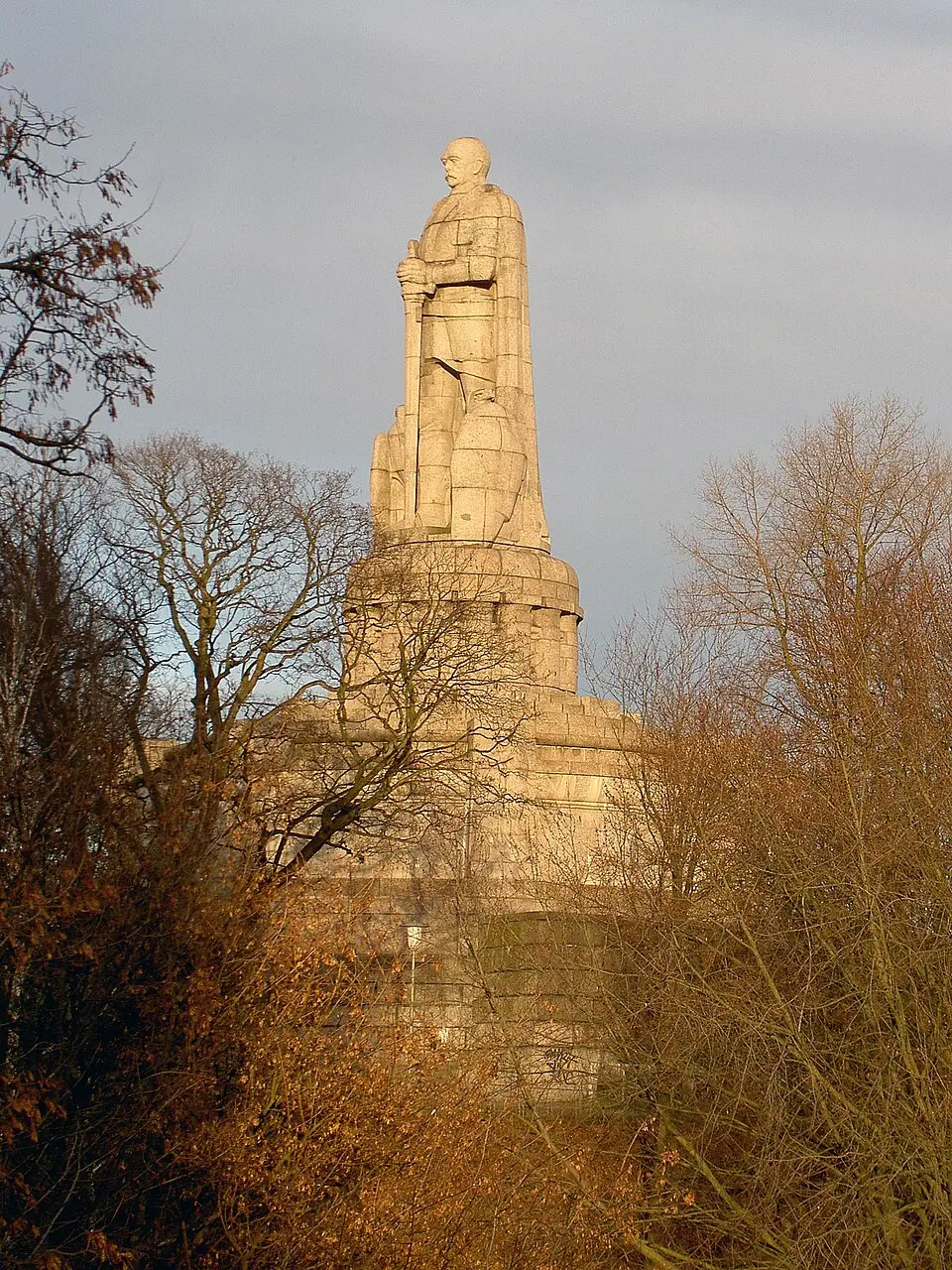
About Bismarck Monument
At more than 34 meters (112 feet) tall, the Bismarck Monument in the Old Elbe Park (Alter Elbpark) is the largest of its kind in Germany and one of Hamburg's best-known landmarks. Built between 1901 and 1906 to designs by Emil Schaudt and Hugo Lederer, it commemorates Otto von Bismarck, the first chancellor of the German Empire. The monumental figure portrays Bismarck as a Hanseatic Roland, a traditional symbol of civic freedom, and gazes from its hill above the Elbe directly onto the harbor. The structure is made of one hundred granite blocks from the Black Forest and weighs around 625 tons. At the feet of the main figure stand eight granite figures representing the Germanic tribes. These were not added until 1908, after the original donations proved insufficient to cover the cost of the expensive stone.
You can admire the monument from the outside, but it is the interior that is of particular historical interest. During the war years of 1939 to 1941, the hollow spaces in the base were converted into an air-raid shelter for up to 950 people. Traces of that era can still be found inside today, including murals with Nazi symbols such as an eagle and a swastika, which have been preserved as evidence of history. The locked substructure is closed to the public, since the monument was structurally secured and protected against moisture in an extensive renovation completed in 2023.
Culturally and socially, the monument remains a place of debate. Since it was added to the list of protected monuments in 1960, it has been regarded both as a work of modern art and as a historical document. In recent years, the city of Hamburg has held intensive discussions about how to place the monument in the context of Bismarck's legacy. There are also plans to set up a museum on the history of the monument in the previously unused vaults, one that examines the complex past of the site.
At a glance
- Category
- Sight › Monuments
- Rating
- no reviews yet · write a review
- Address
- Seewartenstraße 4
20459 Hamburg, Germany - District
- Neustadt
- Phone
- +494030051701
- Website
- www.hamburg.de
- —
- Coordinates
- 53.54868° N · 9.97211° E
- Data quality
- confidence 0.73
- Identifier
- ID 1c3b7b90-83b…
Part of the tour
Hamburg for Food Lovers: From Lunch to Midnight →Location & surroundings
Toggle layersFAQ about Bismarck Monument
quick answersWhat is the Bismarck Monument in Hamburg?
The Bismarck Monument in the Old Elbe Park (Alter Elbpark) in Hamburg-Neustadt, with a total height of more than 34 meters (112 feet), is the largest Bismarck monument in Germany and one of Hamburg's best-known landmarks. It was built between 1901 and 1906 to designs by Emil Schaudt and Hugo Lederer and commemorates Otto von Bismarck, the first chancellor of the German Empire. The figure portrays Bismarck as a Hanseatic Roland, a traditional symbol of civic freedom, and looks from the Elbe hillside straight out over the port. The structure is made of one hundred granite blocks from the Black Forest and weighs around 625 tons.
Can you go inside the Bismarck Monument in Hamburg?
No, the interior of the Bismarck Monument in Hamburg is closed to the public, so you can only view the monument from the outside. The base is locked because, following an extensive renovation completed in 2023, the structure has been structurally secured and protected against moisture. Between 1939 and 1941, the hollow spaces in the base were converted into an air-raid shelter for up to 950 people, and wall paintings with Nazi symbols such as an eagle and a swastika have been preserved there as a record of history. Plans call for a museum on the history of the monument to be set up in the previously unused vaults.
What do the figures at the foot of the Bismarck Monument in Hamburg represent?
The eight granite figures at the feet of the main figure of the Bismarck Monument in Hamburg represent the Germanic tribes. They were not added until 1908, after the monument was completed in 1906. The delay came about because the original donations had not been enough to pay for the expensive stone.
Why is the Bismarck Monument in Hamburg the subject of debate?
The Bismarck Monument in Hamburg is considered a site of cultural and social debate over how Bismarck is remembered. Since it was added to the list of protected monuments in 1960, it has been regarded both as a work of modern art and as a historical document. More recently, the city of Hamburg has held intensive discussions about how to contextualize the monument. The planned museum in the vaults is meant to examine the complex past of the site.
What can you see around the Bismarck Monument in Hamburg?
Around the Bismarck Monument in Hamburg-Neustadt, there are several sights and museums within a few hundred meters. travelguide195 lists the English Church (about 170 m), the Millerntor Guardhouse (about 200 m), the Stintfang (about 290 m), the Museum of Hamburg History (about 290 m), the Kugeldenkmal Hamburg (about 330 m), and the Old Elbe Tunnel (about 360 m), among others. For a break, travelguide195 lists around 88 restaurants within 500 meters, and the monument is part of the tour "Hamburg Culinary: From Noon to Midnight."
Ratings & comments
none yetNear Bismarck Monument
closest 5 per category · 2 kmSights
Restaurants
Museums
Hotels
More:Monuments in Hamburg (47)Sights in Neustadt (33)All sights in Hamburg (325)
290 places within 2 km loaded.
You need a free account to leave reviews and photos – that keeps comments genuine and lets you edit them later.