About Altes Museum
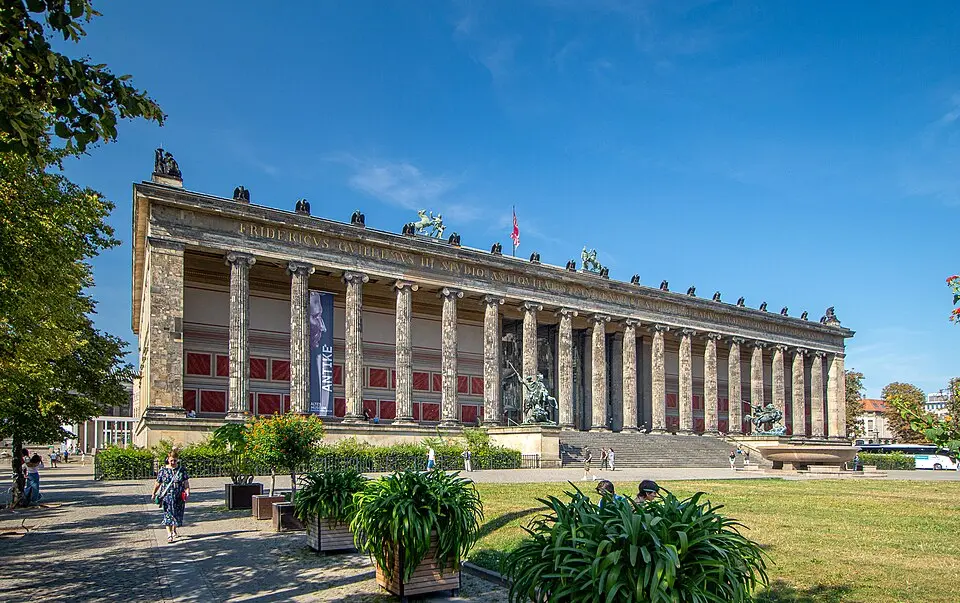
The Altes Museum (Old Museum) on Berlin's Lustgarten is an architectural masterpiece of German Neoclassicism and a central part of Museum Island, a UNESCO World Heritage Site. Built between 1825 and 1830 to designs by Karl Friedrich Schinkel, the building stands on the northern side of the Lustgarten and forms a harmonious ensemble with Berlin Cathedral, the rebuilt Palace, the Zeughaus and the Neues Museum (New Museum). Today it mainly houses the Antikensammlung (Collection of Classical Antiquities) as well as part of the Münzkabinett (Coin Cabinet). With around 215,000 visitors in 2023, it remains a popular destination for art lovers and history buffs.
The museum's creation is closely tied to the Prussian educational ideals of the early 19th century. King Frederick William III responded to the wishes of the emerging middle class, who wanted works of art no longer kept only in palaces but made accessible to the public in buildings constructed for that purpose. Inspired by the Louvre in Paris and by the success of an exhibition of the art treasures Napoleon had looted and that were later brought back, the king commissioned Schinkel to plan a new museum. The aim was to put Berlin on a par with metropolises such as Paris and London as an intellectual capital and to raise the standard of local artistic production by showcasing great art.
Schinkel did not conceive the building in isolation but as part of an overall urban design around the Lustgarten. The museum symbolized science and art, supported by a self-confident middle class, while the Palace represented worldly power, the Cathedral divine power and the Zeughaus military power. The construction planning was complex, since a connecting canal ran across the site and had to be stabilized by driving thousands of pine piles into the ground. The building opened in 1830 and was the first structure in Berlin explicitly built as a museum.
The exterior strictly follows the forms of ancient Greece and underscores the idea of the museum as a temple of learning. The two-story building, set on a plinth, is dominated by a monumental portico with 18 Ionic columns opening onto the Lustgarten. Sandstone eagles perch above the columns, lending the building a solemn character. The transition from outside to inside is fluid: a broad flight of steps leads up to the colonnade, from there into the stair hall and finally into the central rotunda. This sequence was meant to prepare visitors for the exhibitions.
Inside, the rotunda, which rises through both stories, forms the heart of the museum. Inspired by the Pantheon in Rome, it is crowned by a coffered dome and a gallery ring resting on twenty Corinthian columns. A large granite bowl was originally planned for this space, but today the rotunda displays a selection of Greco-Roman statues of gods. The exhibition rooms are grouped around two inner courtyards and were originally divided by heavy walls into smaller cabinets based on the positions of the windows. The stair hall behind the portico is especially appealing, as its open structure makes it feel like both an interior and an exterior space.
The building's history has been marked by destruction and reconstruction. In World War II, the museum was badly damaged by air raids and finally by the explosion of an ammunition wagon. In East German times it was first used as a backdrop for propaganda events before being restored from 1951 and repurposed as a state gallery for socialist art. During the reconstruction, the exterior was faithfully restored, but flexible exhibition space was created inside. Remnants of the original frescoes by Peter von Cornelius, which Schinkel had designed for the portico, were lost in the process. Only after German reunification did the gradual return to its historical use begin.
Since 2010, the Altes Museum has once again fulfilled its original purpose: presenting the Collection of Classical Antiquities. The ground floor holds the Greek antiquities, while Etruscan and Roman works are displayed upstairs. Here you can marvel at masterpieces of classical antiquity, including the famous Praying Boy, which originally belonged to Frederick the Great. The building also houses a cabinet exhibition of ancient coins. The museum also offers special outreach programs such as "Multaka," a program for Arabic- and Persian-speaking visitors that promotes intercultural dialogue about cultural heritage.
Future plans call for a thorough renovation of the building in the 2030s, since the structure is slowly sinking and its building systems need to be modernized. A connection to the other buildings on Museum Island via an underground Archaeological Promenade is also planned. Despite the work ahead, the Altes Museum remains an important place to encounter the ancient world and a symbol of Berlin's cultural history.
At a glance
- Category
- Museum › History museums
- Rating
- no reviews yet · write a review
- Address
- Am Lustgarten 1
10178 Berlin, Germany - District
- Mitte
- Phone
- 030 266424242
- Website
- www.smb.museum
- service@smb.museum
- Coordinates
- 52.51954° N · 13.39880° E
- Data quality
- confidence 0.77
- Identifier
- ID 1c4706b3-684…
Part of the tour
Berlin in the Rain: Museums in Mitte →Location & surroundings
Toggle layersRatings & comments
none yetNear Altes Museum
closest 5 per category · 2 kmSights
Restaurants
Museums
Hotels
More:History museums in Berlin (111)Museums in Mitte (178)All museums in Berlin (502)
300 places within 2 km loaded.
Don't miss in Berlin
All sights Historic sites01
Die Berliner Mauer
Mühlenstraße 79 · Berlin● Website● Phone Historic sites02
Brandenburger Tor
Pariser Platz · Berlin● Website● Phone Historic sites03
Fernsehturm
Panoramastraße 1 · Berlin● Website● Phone Historic sites04
You need a free account to leave reviews and photos – that keeps comments genuine and lets you edit them later.
The main floor houses the antiquities collection in an ongoing exhibit called "Neue Antike im Alten Museum" (New Antiquities in the Old Museum). Directly through the front door, entering from the Lustgarten (Pleasure Garden, now under reconstruction), there is a domed rotunda with red and white cameos, Greek-style, with statues of the gods. To reach the Hildesheim silver collection, go to the back of the rotunda, turn left, walk through the long gallery and turn left into a small room at the end.
Source: Wikivoyage, „Berlin/Mitte“ · authors per page history · CC BY-SA 4.0