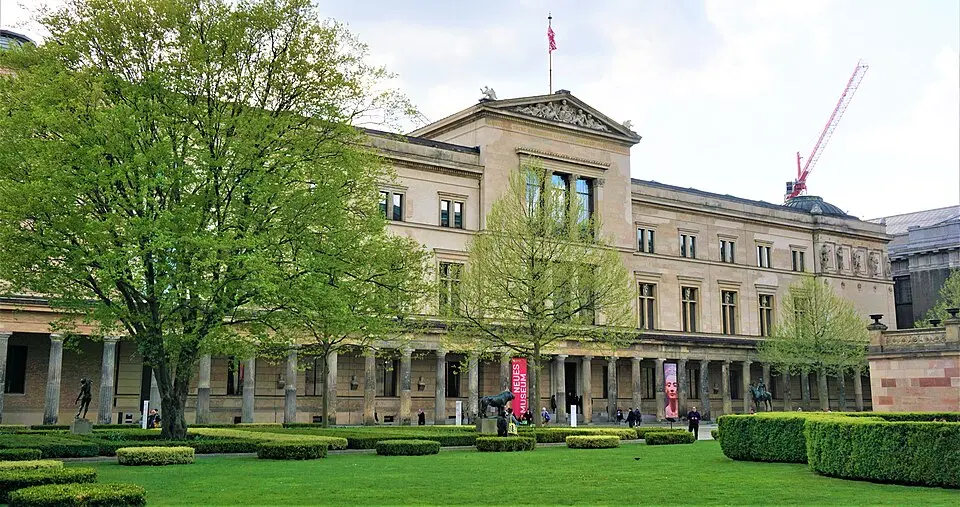
About Neues Museum
The Neues Museum (New Museum) in Berlin-Mitte is a central part of Museum Island, a UNESCO World Heritage Site. The building, the principal work of the architect Friedrich August Stüler, was constructed between 1843 and 1855 on the orders of King Frederick William IV. It combines Neoclassical style with elements of the Neo-Renaissance and is considered one of the most significant museum buildings of the 19th century. After severe destruction in World War II and a long period of decay in the East German era, the building was restored from 1999 to 2009 under the direction of the British architect David Chipperfield. Today it houses the Egyptian Museum with its papyrus collection, the Museum of Prehistory and Early History, and part of the Collection of Classical Antiquities. With more than 800,000 visitors a year, it is one of the most visited museums of the Staatliche Museen (State Museums).
The history of the building is closely tied to the technological innovations of its time. Because of the difficult, sandy ground in the Berlin glacial valley, a pile foundation of more than two thousand wooden piles had to be built beneath the entire structure. To drive these piles, a steam engine was used in Berlin for the first time; it was also used to drain the construction site and to run elevators. Inside, behind the plain facade, lay a complex system of iron construction. These new building techniques made it possible to add an extra story compared with the neighboring Altes Museum (Old Museum) despite the difficult soil conditions, and to create a wide variety of ceiling forms. The Neues Museum was thus the first monumental building in Prussia to consistently apply the new construction techniques made possible by industrialization.
The exterior of the nearly rectangular building is deliberately restrained. The facade of plastered brick masonry is articulated by incised ashlar patterning meant to create the illusion of a natural stone facade. The eastern main front is symmetrical, dominated by a central projection crowned with a pediment and two corner projections topped with domes. The west side, facing the Kupfergraben canal, has similar design elements, plus additional window bays and cast-zinc figures at the corners. The inscription on the pediment of the east side recalls that the son enlarged the museum founded by his father. Despite the plain exterior, the interior was richly decorated, with the architectural setting tailored to the respective collections.
After World War II, the building stood as a ruin for a long time. During the East German era, parts of the structure were removed or used as storage, causing a further loss of historic fabric. Only after reunification did comprehensive plans for reconstruction begin. David Chipperfield, commissioned in 1997, developed a concept of complementary restoration. The completely destroyed wings were rebuilt in close adherence to the original volumes, while the surviving parts were restored and supplemented. A central feature of this approach is that the additions are openly displayed and remain recognizable as such. Chipperfield deliberately refrained from fully reconstructing lost interior furnishings, such as the great staircase, to avoid a romantic old-versus-new rhetoric.
The reconstruction was part of the master plan for Museum Island, which calls for combining the buildings into a single museum complex. Key elements of this connection are the James-Simon-Galerie as the new entrance building and the Archaeological Promenade. The latter is an underground walkway linking all of the island's buildings except the Alte Nationalgalerie (Old National Gallery). In the Neues Museum, this promenade runs through the Greek Court, the great staircase hall, and the Egyptian Court. In these areas you can see exhibitions on themes such as chaos and cosmos, time and history, and death and transfiguration. The promenade serves to guide visitor flows sensibly and to protect the historic fabric of the building.
The exhibition rooms are reached via a monumental open staircase connecting the three above-ground floors. The lower level, designed as a vaulted space, presents collections from the Pharaonic and Greek periods. From here, a staircase leads to a re-created burial chamber that gives visitors an impressive glimpse into ancient beliefs about the afterlife. The entrance level shows, among other things, finds from Schliemann's Troy as well as objects from Cyprus and Egypt. The systematic arrangement of the exhibits provides an overview of the cultural developments of different regions and eras.
The collection's special highlights are on the upper floors. On the second level, the famous bust of Nefertiti, created around 1340 B.C., is displayed in the North Dome Room. A direct line of sight connects this room with the South Dome Room, where a larger-than-life statue of the Roman sun god Helios stands. Also on this level is the Xanten Boy, a bronze figure that has survived the centuries largely intact. The third level is devoted to prehistory and early history. Here the Paleolithic and Mesolithic periods, the Ice Age, the Neolithic, the Bronze Age, and the Iron Age are presented with numerous finds. One particularly notable exhibit is the Berlin Gold Hat from the Bronze Age, decorated with celestial symbols arranged in bands.
The restoration of the Neues Museum has received several international awards. In 2010, the museum received the Europa Nostra Award of the European Commission for outstanding achievement in the field of restoration. That same year, the renovation was honored with the Große Nike architecture prize of the Association of German Architects (BDA). In 2011 came the European Union Prize for Contemporary Architecture (Mies van der Rohe Award), which recognized the successful combination of contemporary architecture, restoration, and art. Architect David Chipperfield was awarded the German Architecture Prize for his work. The building was also added to the list of Historic Landmarks of Engineering in Germany.
Reception of the reconstruction was divided among both the public and the professional world. While many critics praised the respectful treatment of the historic fabric and the clear, reduced palette of materials of dark oak, bronze, and concrete, there was also sharp criticism. Opponents of the concept accused those responsible of having falsified the building by turning its ruin into a monument and of having destroyed the original harmony of the Neoclassical total work of art. The Gesellschaft Historisches Berlin e. V. had already spoken out against the planned additions before completion and demanded a faithful restoration. Despite these controversies, the reopened museum is regarded today as a lasting stone monument to its first architect, Friedrich August Stüler.
Today the Neues Museum offers a unique insight into the history of humankind, from the Stone Age to antiquity. The cleverly designed display cases and the strikingly grouped sculptures draw visitors' eyes and open up dramatic sight lines through the centuries. Like few other museums, it dares to survey the cult, art, and everyday life of different cultures. The combination of original, partly ruined building elements and modern additions creates an atmosphere of humility and historical awareness that differs markedly from the original 19th-century staging. Here you experience not only the exhibits but also the history of the building itself, a witness to the Industrial Revolution and the destruction of the 20th century.
At a glance
- Category
- Museum › Museums (general)
- Rating
- no reviews yet · write a review
- Address
- Bodestraße 1
10178 Berlin, Germany - District
- Mitte
- Phone
- +4930266424242
- Website
- www.smb.museum
- aemp@smb.spk-berlin.de
- Coordinates
- 52.52016° N · 13.39778° E
- Data quality
- confidence 1.00
- Identifier
- ID d4be20d3-d3b…
Part of the tour
Berlin in One Day: From the East Side Gallery to the Reichstag →Location & surroundings
Toggle layersRatings & comments
none yetNear Neues Museum
closest 5 per category · 2 kmSights
Restaurants
Museums
Hotels
More:Museums in Mitte (178)All museums in Berlin (502)
300 places within 2 km loaded.
Don't miss in Berlin
All sights Historic sites01
Die Berliner Mauer
Mühlenstraße 79 · Berlin● Website● Phone Historic sites02
Brandenburger Tor
Pariser Platz · Berlin● Website● Phone Historic sites03
Fernsehturm
Panoramastraße 1 · Berlin● Website● Phone Historic sites04
You need a free account to leave reviews and photos – that keeps comments genuine and lets you edit them later.
The "New Museum" (reopened in 2009, after having been largely destroyed in the war) was the first place to publicly exhibit the famous bust of Nefertiti, the wife of Akhenaten, the "heretic Pharaoh" who introduced a new monolatric cult of "Aten", the sun-disk. The circumstances under which the bust came into German possession in 1913 are frequently alleged to be the result of German subterfuge and there are calls to have it returned or at least loaned to Egypt. While the bust is without a doubt the "star" of the exhibition, there are many other Egyptian antiquities exhibited here.
Source: Wikivoyage, „Ancient Egypt“ · authors per page history · CC BY-SA 4.0