About Museo De La Catedral De Aquisgran
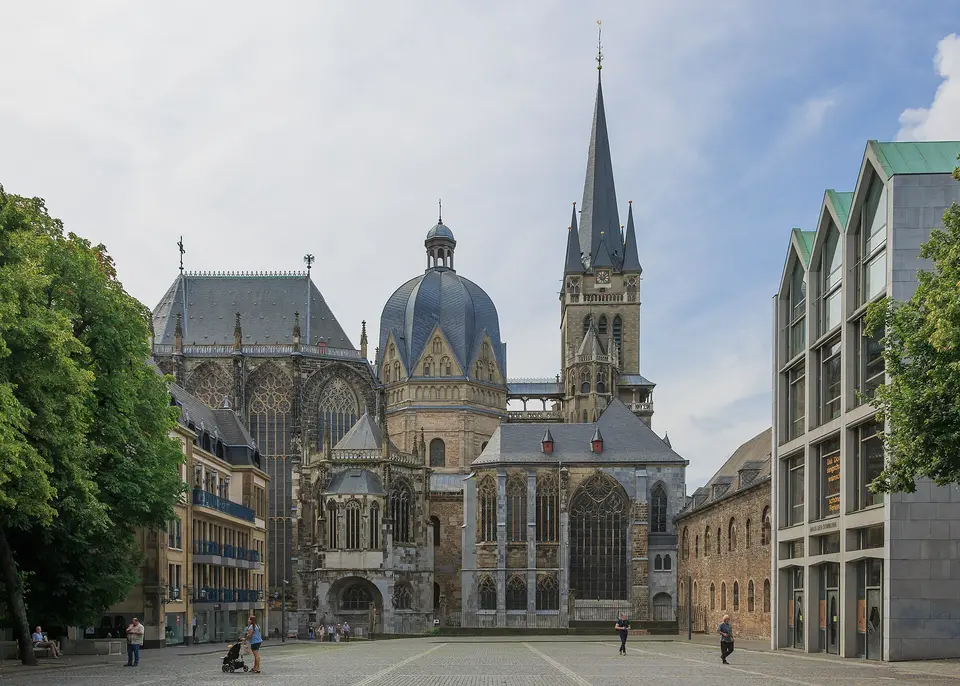
Aachen Cathedral, also known as St. Mary's Church or the Minster, is the city's most important landmark and the seat of the Diocese of Aachen. One of the oldest and most significant buildings north of the Alps, it is dedicated to Mary, the Mother of God. The history of this site stretches back more than 1,200 years and encompasses a fascinating blend of architectural eras, from the early Middle Ages to the late modern period. The heart of the complex is the Carolingian octagon, which originally served as the palatine chapel of Charlemagne's royal palace and is now regarded as an outstanding example of the Carolingian Renaissance.
The building's history begins with Charlemagne's decision to settle in Aachen and create a new cultural and spiritual center here. Construction of the palatine church was initiated toward the end of the 8th century, with the foundation stone laid around 795 and completion around 803. The church was oriented strictly according to the cardinal directions, with the portal in the west and the altar in the east. This precise orientation and the choice of building site, erected on the remains of a Roman thermal bath complex, underscore the importance of the place as the spiritual center of the Frankish Empire.
The architectural concept of the centrally planned building was a technical masterpiece of its time. It consists of a tall, octagonal space, the octagon, surrounded by a lower, two-story ambulatory. The inner octagon is supported by sturdy piers, on which rests a vault made up of eight curved sections. Above this rises an imposing dome, supported by an octagonal drum with window openings. The building's proportions follow ideal geometric ratios inspired by the description of the Heavenly Jerusalem, which gives the structure a special symbolic depth.
A particular feature of the cathedral is its use of spolia, or reused building materials. Charlemagne had valuable ancient columns brought to Aachen from Italy, Greece, and Egypt to incorporate them into the pier arches of the octagon. These columns, some of which came from lands across the Alps, form a symmetrical grid and lend the interior a majestic quality. Although some of these columns were taken to Paris during the French occupation, they were later retrieved and reinstalled in their original location.
Over the centuries, the cathedral was expanded with numerous additions that shape the building's diverse character. In the 14th century, a tall Gothic choir hall was built to the east; it served as the capella vitrea and was used to present the sacred relics and reliquary shrines. Further chapels followed on the south side, including the Hungarian Chapel and St. Matthias' Chapel, while the Gothic St. Nicholas' Chapel was added on the north side. These extensions reflect the cathedral's development from a palatine chapel into an important pilgrimage site, which drew pilgrims from all over Europe every seven years for the Heiligtumsfahrt (Pilgrimage of the Relics).
The Baroque era brought profound changes to the cathedral's furnishings and architecture. After the devastating city fire of 1656, the roofs were repaired and the church's interior was given a Baroque makeover by Italian stucco artists. The walls were decorated with mosaics, and the barrel vault in the upper minster was repainted. This remodeling significantly changed the cathedral's appearance, although many of these Baroque elements were later removed in the 19th century as part of a purification effort to expose the Carolingian masonry.
The 19th century saw a comprehensive restoration and redesign of the cathedral. The neo-Gothic west tower was built to replace a makeshift bell tower, and the Gothic choir hall was reglazed. A central focus of the redesign was the decoration of the interior, especially the sixteen-sided ambulatory, with neo-Byzantine mosaics and marble cladding. This work, led by Hermann Schaper, was meant to give the building new splendor but was viewed critically by preservationists, as the materials used did not always fit the Carolingian stylistic context.
Aachen Cathedral is not only an architectural masterpiece but also a place of great historical and religious significance. From 936 to 1531, it was the coronation site of the Roman-German kings, who were crowned on Charlemagne's marble throne. As Charlemagne's mausoleum, and through the veneration of the four great Aachen textile relics, Aachen developed into an important pilgrimage destination. The Heiligtumsfahrt, held every seven years, is a major event at which the relics are shown to the public and the cathedral is visited by large numbers of pilgrims.
Today, Aachen Cathedral is a UNESCO World Heritage Site and attracts many visitors every year who come to admire its unique blend of Carolingian, Gothic, and Baroque architecture. With its mosaics, marble floors, and historic columns, the interior makes a striking impression. You can explore the cathedral's various levels, from the lower ambulatory to the upper minster, and trace the history of the site in the details of its furnishings and architecture.
The cathedral is also a place of quiet and reflection, open to worshippers and tourists alike. Statues of Mary at the entrances welcome every visitor, and the atmosphere of the space invites you to linger. The combination of historical significance, architectural diversity, and spiritual presence makes Aachen Cathedral a must-see for anyone interested in the history and art of the Middle Ages.
In conclusion, Aachen Cathedral is a living testimony to European cultural history. It connects the past with the present and offers insight into the religious, political, and artistic developments of more than a thousand years. The ongoing care and restoration of the building, including the extensive overhaul of recent years, ensures that this unique heritage will be preserved for generations to come. The cathedral is not only a landmark of Aachen but a symbol of the cultural diversity and richness of the Christian tradition in Europe.
At a glance
- Category
- Museum › Museums (general)
- Rating
- no reviews yet · write a review
- Address
- Aachen
Aachen, Germany - Phone
- —
- Website
- www.aachenerdom.de
- —
- Coordinates
- 50.77530° N · 6.08280° E
- Data quality
- confidence 0.87
- Identifier
- ID 7c812a2c-c1e…
Location & surroundings
Toggle layersRatings & comments
none yetNear Museo De La Catedral De Aquisgran
closest 5 per category · 2 kmSights
Museums
Hotels
More:All museums in Aachen (23)
205 places within 2 km loaded.
You need a free account to leave reviews and photos – that keeps comments genuine and lets you edit them later.