About Unité d'Habitation
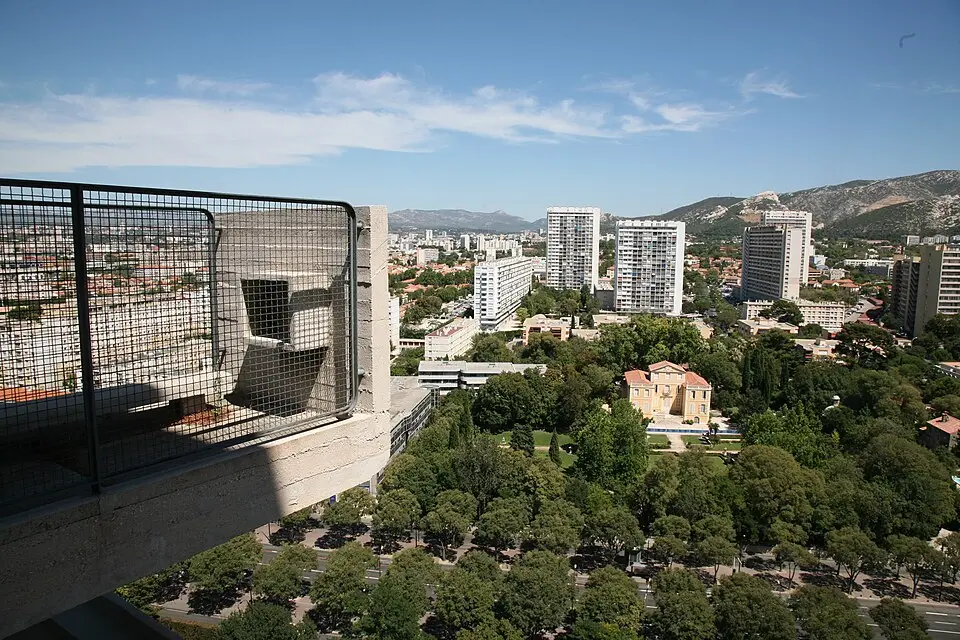
The Unité d'habitation in Marseille, also known as the Cité radieuse, is an iconic building by the architect Le Corbusier. It opened in 1952 and is considered a forerunner of the large housing estates that followed. The building was created as part of a project meant to ease the housing shortage after World War II, and it put into practice Le Corbusier's concept of the "vertical city," in which housing and urban functions are combined in a single complex. As part of a UNESCO World Heritage Site, the complex is a milestone of modern architecture and had a major influence on the development of Brutalism. The 56-meter-high (184-foot) reinforced concrete frame structure rises 18 floors and rests on an open ground level supported by pillars, which houses the entrances. The 337 apartments are designed as maisonettes spanning two floors. Thanks to a clever floor plan, most apartments get both morning and evening sun, with the units interlocked in two variants. One runs from top to bottom, the other from bottom to top; the latter, with bedrooms on the upper level and views of the hills, is often considered more comfortable.
Visitors are free to explore the building and only need to sign a book at the concierge's desk. The seventh and eighth floors hold shops, a small hotel, and a laundry that cover residents' everyday needs. A special highlight is the walkable rooftop landscape, which originally housed a kindergarten, an open-air theater, and a gymnasium. Today it is home to the MaMo exhibition center, run by the designer Ora-Ïto. From the roof terrace, you get sweeping views over the city of Marseille, the Mediterranean, and the surrounding mountains. All of the building's dimensions are based on Le Corbusier's Modulor system, which draws on the golden ratio and human proportions. After a fire in 2012, extensive renovation work was carried out to modernize and restore the facade and the roof terrace.
Beyond its architectural importance, the Unité d'habitation is also interesting for its historical dimension. Le Corbusier developed this concept as early as the 1920s and realized it between 1947 and 1965 at several sites in France and in Berlin. The Marseille project, however, was the first and best known of the series. Around one hundred people were involved in the planning and execution, including prominent names such as Nadir Afonso, Jean Prouvé, and Charlotte Perriand. The building stands not only for an innovative form of housing, but also for an attempt to create a high standard of living comfort for the masses through standardized mass production and industrial construction methods. Today the Cité radieuse is a vibrant place that brings together housing, culture, and tourism, and it is regarded as a testament to the history of modern architecture.
At a glance
- Category
- Sight › Historic sites
- Rating
- no reviews yet · write a review
- Address
- 280 Bd Michelet
13008 Marseille, France - District
- 8th Arrondissement
- Phone
- —
- Website
- www.hotellecorbusier.com
- —
- Coordinates
- 43.26135° N · 5.39661° E
- Data quality
- confidence 0.84
- Identifier
- ID ec5d28d4-aaa…
Location & surroundings
Toggle layersFAQ about Unité d'Habitation
quick answersWhat is the Unité d'Habitation in Marseille?
The Unité d'Habitation, also known as the Cité radieuse, is a residential building by the architect Le Corbusier that opened in 1952 at 280 Bd Michelet in Marseille's 8th arrondissement. It was built to ease the housing shortage after World War II and puts into practice Le Corbusier's concept of the "vertical city," in which housing and urban functions are combined in a single complex. The building is a UNESCO World Heritage Site and is considered a milestone of modern architecture that had a major influence on Brutalism. The Unité d'Habitation in Marseille was the first and best known in a series that Le Corbusier built between 1947 and 1965 at several locations in France and in Berlin.
Can you visit the Unité d'Habitation in Marseille?
Yes, you can visit the Unité d'Habitation in Marseille freely if you sign the visitors' book at the front desk. On the seventh and eighth floors you'll find shops, a small hotel, and a laundry that cover the residents' everyday needs. The rooftop landscape, which originally held a kindergarten, an open-air theater, and a gymnasium, now houses the MaMo exhibition center, run by the designer Ora-Ïto. From the roof terrace you have sweeping views over Marseille, the Mediterranean, and the surrounding mountains.
What is special about the architecture of the Unité d'Habitation in Marseille?
The Unité d'Habitation in Marseille is a 56-meter-tall reinforced-concrete frame building with 18 floors, resting on pilotis that lift it above an open ground level containing the entrances. Its 337 apartments are laid out as two-story maisonettes in two interlocking variants, so that most units get both morning and evening sun. All dimensions are based on Le Corbusier's Modulor system, which draws on the golden ratio and human proportions. Around one hundred people were involved in the planning and construction, including Nadir Afonso, Jean Prouvé, and Charlotte Perriand.
Has the Unité d'Habitation in Marseille been renovated?
Yes, the Unité d'Habitation in Marseille underwent extensive renovation after a fire in 2012. The work focused mainly on modernizing and restoring the façade and the roof terrace. Today the Cité radieuse is a lively place that combines housing, culture, and tourism.
What can you see around the Unité d'Habitation in Marseille?
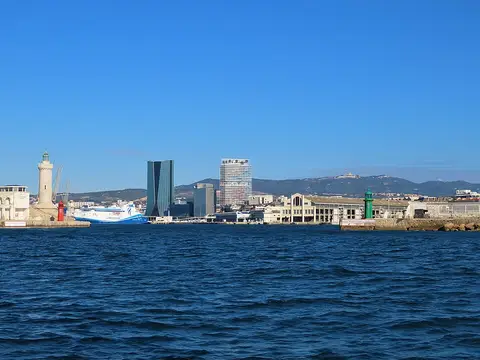
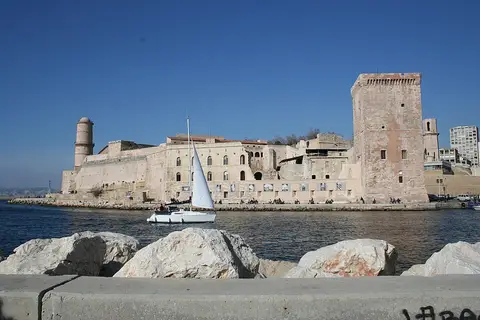
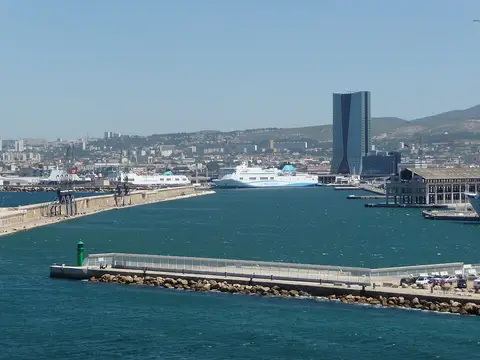
Near the Unité d'Habitation in Marseille you'll find other sights such as the Monument en Mémoire de Rimbaud, about 816 meters away, and the Pouce de César, about 909 meters away. travelguide195 also lists around 23 restaurants within 500 meters. The Unité d'Habitation is also part of the tour "Marseille for Food Lovers: From Harbor Breakfast to Speakeasy Night."
Ratings & comments
none yetNear Unité d'Habitation
closest 5 per category · 2 kmSights
Restaurants
Museums
Hotels
Cocktail bars
More:Historic sites in Marseille (196)Sights in 8th Arrondissement (21)All sights in Marseille (237)
126 places within 2 km loaded.
You need a free account to leave reviews and photos – that keeps comments genuine and lets you edit them later.
The building is called "la maison du fada" (the house of the foolish) by indigenous people. The building contains a shopping street, a church, a children's school and housing. You can access the roof and enjoy the breathtaking view of Marseille between hills and sea. There is a bar/restaurant/hotel on the 3rd floor too.
Source: Wikivoyage, „Le Corbusier World Heritage“ · authors per page history · CC BY-SA 4.0 · as of 12/21/2017