About Sibelius Monument
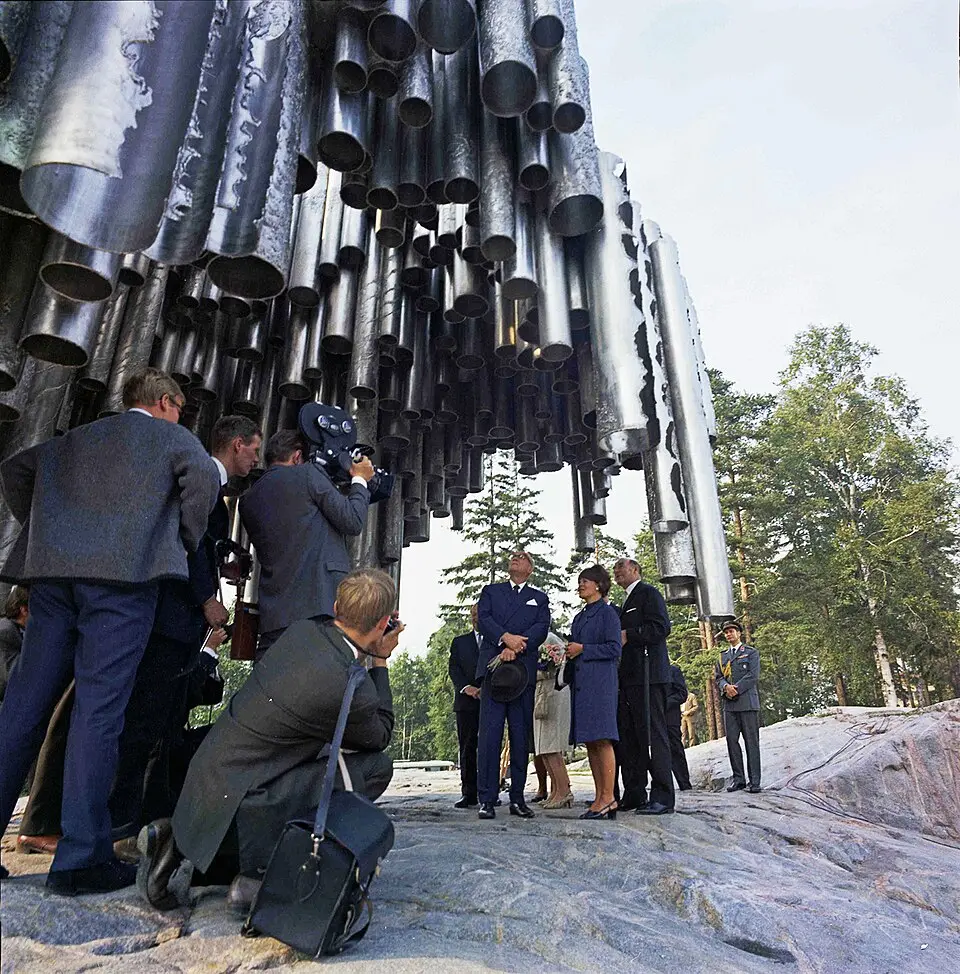
The Sibelius Monument in Helsinki is one of the best-known and most-visited sights in the Finnish capital. It honors the composer Jean Sibelius, who died in 1957, and stands in Sibelius Park in the Töölö district. The sculpture was created by the Finnish sculptor Eila Hiltunen and was formally presented to the city of Helsinki on September 7, 1967. Today the work is managed and maintained by the Helsinki Art Museum as part of the city's art collection. The park itself, originally called Humala Park, was renamed Sibelius Park in 1945 in honor of the composer's 80th birthday, which laid the groundwork for the later erection of a monument.
The creation of the monument was accompanied by a protracted and controversial competition, which the Sibelius Society of Finland announced between 1961 and 1962. The rules allowed both figurative and abstract solutions, which were meant to reflect both the personality and the music of the composer. Eila Hiltunen, who was already known at the time for her pioneering work in welded sculpture, initially submitted an abstract work titled "Credo." It consisted of a welded cluster of pipes, inside which visitors could stand. Although the jury rewarded other artists in the first round, it recommended purchasing Hiltunen's design, which led to a second round.
In the second round, Hiltunen developed her design into the work "Passio Musicae" (Passion for Music). Compared with the first version, the arrangement of pipes now stood on one fewer leg and had an undulating, dynamic structure. The pipes were decoratively textured and given cracks to manipulate light and shadow. Hiltunen drew inspiration from Milan Cathedral, which she had visited on a trip. In the second round, the jury unanimously backed Hiltunen's design, regarding it as the most original and highest-quality entry. Despite this recognition, the society insisted that a figurative element had to be added to the abstract work in order to counter critics.
This compromise led to the addition of a high-relief portrait of Sibelius to the monument. The portrait, which shows the composer in his mid-forties, was cast in acid-resistant stainless steel and framed by three freely shaped fragments. It is mounted on a granite wall about fifteen meters from the main part of the sculpture. The decision to add this element was part of a public debate in which many critics considered the purely abstract design inappropriate for a national hero. Hiltunen herself had stressed that she had not been thinking of a particular musical instrument but wanted to express the abstract idea of music itself.
Building the monument was an enormous technical challenge. Hiltunen worked in an unheated industrial hall in Lauttasaari, where she textured and welded the pipes by hand. This process took several years and took a toll on the artist's health, as she inhaled toxic fumes. The stainless steel plates came from France and were formed into pipes in Finland. At the construction site in Sibelius Park, the fourteen components were joined together. To withstand the wind, deep pits were dug and reinforced with steel and concrete. A chemical treatment of the surface prevented the metal from developing a patina or corroding over time, so the monument still shines in its original silvery brilliance today.
The unveiling ceremony in 1967 was a major cultural event, attended by then-President Urho Kekkonen and Sibelius's daughters. The festivities began with a performance of Sibelius's "Preludio" and ended with the famous "Finlandia." Although the monument was officially given to the city, Hiltunen experienced the handover as emotionally draining. She felt the Sibelius Society had not adequately recognized her, which led to a period of isolation and prompted her to set up a second home in Italy. Even so, the work quickly became a symbol of the modern Finnish art scene.
Since its completion, the Sibelius Monument has become an important site of Finland's cultural diplomacy. The country has donated study models of the work to international institutions, including UNESCO in Paris and the United Nations headquarters in New York. These gestures underscored the work's international recognition and served to showcase Finland's cultural identity worldwide. Today the monument draws around half a million visitors a year and is a fixture of Helsinki's cityscape.
Architecturally, the monument consists of two clearly distinct elements. The main element is the abstract cluster of 569 acid-resistant stainless steel pipes, welded in an undulating pattern. The pipes vary in length and diameter and are arranged to form a hollow in which visitors can stand. At a height of 8.5 meters and a weight of 24 metric tons, the structure dominates the park. Hiltunen intended it to symbolically evoke Sibelius's music, but many viewers see in it more a depiction of an organ or of Finnish nature, such as birch forests or shoreline reeds.
Although Hiltunen did not conceive the work as a sound sculpture, the arrangement of pipes produces fascinating acoustic effects through wind, rain, and the echoes of voices and birdsong. The metal reflects sunlight differently depending on the time of day, the weather, and the season, giving the monument a surreal and everlasting luminosity. The second element, the portrait, is about one meter tall and shows a pensive Sibelius. A plaque on the granite wall informs visitors of the work's name, the year of completion, and the biographies of the composer and the sculptor.
The reception of the monument remains divided to this day, which underscores its artistic complexity. While some critics object to the unavoidable association with an organ, since Sibelius hardly composed for that instrument, others praise the monumental effect and the rhythmic form. The monument is considered a milestone in Finnish art history, as it helped modernize what was then a conservative, male-dominated scene. It was the first time a woman had been commissioned to monumentalize a national "great man," challenging gender dynamics in sculpture.
For visitors, Sibelius Park is a place of quiet and reflection. The monument blends harmoniously into its wooded surroundings and invites you to view the abstract form from different perspectives. The chance to stand inside the arrangement of pipes offers a unique, immersive experience that blurs the boundary between viewer and artwork. The Sibelius Monument is not only a tribute to one of Finland's most important composers but also a testament to the artistic breakthrough of a bold sculptor who pushed the boundaries of contemporary sculpture. It remains a fascinating place where music, nature, and modern art meet.
At a glance
- Category
- Sight › Monuments
- Rating
- no reviews yet · write a review
- Address
- Sibeliuksen puisto, Mechelininkatu
00250 Helsinki, Finland - Phone
- +358404855687
- Website
- en.wikipedia.org
- —
- Coordinates
- 60.18208° N · 24.91343° E
- Data quality
- confidence 0.99
- Identifier
- ID 822e6bc9-30c…
Location & surroundings
Toggle layersFAQ about Sibelius Monument
quick answersWhat is the Sibelius Monument in Helsinki?
The Sibelius Monument in Helsinki honors the Finnish composer Jean Sibelius, who died in 1957, and is one of the best-known sights in the Finnish capital. The sculpture is the work of Finnish sculptor Eila Hiltunen and was presented to the city of Helsinki on September 7, 1967. Today the Helsinki Art Museum manages and maintains the work as part of the city's art collection.
Where is the Sibelius Monument in Helsinki?
The Sibelius Monument stands in Sibelius Park (Sibeliuksen puisto) on Mechelininkatu in Helsinki's Töölö district. The park was originally called Humala Park and was renamed Sibelius Park in 1945 for Jean Sibelius's 80th birthday. That renaming laid the groundwork for the later construction of the monument.
How did Eila Hiltunen's Sibelius Monument come about?
The Sibelius Monument in Helsinki grew out of a long and controversial competition held by the Sibelius Society of Finland in 1961 and 1962. Eila Hiltunen, known for her pioneering work in welded sculpture, first submitted an abstract pipe design called "Credo" and developed it in the second round into the work "Passio Musicae" (Passion for Music). The textured pipes, arranged in wave-like formations, are meant to play with light and shadow, and Hiltunen drew inspiration from Milan Cathedral. By her own account, she did not want to depict a specific instrument but the abstract idea of music itself.
Why is there a portrait of the composer at the Sibelius Monument?
The portrait at the Sibelius Monument in Helsinki is a compromise, because many critics considered a purely abstract work inappropriate for a national hero. The Sibelius Society therefore insisted on a figurative element, and the result was a high relief showing Jean Sibelius in his mid-forties. It is cast in acid-resistant stainless steel, framed by three freely shaped fragments, and mounted on a granite wall about 15 meters from the pipe sculpture.
What can you see around the Sibelius Monument in Helsinki?
Near the Sibelius Monument in Helsinki, you'll find more art and smaller museums. travelguide195 lists, among others, the Ilmatar Ja Sotka monument about 156 meters away, the Helsinki Tram Museum (Raitioliikennemuseo) about 450 meters away, and the Virkki kotimuseo home museum about 494 meters away. Within 500 meters, travelguide195 also lists 8 restaurants, and the monument is part of the tour "Helsinki in One Day: The Classics from Senate Square to the Sibelius Monument."
Ratings & comments
none yetNear Sibelius Monument
closest 5 per category · 2 kmSights
Restaurants
Museums
Hotels
More:Monuments in Helsinki (46)All sights in Helsinki (501)
218 places within 2 km loaded.
You need a free account to leave reviews and photos – that keeps comments genuine and lets you edit them later.
The world-famous composer Jean Sibelius' monument was designed by sculptress Eila Hiltunen and unveiled in 1967. It is one of the most well-known tourist attractions in Helsinki as nearly every guided tourist tour is brought to Sibelius Park to marvel at this unique work of art resembling organ pipes, welded together from 600 pipes and weighing over 24 metric tons.
Source: Wikivoyage, „Helsinki/West“ · authors per page history · CC BY-SA 4.0