About Krepost Sveaborg
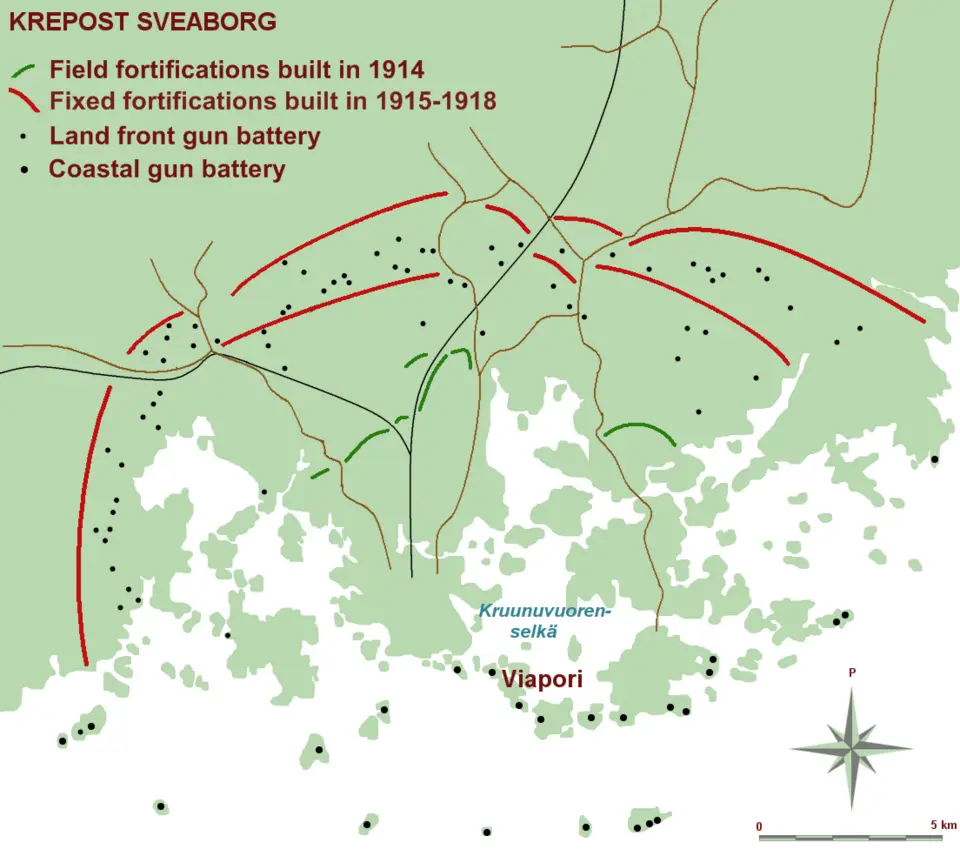
The Krepost Sveaborg was an extensive fortress system that Tsarist Russia built around Helsinki during World War I. Its primary purpose was to create a secure naval base for the Russian Baltic Fleet and to protect both the city of Helsinki and the sea routes to Saint Petersburg from a possible German invasion. As part of the larger Peter the Great's Naval Fortress, it served to defend the coast. Because the old Sveaborg fortress, now known as Suomenlinna, no longer offered adequate protection owing to advances in artillery technology, a new main line of defense was laid out far beyond the old boundaries. This new line consisted of coastal artillery on outlying islands, while land fortifications around Helsinki were meant to repel attacks from the landward side. The fortress was not yet fully completed when the February Revolution of 1917 halted most construction work, which came to a complete standstill after the October Revolution.
The architectural and military structure of the system was divided into an outer main line of defense and an inner second line of defense. The outer line extended across islands such as Miessaari, Rysäkari, Katajaluoto, Harmaja, Kuivasaari, Isosaari, and Santahamina. Modern heavy coastal guns were installed here, including 254-millimeter guns of the 1891 model and 152-millimeter Canet guns of the 1892 model. These batteries were protected by thick concrete parapets and were intended to fend off enemy ships. The older Suomenlinna fortress served as the central stronghold and second line of defense, housing the headquarters, the telephone exchange, and large dry docks. Searchlights, mine control stations, and communications centers were also set up on the outlying islands to coordinate the defense and secure the waterways.
After Finland declared independence, it took over the coastal fortifications to protect Helsinki, while the land fortifications were largely abandoned and demilitarized. Some parts of the land fortifications were nevertheless used during the Finnish Civil War. Today the complex is a historical testament to the region's military history, and the concrete batteries on the small islands and the structures of the old fortress give you a glimpse into the complex defense strategy of the early 20th century. The combination of maritime and land-based defenses illustrates Helsinki's strategic importance as a hub between the Russian hinterland and the Baltic Sea.
At a glance
- Category
- Sight › Historic sites
- Rating
- no reviews yet · write a review
- Address
- —
Helsinki, Finland - Phone
- —
- Website
- —
- —
- Coordinates
- 60.14000° N · 24.98000° E
- Data quality
- confidence 0.78
- Identifier
- ID 4991da1c-f44…
Location & surroundings
Toggle layersRatings & comments
none yetNear Krepost Sveaborg
closest 5 per category · 2 kmSights
Restaurants
Museums
Hotels
Cocktail bars
None within 2 km.
More:Historic sites in Helsinki (442)All sights in Helsinki (501)
21 places within 2 km loaded.
You need a free account to leave reviews and photos – that keeps comments genuine and lets you edit them later.