About Villa Tugendhat
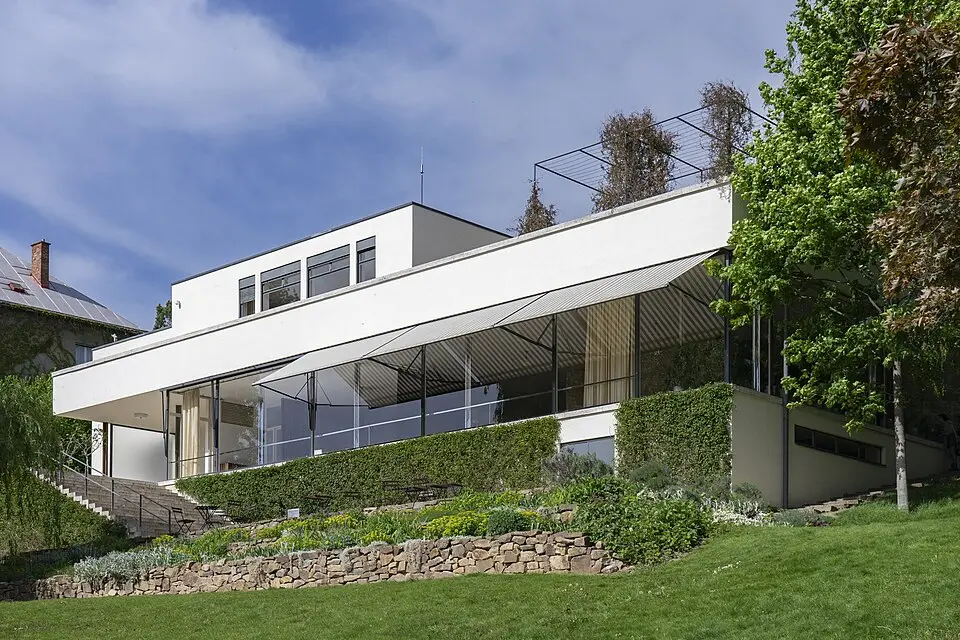
Villa Tugendhat in Brno is an architectural masterpiece built between 1929 and 1930 to designs by the famous architect Ludwig Mies van der Rohe. The house was created for the entrepreneurial couple Fritz and Grete Tugendhat and is regarded today as one of the most important modernist buildings in Europe. Completed at the same time as the Barcelona Pavilion, it is considered a milestone of modern architecture and ranks alongside other icons such as Le Corbusier's Villa Savoye. The building stands on Černá Pole (Black Field) in the northeast of the city, positioned across a slope. From the street side it looks like a plain, single-story pavilion, while on the steeply descending garden side it opens up with an enormous wall of windows. Facing southwest, this orientation offers a panoramic view of Brno's Old Town and uses the natural slope to integrate the house into the landscape.
The design of the building is based on an innovative three-story steel-frame structure, which was a novelty in residential construction at the time. Mies van der Rohe strictly separated structure from walls, which made possible an open floor plan with free-flowing space. On the main living floor, a large, open living area extends out, opened to the south and east by floor-to-ceiling glass panes. When desired, this generous glazing merges completely with the outdoors, as the nearly five-meter-long glass panels can be lowered into the floor. The interior is divided into different functional zones by freestanding elements such as screens or furniture, while the boundaries between living, dining, and work areas remain fluid. The integration of nature is reinforced by the use of muted, subdued tones such as marble, wood, silk, and leather, which offset the changing colors of the garden.
The house's material concept deserves special attention, marked by fine fabrics and high-quality detailing. The structural system consists of cruciform steel columns clad in chrome-plated sheet metal. A central role is played by the freestanding wall of Moroccan onyx marble, which has no structural function but serves as a room divider. This stone is translucent and shimmers in the sunlight in shades from milky white to orange-red. Other materials include Macassar ebony for the paneling of the dining area, rosewood for doors and built-in furniture, and travertine for floors and stairs. The furnishings include classic pieces such as the Barcelona chairs and a glass table with a chrome-plated frame, designed especially for this space. One historical detail is the semicircular partition made of Macassar wood, whose original panels were rediscovered in the cafeteria of Brno University after being lost for a long time and were used for the reconstruction.
The history of the villa is closely tied to the fates of its residents and the political upheavals of the 20th century. Grete Tugendhat, who received the plot of land as a gift from her parents, met Mies van der Rohe in Berlin, where the client and the architect found themselves in great agreement. The construction costs were enormous, and the technical installations were state of the art for the time. With the annexation of the Sudetenland and the occupation of Bohemia and Moravia by the Nazi regime, the family was forced to leave Czechoslovakia. The villa was seized by the Gestapo in 1939 and later served as a design office for an aircraft engine factory. After World War II, the Red Army used the building before it was converted into an orthopedic department of a children's hospital, with the living area turned into a gymnasium.
In the 1960s, initiatives began to protect the monument and make it accessible to the public. After a first reconstruction in the 1980s, during which many original parts were lost, the villa was handed over to the Brno City Museum in 1994 and opened as a monument to modern architecture. In 1995 it was declared a National Cultural Monument. A historic event took place in 1992, when the agreement on the dissolution of Czechoslovakia was signed in the villa. In 2001 the building was added to the UNESCO World Heritage List, underscoring its exceptional artistic value. After a comprehensive restoration, for which the city of Brno provided substantial funding, the villa reopened to the public in 2012. Today it is an important site of cultural memory and a symbol of the history of modern architecture in the region.
At a glance
- Category
- Sight › Historic sites
- Rating
- no reviews yet · write a review
- Address
- Černopolní 45
613 00 Brno, Czechia - District
- Brno-sever
- Phone
- +420515511015
- Website
- www.tugendhat.eu
- info@tugendhat.eu
- Coordinates
- 49.20718° N · 16.61607° E
- Data quality
- confidence 0.99
- Identifier
- ID 156eb1eb-bfd…
Part of the tour
Brno in One Day: Villa Tugendhat, Old Town, and Špilberk →Location & surroundings
Toggle layersFAQ about Villa Tugendhat
quick answersWhat is Villa Tugendhat in Brno?
Villa Tugendhat in Brno is a residence designed by the architect Ludwig Mies van der Rohe and is considered one of the most important works of modernist architecture in Europe. It was built between 1929 and 1930 for the entrepreneur couple Fritz and Grete Tugendhat. The villa was completed at the same time as the Barcelona Pavilion and is mentioned in the same breath as icons such as Le Corbusier's Villa Savoye.
Where is Villa Tugendhat in Brno?
Villa Tugendhat stands at Černopolní 45 in the Brno-sever district, on the Schwarzfeld (Černá Pole) in the northeast of Brno. The house sits across a slope and faces southwest, so from the garden side you have a panoramic view of Brno's Old Town. travelguide195 lists around 15 restaurants within 500 meters.
What makes the architecture of Villa Tugendhat so special?
Villa Tugendhat in Brno is built on a three-story steel skeleton, which was a novelty in residential construction at the time. Mies van der Rohe strictly separated structure and walls, creating an open floor plan with fluid transitions between the living, dining, and work areas. The floor-to-ceiling glass panels of the living area, almost five meters long, can be lowered into the floor so that interior and exterior merge. From the street, by contrast, the house looks like a simple one-story pavilion.
What materials and furniture can you see in Villa Tugendhat?
In Villa Tugendhat in Brno, fine materials such as onyx marble, Macassar ebony, rosewood, and travertine define the interior. Especially striking is the freestanding wall of Moroccan onyx marble, which shimmers in the sunlight from milky white to orange-red. The furnishings include the Barcelona chairs and a glass table with a chrome-plated frame, designed specifically for this room. The original panels of the semicircular Macassar partition were rediscovered in the cafeteria of Brno University and used for the reconstruction.
What can you visit around Villa Tugendhat in Brno?
Several museums are located in the immediate vicinity of Villa Tugendhat in Brno. travelguide195 lists Villa Löw-Beer about 217 meters away, the Museum of World Languages about 438 meters away, and the Muzeum II. patro about 877 meters away. If you want to see more of Brno, you'll also find the villa on the tour "Brno in One Day: Villa Tugendhat, Old Town, and Špilberk".
Ratings & comments
none yetNear Villa Tugendhat
closest 5 per category · 2 kmSights
Museums
Hotels
More:Historic sites in Brno (148)All sights in Brno (165)
227 places within 2 km loaded.
You need a free account to leave reviews and photos – that keeps comments genuine and lets you edit them later.
The villa is listed on the UNESCO World Heritage List. Designed by Mies van der Rohe, it is seen to be a classic example of functionalist architecture, and was also the location of the meeting which decided upon the Velvet Divorce that separated Czechia and Slovakia in 1992. It is possible to visit the Villa by guided tour; tours are led hourly and must be booked in advance (see the Villa website). The building reopened in March 2012 after an extensive restoration.
Source: Wikivoyage, „Brno“ · authors per page history · CC BY-SA 4.0