Istria: Roman Arena, Hill Towns, and Truffles
Travel guide · editorialA vacation in Istria County combines coastal towns with a Venetian flair and a green hinterland full of hill villages, vineyards, and truffle forests. The peninsula in the northern Adriatic is bilingual, Croatian and Italian, and easy to reach by car from Germany and Austria. No wonder it ranks among Croatia's most popular destinations.
Landscape and Location
Istria is the largest peninsula in the Adriatic and is shared among Croatia, Slovenia, and a small piece of Italy. The Croatian part is divided by soil color: "White Istria" in the northeast is bare limestone mountains with the Učka massif, "Gray Istria" in the interior has marl soils and hills, and "Red Istria" on the west coast has red earth, olive groves, and vineyards. The administrative seat is the small town of Pazin in the center, where a castle perches above a gorge. The west coast is flat and lined with small islands, and the Lim Channel cuts deep into the land.
Sights in Istria
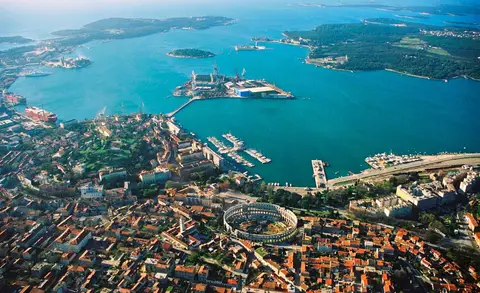
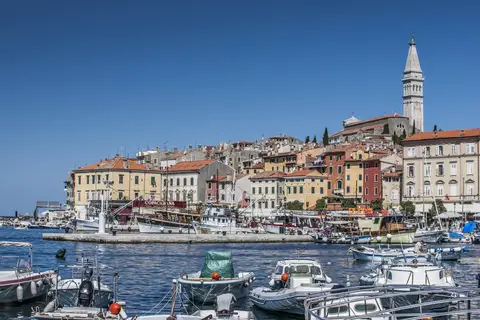
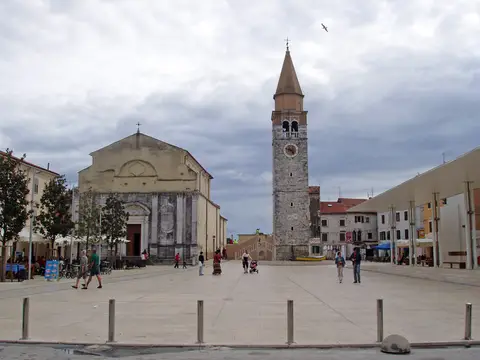
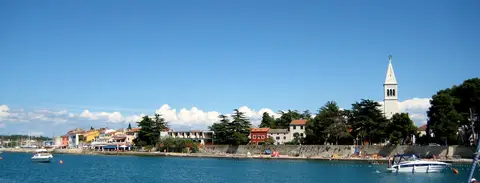
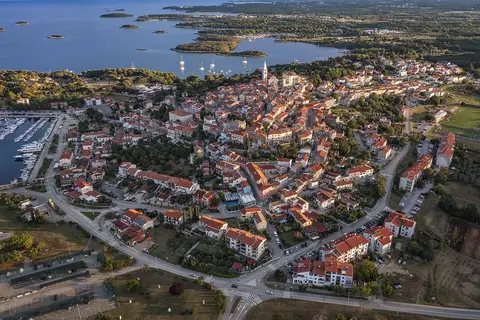
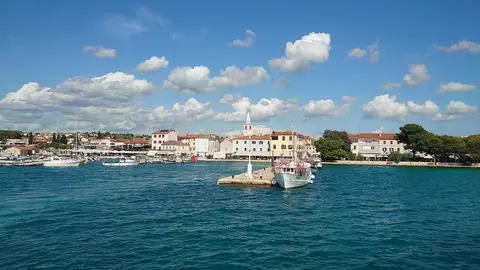
The Pula Arena, built in the 1st century, is one of the best-preserved Roman amphitheaters in the world and serves as a stage for concerts and a film festival in summer. In Poreč, the 6th-century Euphrasian Basilica displays gleaming gold Byzantine mosaics and is a UNESCO World Heritage Site. Rovinj crowds around the Church of St. Euphemia on a former island, its bell tower rising above the harbor. Novigrad and Umag in the northwest are quieter harbor towns, while Vrsar sits on a hill at the entrance to the Lim Channel. Brijuni National Park off Pula was Tito's summer residence and offers a safari park, Roman villas, and dinosaur tracks.
Hinterland and Coast
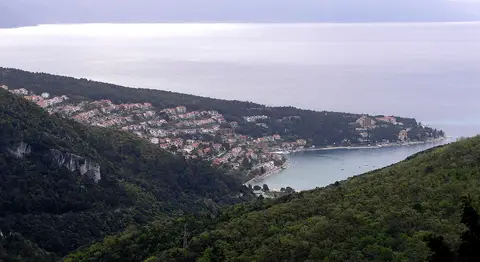
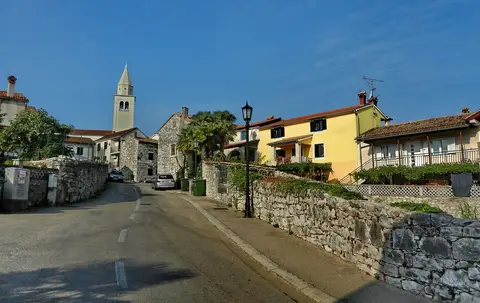
Inland, small towns like Motovun, Grožnjan, and Hum sit enthroned on hilltops. Motovun looks out over the Mirna Valley, where white and black truffles grow in oak forests; Grožnjan is an artists' town with galleries and music courses, and Hum is considered the smallest town in the world. On the east coast, Rabac lies below Labin, an old mining town. Medulin in the south has shallow bays and Cape Kamenjak, a nature reserve with cliffs you can jump into the sea from. Labin was a mining center until the late 1980s; today artists exhibit in the old town. In summer, film and music festivals take place in Pula, Motovun, and Rovinj.
Food and Drink
Istria is regarded as a gourmet region. Truffles are shaved over fuži, hand-rolled pasta, or scrambled eggs; the region's olive oil regularly wins international awards. Pršut, air-dried ham, and ombolo, pork loin, belong on every appetizer platter. Malvazija is the typical white wine, Teran a robust red. On the coast you'll find mussels from the Lim Channel and scampi from the Kvarner Bay.
Getting There and Best Time to Visit
Pula Airport is served from many European cities in summer, and Trieste and Rijeka are also nearby. Via Slovenia, you can reach Istria on the Istrian Y, a motorway connecting Umag, Pula, and the Učka Tunnel. The best times to visit are May and June as well as September and October, when the truffle season also begins. In July and August, the coastal towns are crowded and expensive.