

Discovering Chengdu: Pandas, Teahouses and Hot Pot
Travel guide · editorialIn Chengdu, you can sit for hours in a teahouse, have your ears cleaned, and eat hot pot that leaves your lips tingling. A trip to Chengdu, the capital of Sichuan, combines giant pandas, a relaxed way of life, and one of the most exciting cuisines in China.
Land of Abundance
Chengdu has been inhabited for more than 2,000 years. The Dujiangyan irrigation system, built in the 3rd century B.C., turned the plain into one of the most fertile regions in China, the "Land of Abundance." In the 3rd century, Chengdu was the capital of the Kingdom of Shu, familiar from the novel "Romance of the Three Kingdoms." The world's first paper money was issued here in the 11th century. Today Chengdu is an economic and technology hub of western China, known for its laid-back lifestyle.
Sights in Chengdu
The Panda Research Base in the north is the best-known attraction: giant pandas munch bamboo in spacious enclosures, and they are most active in the morning. Red pandas live there as well. In the center of town you'll find the Wuhou Shrine, dedicated to the strategist Zhuge Liang, with Jinli Street right next door, lined with lanterns and snack stalls. Du Fu's Thatched Cottage, a garden estate with bamboo groves and pavilions, commemorates the famous Tang-dynasty poet who lived here for several years. Wenshu Monastery is an active Buddhist monastery with a popular teahouse. The Kuanzhai Alleys (Kuanzhai Xiangzi), with their restored courtyard houses, show you the old Chengdu, while the area around Chunxi Road and Taikoo Li is the modern shopping district, complete with a giant panda climbing up a facade.
Teahouses and Sichuan Opera
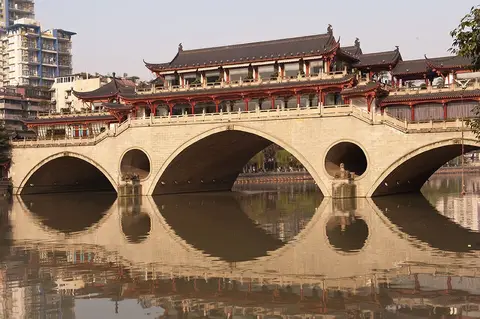
In People's Park, locals gather at the Heming Teahouse, play mahjong, and get treated by ear cleaners. In the evening, a performance of Sichuan opera is well worth it, featuring the famous bianlian, the lightning-fast mask changing, as well as fire-spitting. The Yulin district, celebrated in a well-known folk song, has bars and small music venues, and in the evening people stroll along the banks of the Jinjiang River.
Eating in Chengdu
In 2010, UNESCO named Chengdu a City of Gastronomy. Sichuan cuisine thrives on numbing Sichuan pepper and chili, the flavor known as "mala." Classics include huoguo, or hot pot, mapo tofu, kung pao chicken, dan dan noodles, and chuan chuan, skewers cooked in a spicy broth. There are also milder snacks such as long chao shou, wontons in broth, and sweet rice cakes. Many restaurants in Chengdu also offer mild options, such as a divided hot pot with one spicy and one mild broth. If you'd like to learn to cook for yourself, you'll find cooking schools that start with a visit to a market selling chili varieties, pickled vegetables, and Pixian bean paste. In the evening, the street-food lanes around the Yulin area fill up, serving skewers, rabbit heads, and cold noodles until late.
Getting There and Day Trips
Chengdu has two airports: the new Tianfu in the southeast and Shuangliu in the southwest, both reachable by metro. High-speed trains run to Chongqing, Xi'an, and beyond. Worthwhile day trips lead to the Leshan Giant Buddha, at 71 meters the largest stone Buddha statue in the world, to the sacred Mount Emei, and to the Dujiangyan irrigation system. The best time to visit is spring and fall; summer is hot and humid, and winter is gray and cool.