About EdgeWalk at the CN Tower
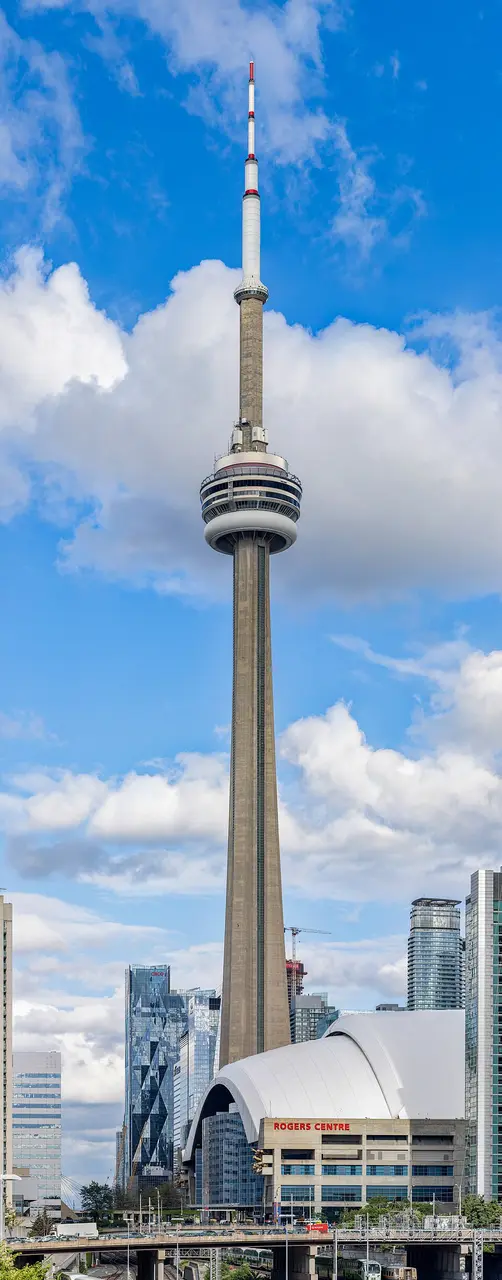
The CN Tower in Toronto is a 553-meter-tall landmark of the Canadian metropolis and serves primarily as a telecommunications tower. As one of the tallest broadcast towers in the world, it transmits more than thirty television and radio programs. From 1975 to 2009 it held the record as the world's tallest tower, and until 2007 it was also the tallest freestanding structure on Earth without guy wires. Today it is far more than a technical installation: it is the city's most important tourist attraction, drawing up to two million visitors a year. Experts regard the tower's architecture as a success, and in 1995 the American Society of Civil Engineers added it to its list of the Seven Wonders of the Modern World.
The tower's story began in the 1960s, when the growing number of skyscrapers in the Financial District increasingly interfered with radio and television reception in Toronto. To solve this problem, Canadian National Railways and the Canadian Broadcasting Corporation planned to build a transmission mast. The original plan called for a mast of at least 350 meters with no public areas. However, because broadcast coverage also had to be secured for the surrounding region, the planned height was raised considerably. The final decision to build came in 1970, and wind tunnel tests began a year later. Geologists surveyed the building site, which proved to be rocky and stable, making it possible to erect a very tall structure.
John Andrews handled the architectural design in collaboration with the architecture firm WZMH. The original idea was fairly functional, but over the course of planning, a design emerged that would come to define the city. The tower shaft has a hexagonal core supported by three legs, creating a Y-shaped cross-section. This structure tapers toward the top and echoes the original idea of three connected masts. Ground was broken on February 6, 1973. The construction time of just 40 months was considered an extraordinary achievement at the time. Construction costs came to 63 million Canadian dollars, which, adjusted for inflation, would equal about 300 million dollars today.
Building the tower shaft was a technical challenge. The shaft, made of prestressed concrete, was poured using slipform construction. To keep it plumb, a heavy steel cylinder was suspended on a wire cable inside the hollow core, and measurements were taken regularly with optical instruments. The result was a tower that deviates from vertical by only 27 millimeters. During construction, the owner decided to raise the tower by 30.5 meters in order to break the record for the world's tallest structure. The tower pod, a seven-story structure weighing 318 tons, was raised to a height of 350.5 meters using hydraulic jacks. The antenna was assembled from 44 individual sections and flown to the top of the tower by helicopter, which shortened the construction time considerably.
After its completion on February 6, 1976, the CN Tower replaced the Ostankino Tower in Moscow as the tallest freestanding structure. The official opening took place on October 1, 1976, in the presence of then-Prime Minister Pierre Trudeau. In its first years, the tower still stood in isolation on the railway company's land, but over time the surrounding area was integrated into the cityscape with the construction of sports venues, the Rogers Centre, and other buildings. The tower became a symbol of Toronto's economic boom and a national symbol of Canada. It often appears on coins and postage stamps and frequently serves as a backdrop for film productions.
For visitors, the tower offers a wide range of experiences on different levels. The elevators, which travel at up to six meters per second, take guests to the first observation deck in 58 seconds. At a height of 342 meters there is an open-air observation deck secured by a grille. On the lowest floor of the tower pod lies the Glass Floor, a 23-square-meter floor of armored glass that lets you look straight down. Above it you will find the Horizons Café and an enclosed observation deck. At a height of 351 meters, the 360 Restaurant rotates once around its axis every 72 minutes and seats up to 400 guests. The same level also houses a wine cellar, said to be the highest in the world.
A special attraction is the EdgeWalk, which opened on August 1, 2011. At a height of 356 meters, visitors can walk all the way around the tower on a 1.5-meter-wide ledge. Since there is no railing, participants are secured with a climbing harness hooked to an overhead rail. This experience is considered the world's highest hands-free walk of its kind. For bold visitors who prefer something a little calmer, a staircase of 1,776 steps leads up to the tower pod; it is used twice a year for stair-climbing races.
Above the main tower pod, at 446.5 meters, lies the Sky Pod, another observation deck reached by a separate elevator. On a clear day, you can see up to 120 kilometers from here. The Sky Pod has two levels, and the upper one has outward-sloping windows that allow an almost vertical view downward. Above the Sky Pod, a 102-meter steel mast serves as an antenna and is fitted with various telecommunications equipment. The mast is divided into five sections and marked with colored rings for aviation safety.
The CN Tower is not only a tourist destination but also a site of science and research. Since 1978 it has served several research institutions for lightning studies. Because of its height and grounding, it attracts lightning and is struck an average of 75 times a year. Magnetic coils on the antenna mast measure how magnetic fields spread during lightning strikes. This data helps with statistical studies of the propagation of electromagnetic waves. In addition, a time capsule was set into a wall below the observation deck at the opening; it contains letters, newspapers, coins, and a video about the construction. It is not to be opened until October 1, 2076.
The tower's lighting is another highlight, especially in the evening. Since 2007, the tower has been illuminated by more than 1,300 LEDs that can be controlled individually and wirelessly. The colors and lighting schemes vary with the season and occasion. On special days such as Canada Day or Pride Toronto Weekend, the tower glows in specific colors, and on New Year's Eve it puts on a special light show. During bird migration season, the special lighting is dimmed so as not to disorient migratory birds. This dynamic lighting makes the tower a living element of the Toronto skyline.
The CN Tower is open year-round and is run by a team of up to 550 employees. The ground floor houses an interactive multimedia center, a souvenir shop, a café, and a small theater showing films about the tower's construction. The tower is also a venue for events and celebrations, with around 300 events held each year. With its combination of technical mastery, historical significance, and varied visitor experiences, the CN Tower remains an indispensable part of Canadian culture and a symbol of innovation and progress.
At a glance
- Category
- Sight › Historic sites
- Rating
- no reviews yet · write a review
- Address
- 290 Bremner Blvd
M5V 3L9 Toronto, Canada - District
- Harbourfront-CityPlace
- Phone
- +14166013833
- Website
- www.edgewalkcntower.ca
- edgewalkinfo@cntower.ca
- Coordinates
- 43.64257° N · -79.38706° E
- Data quality
- confidence 1.00
- Identifier
- ID c1aa7055-6fb…
Part of the tour
Toronto for the First Time: From Casa Loma to the CN Tower →Location & surroundings
Toggle layersRatings & comments
none yetNear EdgeWalk at the CN Tower
closest 5 per category · 2 kmRestaurants
Museums
Hotels
More:Historic sites in Toronto (1,327)Sights in Harbourfront-CityPlace (53)All sights in Toronto (1,372)
282 places within 2 km loaded.


You need a free account to leave reviews and photos – that keeps comments genuine and lets you edit them later.