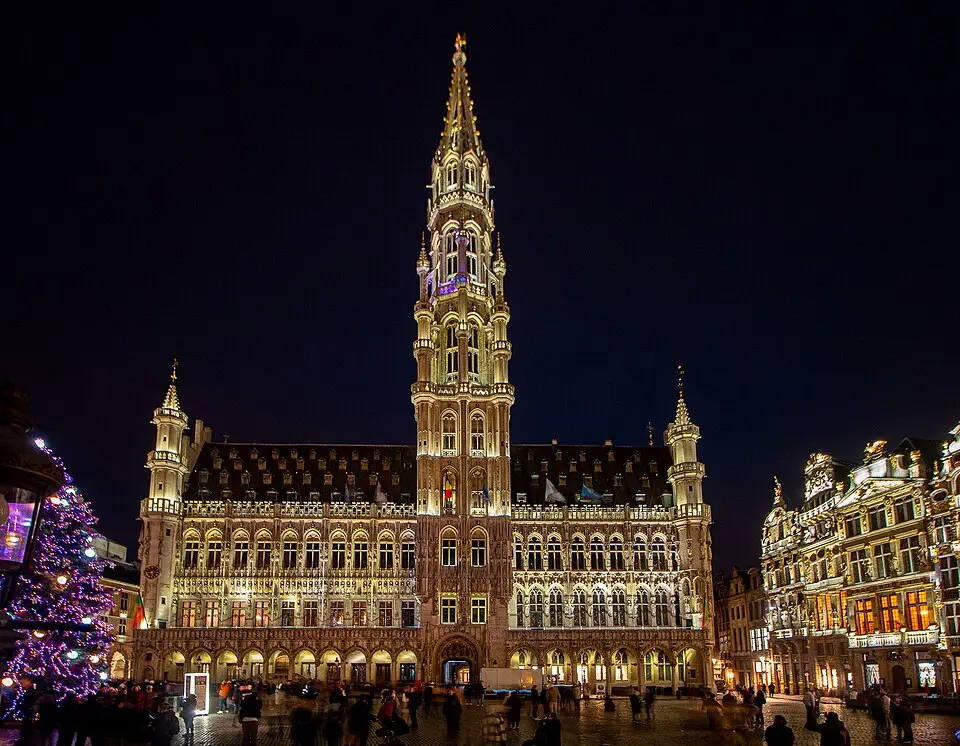
About Grote Markt
The Grote Markt, known in French as the Grand-Place, is the central and arguably most famous square in the Belgian capital, Brussels. One of the city's landmarks, it is regarded internationally as one of the most beautiful squares in Europe and was added to UNESCO's World Heritage List as an ensemble in 1998. The rectangular square measures 110 meters long and 68 meters wide, with its southeast side set at a slight angle. Seven narrow streets lead from this historic center into the surrounding Old Town without breaking the continuous line of facades. Today the square is one of Brussels' biggest tourist attractions, lined with numerous sidewalk cafés and hotels. In the evening, effective lighting highlights the architecture, while a flower market enlivens the square on weekdays and a bird market on Sundays.
The history of the site goes back to the 11th and 12th centuries, when the originally marshy ground was drained. At that time the square lay considerably lower than it does today and was called "Nedermerct," a name that refers to the lower market. Thanks to its proximity to the merchants' quarter around the Church of St. Nicholas, it quickly developed into the economic center. In the 12th century, more and more guilds and corporations settled here, making the square the political and cultural heart of the city. Assemblies, court trials, and festivals took place here, as did executions. A fateful event was the almost complete destruction of the square by French troops' bombardment in 1695. Only the walls and towers of the town hall and of the building opposite remained standing, while all other structures lay in ruins.
The unbroken Baroque line of facades you see today was built in the years after this destruction. The city council made sure that all designs for the new buildings conformed to a uniform and dignified appearance. The dominant building is the Gothic town hall, constructed from 1401 to 1421 and later expanded with a second wing. Its 96-meter-high belfry, built between 1449 and 1455, crowns the building and is topped by a gilded statue of the Archangel Michael. The asymmetrical design of the tower and the richly windowed facade with magnificent sculptural decoration made the town hall a model for later buildings in Brabantine Gothic style. After the bombardment, the building received its present appearance between 1706 and 1714. Inside, Neo-Gothic elements now dominate, including the Maximilian Room with historic tapestries, the opulent council chamber, and the ceremonial hall.
Opposite the town hall stands the Maison du Roi, also known as the Broodhuis. The name recalls a medieval predecessor in which bakers sold their bread, before the building later housed the ducal and royal court. The present building, in the Neo-Gothic and Neo-Renaissance styles, was restored and expanded in the 19th century. Today it houses the City Museum, where you can see the original sculptures from the town hall dating from around 1400 as well as the costumes of the famous Manneken Pis statue. The facade is modeled on historic engravings and recalls the town hall of Oudenaarde.
The remaining 37 buildings framing the square are the guildhalls, which were rebuilt in magnificent Baroque style after the destruction of 1695. Their narrow plots followed the Gothic floor plans of the earlier buildings, which gives the square a lively and varied character. The strongly articulated facades are distinguished by rich sculptural decoration, elaborate gables, pilasters, and balustrades inspired by Italian Baroque with Flemish influences. In addition to the name of the guild it belonged to, each house bears its own individual name. The houses on the northwest side in particular are considered the most beautiful of the row.
In the 21st century, the Grote Markt is a place of living traditions. In July, the Ommegang ends here, a procession in historic costumes that has taken place since the 14th century and was recognized by UNESCO as intangible cultural heritage in 2019. Every two years, a huge carpet of flowers is spread across the square, drawing visitors from all over the world. Large concerts are also occasionally held here. The square's car-free design, introduced only in 1971 after a citizens' initiative and a symbolic picnic protest, contributes greatly to its special atmosphere today and protects the historic ensemble from traffic noise.
At a glance
- Category
- Sight › Historic sites
- Rating
- no reviews yet · write a review
- Address
- Grand-Place 4
1000 Brussels, Belgium - District
- Quartier du Centre - Centrumwijk
- Phone
- +3225114987
- Website
- www.starbucks.com
- —
- Coordinates
- 50.84667° N · 4.35257° E
- Data quality
- confidence 0.86
- Identifier
- ID 4486f659-7d2…
Location & surroundings
Toggle layersRatings & comments
none yetNear Grote Markt
closest 5 per category · 2 kmSights
Museums
Hotels
More:Historic sites in Brussels (140)Sights in Quartier du Centre - Centrumwijk (30)All sights in Brussels (195)
300 places within 2 km loaded.
You need a free account to leave reviews and photos – that keeps comments genuine and lets you edit them later.
Surrounded by the city tower and a range of beautiful 300-year-old buildings. In the evening, lit by bright illumination, it is simply ravishing. Some evenings a music and light show is provided with the buildings serving as a canvas. Have a "gaufre de Liège-Luikse wafel" here (Belgian waffle with caramelized sugar) — the best ones are available from the little shops off the northeast corner of the Grand-Place. It is a .
Source: Wikivoyage, „Brussels/Centre“ · authors per page history · CC BY-SA 4.0 · as of 7/23/2017