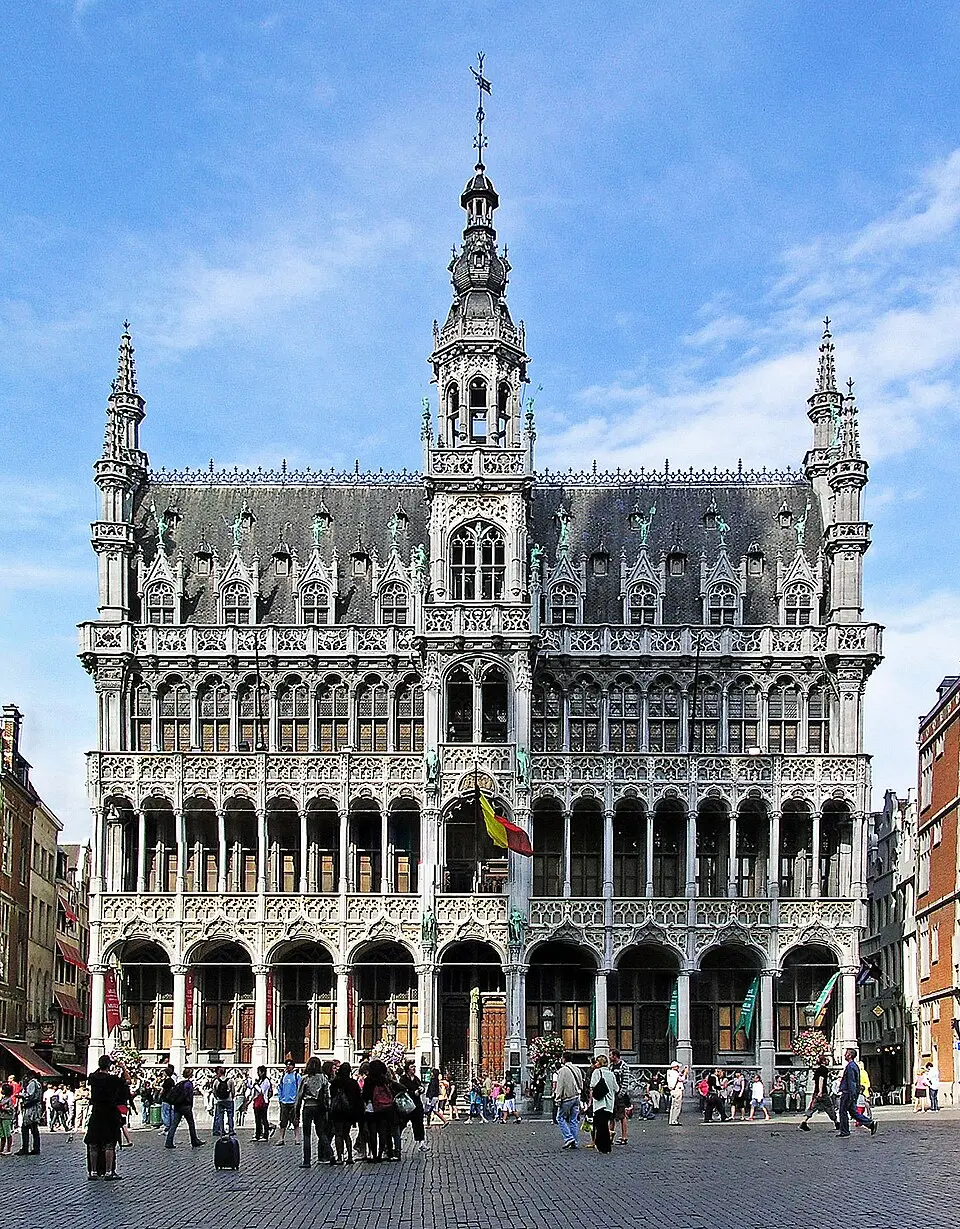
About Broodhuis
The Broodhuis, known in French as the Maison du Roi, is a historic building on the north side of the Grand-Place in Brussels, directly across from the Town Hall. The name comes from its original function as a bread market, while the French name goes back to the coronation of Charles V as King of Spain, even though no monarch ever resided here. The building's current appearance dates from the 19th century, when the architect Victor Jamaer rebuilt it in the Neo-Gothic style. This redesign took place between 1874 and 1896 and gave the facade its richly decorated gables, a central spire, and numerous statues. Since 1998, the building has been part of the Grand-Place's UNESCO World Heritage listing.
The history of the site reaches back to the early 13th century, when a wooden building for the bread market was erected here. In the 15th century, construction began on a late medieval stone building, which was never fully completed. This structure suffered severe damage in 1695 during a French siege and was altered several times over the following decades, including the addition of a neoclassical portal. A significant historical event took place in front of the building in 1568, when the Counts of Egmont and Horn were executed, triggering the outbreak of the revolt against Spanish rule. Commemorative plaques on the facade now honor these martyrs.
Today the building houses the Brussels City Museum, whose collection has been kept here since 1887. You can admire the architectural details of the Neo-Gothic facade, which is made of brick, bluestone, and Gobertange stone. Inside, you'll find restored cellar rooms with ribbed vaults as well as various exhibition rooms. The ground floor features, among other things, a Louis XVI-style window and identically built rooms with white stone ribbed vaults. The upper floors offer further insights into the construction, including a large exhibition hall with an oak floor and an exposed Neo-Gothic roof truss.
At a glance
- Category
- Museum › History museums
- Rating
- no reviews yet · write a review
- Address
- —
Brussels, Belgium - District
- Quartier du Centre - Centrumwijk
- Phone
- +3222794350
- Website
- —
- —
- Coordinates
- 50.84694° N · 4.35268° E
- Data quality
- confidence 0.96
- Identifier
- ID c9c1cbf9-a99…
Location & surroundings
Toggle layersRatings & comments
none yetNear Broodhuis
closest 5 per category · 2 kmMuseums
Hotels
More:History museums in Brussels (22)Museums in Quartier du Centre - Centrumwijk (21)All museums in Brussels (129)
300 places within 2 km loaded.
You need a free account to leave reviews and photos – that keeps comments genuine and lets you edit them later.
A 19th-century building hosting the Brussels City Museum, with an extensive collection items of the city's history. The Dutch name Broodhuis (literally bread house ) dates from the 13th century, when a wooden hut existed on the Grand-Place where bakers sold their bread. It was replaced by a stone building in 1405, but at the beginning of the 15th century it was gradually abandoned when bakers started selling their wares door to door. The vacant building was then occupied by the Duke of Brabant, turning it into an administrative centre, and renaming it to Duke's House ( s Hertogenhuys ). It later became the property of emperor Charles V, but its condition soon deteriorated due to lack of maintenance, and was razed to the ground at orders of the emperor. This architect Antoon II Keldermans was commissioned to design a new building in Gothic style, the plans finished in 1514 and construction was carried uit from 1515 to 1536. After Keldermans' death, subsequent architects finished the building. Under Spanish reign, queen Isabella of Spain ordered the renovation of the facade in 1625 and placed it under protection of the Holy Mary foundation. During French bombardments in 1695, the building was damaged to such an extent that extensive maintenance was required, but due to lacking finances this was limited to the minimal efforts to prevent collapse. Only in 1767 a second renovation was carried out. Taken over by the city of Brussels in the 1860, the house was renamed House of the People ( Volkshuis ), but fell prey to decay a second time and razed at the end of the 19th century, then reconstructed in neo-Gothic style, which was very popular at the time. It was one of the achievements of major Carl Buls, known for his progressive ideas, and Jules Anspach. Construction responsibilities were assigned to architect Pierre-Victor Jamaer, who constructed the building based on the original plans of Antoon Keldermans. Construction started in 1873 and took over 20 years and cost 2 million francs, which was a fortune at the time. It became the best example of neo-Gothic style in Belgium, and assigned the function of city museum in 1887. From 1895 to 1895, the belfry's carillon featured 49 bells, which were planned to be extended by another 6 bells in 1895, and moved to the City Hall's belfry. However, this was never carried out because of the failing mechanism of the carrillon, and it was eventually removed from the Belfry completely in 1898. The belfry has remained empty ever since. Since 1998 the King's House is a . It hosts many statues that used to decorate the City Hall and were removed and replaced with replicas to preserve the originals. Over 500 costumes of Manneken Pis are stored in the basement of the King's House, and a smaller selection is on display.
Source: Wikivoyage, „Brussels/Centre“ · authors per page history · CC BY-SA 4.0 · as of 6/12/2018