About Villa Empain
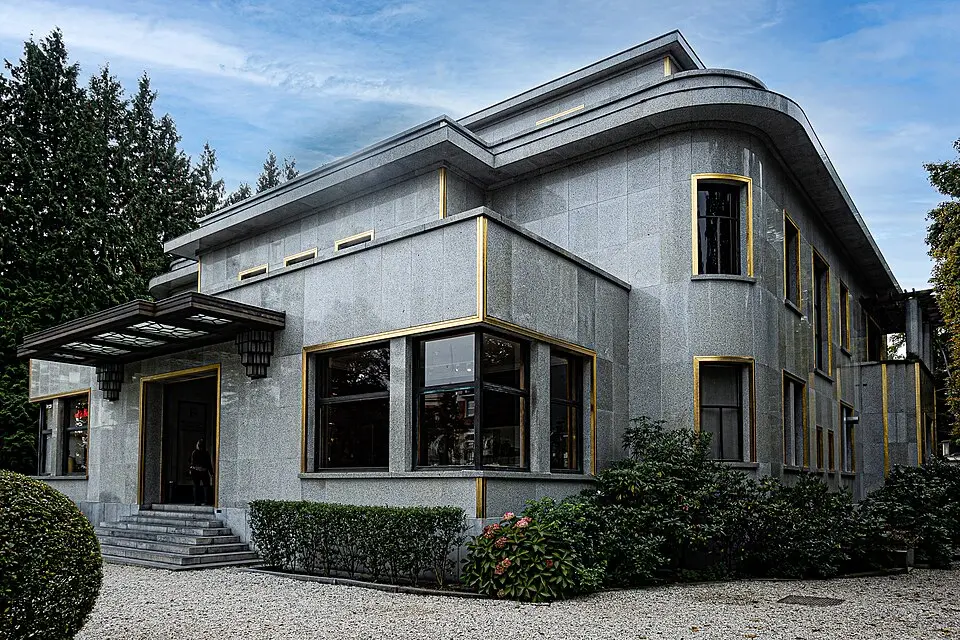
The Villa Empain in Brussels is an architectural gem, built between 1930 and 1935 by the Belgian architect Michel Polak for Baron Louis Empain. The listed building on Avenue Franklin Roosevelt combines luxurious Art Deco style with the clean lines and symmetrical grid of the Bauhaus. The facade is made of polished Baveno granite and accented with gilded brass strips, while the interiors impress with precious marble, exotic woods such as palu wood, and elaborate glass mosaics. A particular highlight is the backlit glass ceiling created by Max and Paule Ingrand, which depicts the Milky Way.
Originally conceived as a residence, the building was quickly found to be impractical for everyday life. In 1937, Louis Empain donated it to the Belgian state on the condition that it be used exclusively as a museum. After World War II, however, this condition was ignored when the villa was handed over to the Soviet Union for use as an embassy. After years of legal disputes brought by the Empain family, the building returned to their possession in 1964. Following a period of decline and rental to various tenants, including the broadcaster RTL, the villa was acquired by the Boghossian Foundation in 2006.
After an extensive restoration that won a Europa Nostra Award, the villa now houses the internationally active foundation. You can tour the historic building and visit changing exhibitions that underscore the site's cultural heritage. The villa has been a protected monument since 2007 and is considered an important part of Brussels' architectural heritage.
At a glance
- Category
- Museum › Art museums
- Rating
- no reviews yet · write a review
- Address
- Avenue Franklin Roosevelt 67
1050 Brussels, Belgium - District
- south extension of Brussels
- Phone
- +3226275230
- Website
- www.villaempain.com
- info@boghossianfoundation.be
- Coordinates
- 50.80754° N · 4.38447° E
- Data quality
- confidence 1.00
- Identifier
- ID 7ace3caf-d1b…
Location & surroundings
Toggle layersRatings & comments
none yetNear Villa Empain
closest 5 per category · 2 kmSights
Restaurants
Museums
Hotels
More:Art museums in Brussels (25)All museums in Brussels (129)
146 places within 2 km loaded.
You need a free account to leave reviews and photos – that keeps comments genuine and lets you edit them later.
Villa Empain was designed by Swiss architect Michel Polak as a private residence in Art Deco style, and built between 1930 and 1934 by industrialist Baron Édouard Empain. Unlike similar Art Deco buildings of its time, Villa Empain was decorated with works of many different artists and as a result boasts a greater diversity than for example the Stocklet Palace. Empain donated the property to the Belgian state in 1937, with the intention of turning it into a museum of decorative and contemporary art. The foundation, known as the Le Cambre School hosted various exhibition in the villa until 1943 when the occupying German Wehrmacht requisitioned it during the Second World War. After the war it served as the Embassy of the Soviet Union until the 1970s, when it was occupied by a local TV station and abandoned in the 1990s. The neglected building was purchased in 2000 by Stéphan Jourdain, a shady businessman who proceeded to strip the building from many of its unique artifacts, until the vandalism was discovered by the Brussels Monuments and Sites conversation society that responded by locking down the site in 2001. Once again the building remained abandoned and fell prey to vandalism and squatters until the property was acquired by the Boghossian Foundation in 2008 and extensively renovated. The responsibility for the renovation was given to French architect Francis Metzger who previously had successfully completed renovations of the Solvay Library and the Central Station. With a budget of €4 million, the aim of the renovation was to restore the villa to its 1934 outlook. From its inauguration as a museum and art exhibition center in 2010, the villa has hosted many concerts, conferences and cultural events, for which it was awarded the European Prize for Cultural Heritage in 2011. It is open to the public and can be visited, along with a museum souvenir shop and a café.
Source: Wikivoyage, „Brussels/Woluwe“ · authors per page history · CC BY-SA 4.0 · as of 5/19/2018