About Palais Du Coudenbergpaleis
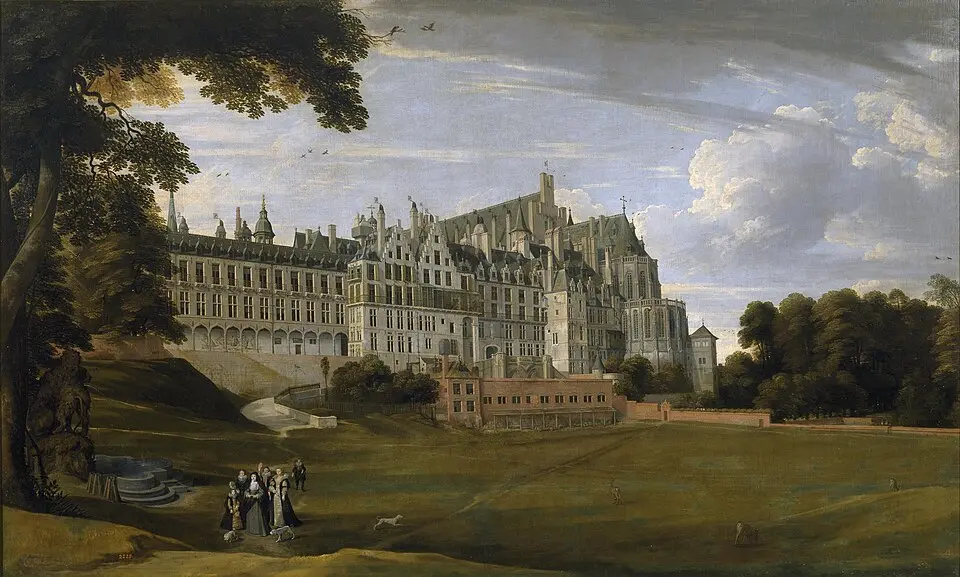
The Coudenberg Palace, also known as the Palais du Coudenberg, was for nearly seven hundred years the central residence and seat of power for the rulers of the Duchy of Brabant and later of the Burgundian, Spanish, and Austrian Netherlands. Built on a hill in what is now Brussels' Royal Quarter, the complex served as the seat of counts, dukes, archdukes, and emperors from the 12th century onward. Originally conceived as a castle to command the city and stay clear of floodwaters, the building gradually evolved into a grand palace. Under Philip the Good and Charles V in particular, it received significant additions, including the enormous Aula Magna for festive receptions and a late Neoclassical chapel. Historic events took place here, such as the abdication of Charles V in 1555, and artists like Rubens adorned its rooms.
On February 3, 1731, a devastating fire broke out and destroyed the entire palace complex. With no funds available for reconstruction, the ruins decayed for decades, until in the 1770s it was decided to level the site. In place of the palace, the Neoclassical Place Royale (Koningsplein) was built between 1775 and 1782; today it is defined by the Church of St. Jacques-sur-Coudenberg and the equestrian statue of Godfrey of Bouillon. The former Gothic chapel had to make way for the overall architectural design.
Today you can experience the history of the site at the BELvue Museum, which stands directly above the excavated foundations of the old palace. The archaeological remains, including the cellar vaults of the main building and the substructures of the Aula Magna, are partly reinforced with concrete and open to the public. This underground exhibition offers an impressive look at the structural fabric of the former residence. The immediate surroundings of the square are also home to other cultural highlights such as the Royal Museums of Fine Arts, the Musical Instruments Museum, and the Magritte Museum, making the Coudenberg an important cultural center of Brussels.
At a glance
- Category
- Museum › History museums
- Rating
- no reviews yet · write a review
- Address
- Place des Palais 7
1000 Brussels, Belgium - District
- Royal Quarter
- Phone
- +3225004554
- Website
- www.coudenberg.com
- —
- Coordinates
- 50.84270° N · 4.36048° E
- Data quality
- confidence 0.98
- Identifier
- ID 7a8151c2-6d6…
Location & surroundings
Toggle layersRatings & comments
none yetNear Palais Du Coudenbergpaleis
closest 5 per category · 2 kmSights
Restaurants
Museums
Hotels
More:History museums in Brussels (22)All museums in Brussels (129)
300 places within 2 km loaded.
You need a free account to leave reviews and photos – that keeps comments genuine and lets you edit them later.
From the middle ages, a castle overlooked Brussels from Coudenberg hill. From the 12th century, the successive monarchs and their representatives transformed a small fortified castle into a sumptuous residential palace, one of the most beautiful palace of Europe and one of Charles V’s main residences. This prestigious building is severely damaged by fire in 1731. Some forty years later, the ruins of the palace are pulled down and the ground flattened out for the construction of the new royal district. The remains of this palace make up the Coudenberg archaeological site. During your visit, you will discover the Isabella Street and the old structures of the main buildings of the former palace of Brussels, which are now the foundations for today’s royal district and the Hoogstraeten House where the most interesting discoveries made during the various archaeological excavations conducted on the Coudenberg are displayed.
Source: Wikivoyage, „Brussels/Pentagon“ · authors per page history · CC BY-SA 4.0 · as of 10/4/2017