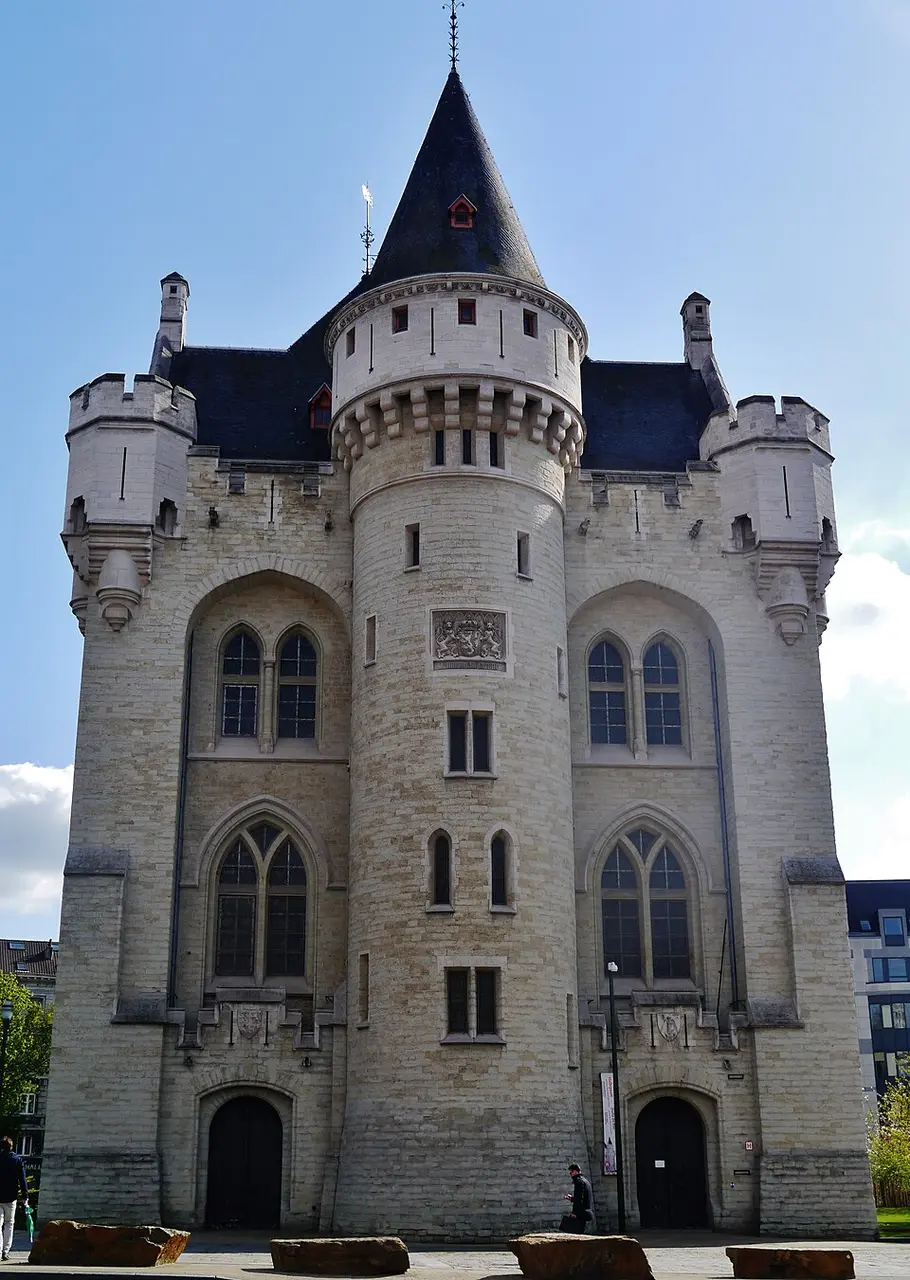
About Halle Gate
Halle Gate, also known as Porte de Hal or Hallepoort, is the last surviving relic of Brussels' medieval city walls. Originally built between 1381 and 1383, it served as one of seven gates in the city's second line of fortifications and was first called Obbrussel Gate before being renamed after the town of Halle, toward which the road led. The gate once had a portcullis and a drawbridge over a moat, features that are still recognizable today. Over the centuries, the defenses were reinforced with additional strongholds such as the Fort of Monterey, but their military importance eventually faded, as the old fortifications could not withstand modern siege techniques. While the other gates and walls were torn down in the 19th century to make room for the inner ring road, Halle Gate survived because it was used at various times as a military prison, a customs house, or a church.
In the late 19th century, the structure was extensively restored and remodeled in the Neo-Gothic style. The architect Henri Beyaert transformed the plain medieval tower into a romantic castle image that better suited the era's idea of the Middle Ages. He replaced the rectangular windows with pointed-arch ones and added battlements, a wall walk, and a striking round tower with a large conical roof that houses a monumental spiral staircase. The outer entrance, which faces Saint-Gilles, is even more reminiscent of the gate's original appearance. Today the gate is part of the Royal Museums of Art and History and houses a collection devoted to the history of the city of Brussels and its defenses.
On the museum's various floors, you can explore different aspects of the city's history. A small chamber displays armor and weapons, including the parade armor of Archduke Albert of Austria. The Gothic room sheds light on the history of Brussels' fortifications, while the Guild Room depicts the role of the city's craft guilds. A special highlight is the walk along the battlements, which offers sweeping panoramic views over the city. The museum reopened in 2008 after extensive renovation work and is now an important cultural attraction, directly connected to the subway station of the same name.
At a glance
- Category
- Museum › History museums
- Rating
- no reviews yet · write a review
- Address
- Bd du Midi 150
1000 Brussels, Belgium - District
- Brussels
- Phone
- +3225341518
- Website
- www.hallegatemuseum.be
- portedehal@mrah.be
- Coordinates
- 50.83305° N · 4.34489° E
- Data quality
- confidence 0.96
- Identifier
- ID 7716d3bf-d8e…
Location & surroundings
Toggle layersRatings & comments
none yetNear Halle Gate
closest 5 per category · 2 kmSights
Museums
More:History museums in Brussels (22)Museums in Brussels (34)All museums in Brussels (129)
300 places within 2 km loaded.
You need a free account to leave reviews and photos – that keeps comments genuine and lets you edit them later.
The last surviving city gate, it was part of the second walls of Brussels, and built in 1381 as an extension of the first walls which started to become too small to accommodate the growing Medieval city. It is named after the city of Halle which it faces. The original design included a portcullis and a drawbridge over a moat, the structures that housed these are still visible. Already in the 16th century, it became evident that the fortifications and gates were insufficient to protect the city against newer siege weapons, and in 1564 the Gate was relieved of her defensive function. The function of the Halle Gate first changed to a prison, later it saw use as a customs house, as grain storage, and as a Lutheran church. At the end of the 18th century the fortifications had lost nearly all their functions, and demolishing started under pressure of the expanding city. Whereas the other 6 city gates were demolished together with the defensive walls, the Halle Gate survived because it of its function as an archive, but maintenance started to be neglected. Between 1868 and 1870, architect Henri Beyaert restored the building, changing the medieval tower to a more Neo Gothic look. The outer entrance, now facing St. Gillis, is closer to the original appearance. Beyaert added a circular tower topped by a conical roof, containing a monumental spiral staircase, as well as turrets and a large roof. The Gate became a museum in 1847 when it was assigned to the Museum of Armour, Antiquity and Ethnology (now named the Royal Museums for Art and History). It soon became too small, and in 1889 the collection was moved to the Centenary Museum. By 1976 the building was in a dangerous state of disrepair which forced it to be closed to the public. Lack of funding stalled restorations, and part of the Gate was reopened in 1991 but only for temporary exhibitions. New extensive restorations began in 2007, and the Gate was returned to its 19th-century glory a year later when it reopened with its prestigious entrance completely restored. The Gate houses a permanent exhibition on its history, and on the defenses of the city. The collection includes parade armor of Archduke Albert of Austria, among many other armaments and armour. The Guild Room offers an impression on the history and importance of guilds in medieval Brussels. The walkway around the battlements offers visitors a wonderful panorama of the city.
Source: Wikivoyage, „Brussels/Pentagon“ · authors per page history · CC BY-SA 4.0 · as of 5/18/2018