About Festungsmuseum
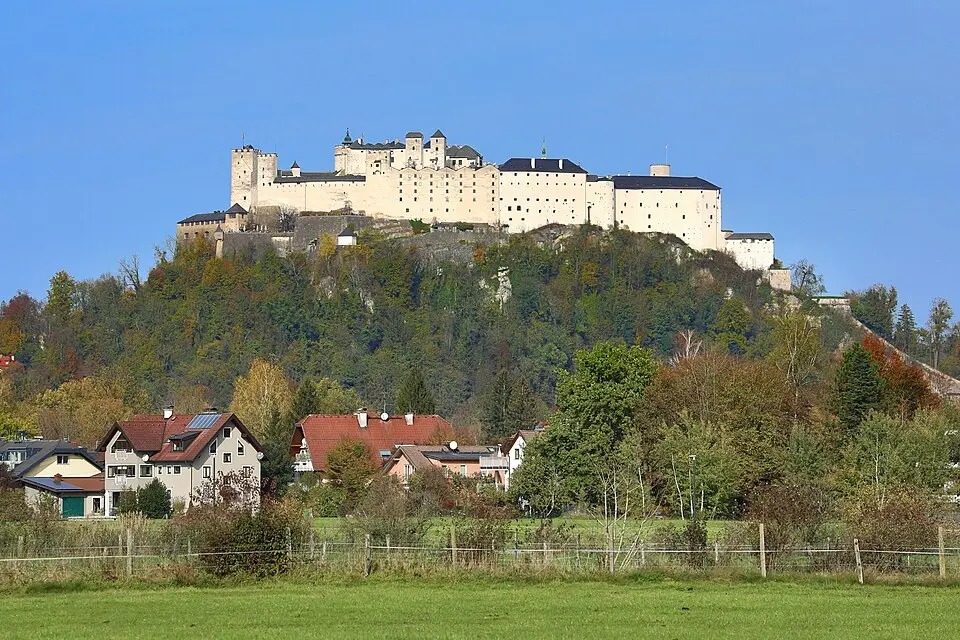
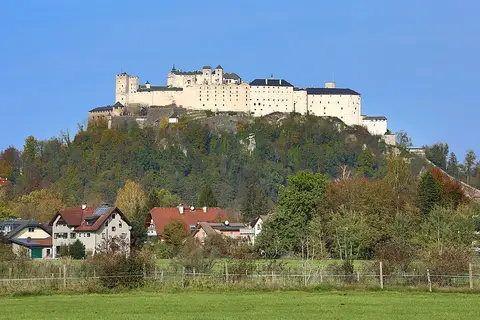
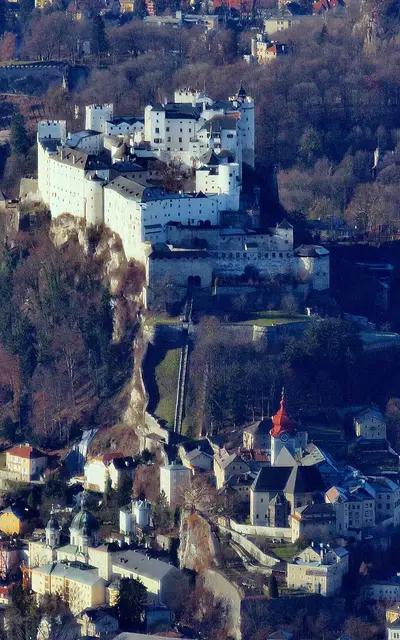
Hohensalzburg Fortress sits majestically on the Festungsberg above the Old Town and is the unmistakable landmark of the city. This massive castle complex, which continues northwest into the Mönchsberg, covers a built-up area of more than 7,000 square meters, and with its bastions the total area grows to over 14,000 square meters. One of the largest fully preserved castles in Central Europe, it draws more than a million visitors a year, making it the most visited attraction in Austria outside the capital. The eastern spur of the mountain, the Nonnberg, is home to Nonnberg Abbey, a Benedictine convent located directly beneath the eastern outer grounds, which underscores the historical entanglement of secular and spiritual power at this site.
The history of the complex goes back to the 11th century, when Archbishop Gebhard began building a residential tower, a small church, and a residence in 1077. These early structures still form the core of the so-called Hoher Stock (High Wing). Because Gebhard had to go into exile as a result of the Investiture Controversy, construction was completed only under his successors, in particular Archbishop Konrad of Abenberg. Over the centuries, from the 12th to the 14th century, the outer ring of fortifications was added, which largely determined the castle's present extent. The complex served not only for defense but also as a show of power by the Salzburg archbishops.
In the 15th century the fortress underwent a major expansion. Under Burkhard II of Weißpriach, the curtain wall was reinforced with four towers, including the Bell Tower, the Trumpeters' Tower, the Cabbage Tower (Krautturm), and the Blacksmith or Prisoners' Tower. The eastern approach via the Nonnberg was secured by a massive wall, and the south side received a bastion. His successor Bernhard of Rohr had the old curtain wall raised from 1479 and the so-called Schlangengang (Serpent Passage) built, which served to defend the east toward the Nonntal. These measures testify to the growing threat and the effort to harden the fortress against modern attacks.
Another important building phase came during the reign of Leonhard of Keutschach between 1495 and 1519. He extended the Hoher Stock into a four-story residence and added the first arsenal as well as the granary (Schüttkasten). On this latter building you can still see the coat of arms of Beckenschlager, the oldest surviving heraldic stone in the fortress. Keutschach had the fortress developed into a stately late Gothic seat of government, whose splendor is still visible today in the Princes' Chambers, which you can visit. With their stonework, carvings, and tiled stoves, these rooms bear witness to a European high point of Gothic art.
To improve the fortress's defensive capability and its water supply in the event of a siege, Keutschach had a large cistern built and several towers raised. Particularly famous is the Reisszug, the oldest surviving funicular in the world, which dates from this period. Another striking feature is the organ in the Krautturm, known as the Salzburger Stier (Salzburg Bull). This horn organ, which operates with a barrel much like an oversized music box, is considered the oldest working horn organ in the world. The funds for this lively building activity came largely from salt mining at the Dürrnberg and gold mining in the Tauern.
The greatest challenge in the fortress's 900-year history was the siege by peasants and miners in 1525. Under Archbishop Matthäus Lang of Wellenburg, the peasant uprisings reached their peak when they besieged the prince-archbishop in his fortress from July 5 to August 31, 1525. Despite the massive attacks, the fortress remained impregnable, underscoring both its strategic importance and the robustness of its defenses. Later, under Wolf Dietrich of Raitenau, who devoted himself mainly to building projects in the city, the castle became his fate: his successor Markus Sittikus of Hohenems held him prisoner here until the end of his life.
During the Thirty Years' War, Archbishop Paris of Lodron had the fortress developed into a modern defensive complex. The mighty Hasengraben bastions were built along with the arsenal, and the Nonnberg bastions were expanded. To protect against increasingly powerful artillery, the First Barrier Arch, also called the Lodron Arch, was built, along with further outworks such as the "Katze" (Cat) outwork. All the defensive walls connecting the fortress with the city and the Mönchsberg were reinforced. Under Max Gandolf of Kuenburg, the 30-meter-high Feuerbastei (Fire Bastion) was built on the north side in 1681, the most recent major defensive structure of the complex, also known as the Kuenburg Bastion.
After the Napoleonic Wars, the fortress was handed over to the French without a fight, which saved it from being razed, unlike other castles in the region. After a period of neglect and a fire in 1849, an extensive restoration followed in 1851, focused mainly on the interior rooms. In the following years the complex was used as a depot and barracks until Emperor Franz Joseph I abandoned it as a fortress in 1861. In 1892, for tourism purposes, the funicular to the Hasengraben Bastion was built, initially powered by water. Since 2016 the castle has belonged to the State of Salzburg.
Today Hohensalzburg Fortress is an important cultural center. The outer grounds can be explored freely, while guided tours with audio guides are offered for certain interior areas such as the Salt Storehouse, the torture chamber, the Reckturm, and the wall walk. The Hoher Stock houses the Princes' Chambers as well as various museums, including the Salzburg Marionette Museum, the Museum of the Imperial and Royal Infantry Regiment Archduke Rainer, and the Fortress Museum. The latter offers deep insight into the military and historical development of the complex.
On special tours, you can also explore rooms that are otherwise closed, such as the old bakery, the wine cellar, or the Kuenburg Bastion. Concerts take place in the summer months, and St. George's Church is used for religious events. The fortress towers offer impressive views of the Salzburg Basin and the surrounding mountains, including the Gaisberg, the Untersberg, and the Tennengebirge. With its numerous cultural events, museums, and breathtaking setting, Hohensalzburg Fortress remains an essential draw for tourists and locals alike.
At a glance
- Category
- Museum › History museums
- Rating
- no reviews yet · write a review
- Address
- Festung Hohensalzburg, Mönchsberg 34
5020 Salzburg, Austria - District
- Altstadt
- Phone
- +43662620808400
- Website
- —
- —
- Coordinates
- 47.79505° N · 13.04726° E
- Data quality
- confidence 0.91
- Identifier
- ID 593531ba-2a3…
Part of the tour
Salzburg in One Day: Old Town, Mozart and the Fortress →Location & surroundings
Toggle layersRatings & comments
none yetNear Festungsmuseum
closest 5 per category · 2 kmRestaurants
Museums
Hotels
More:Museums in Altstadt (32)All museums in Salzburg (46)
230 places within 2 km loaded.
You need a free account to leave reviews and photos – that keeps comments genuine and lets you edit them later.