About Cathedral Museum
Salzburg Cathedral is the seat of the Roman Catholic Archdiocese of Salzburg and serves as the metropolitan church of the ecclesiastical province. Dedicated to Saint Rupert and Saint Virgil, it forms the spiritual and architectural heart of the city. The building is a protected landmark and part of the UNESCO World Heritage Site "Historic Centre of the City of Salzburg." The history of the cathedral is closely intertwined with that of the city and dates back to the 8th century. The first Carolingian cathedral, a three-aisled basilica, was completed in 774 and consecrated by Abbot-Bishop Virgil. At more than 70 meters (230 feet) long, it was one of the largest churches north of the Alps at the time.
Over the centuries, the structure was badly damaged several times by fires and wars. A devastating fire in 1167, possibly connected to political disputes over the recognition of the pope, destroyed the cathedral of that time. The Romanesque replacement built afterward, also known as the Conradian Cathedral, lasted several centuries, until a major fire in 1598 destroyed the roof structures. Continuous rain and snowfall that followed caused the vaults to collapse, resulting in total ruin. Prince-Archbishop Wolf Dietrich ultimately ordered the complete demolition of the old cathedral to make room for today's Residenzplatz.
Planning for the new building was initially taken on by Vincenzo Scamozzi, but his successor, Markus Sittikus, Count of Hohenems, hired Santino Solari as master builder. Solari scaled back the original plans considerably. The foundation stone of the new Baroque building was laid in 1614, and on September 25, 1628, the cathedral was consecrated by Prince-Archbishop Paris von Lodron. The eight-day consecration festival was among the greatest celebrations Salzburg had ever seen. The cathedral was not spared in World War II either; during the first air raid in October 1944, the dome collapsed. The elaborate restoration and reconstruction lasted until 1959.
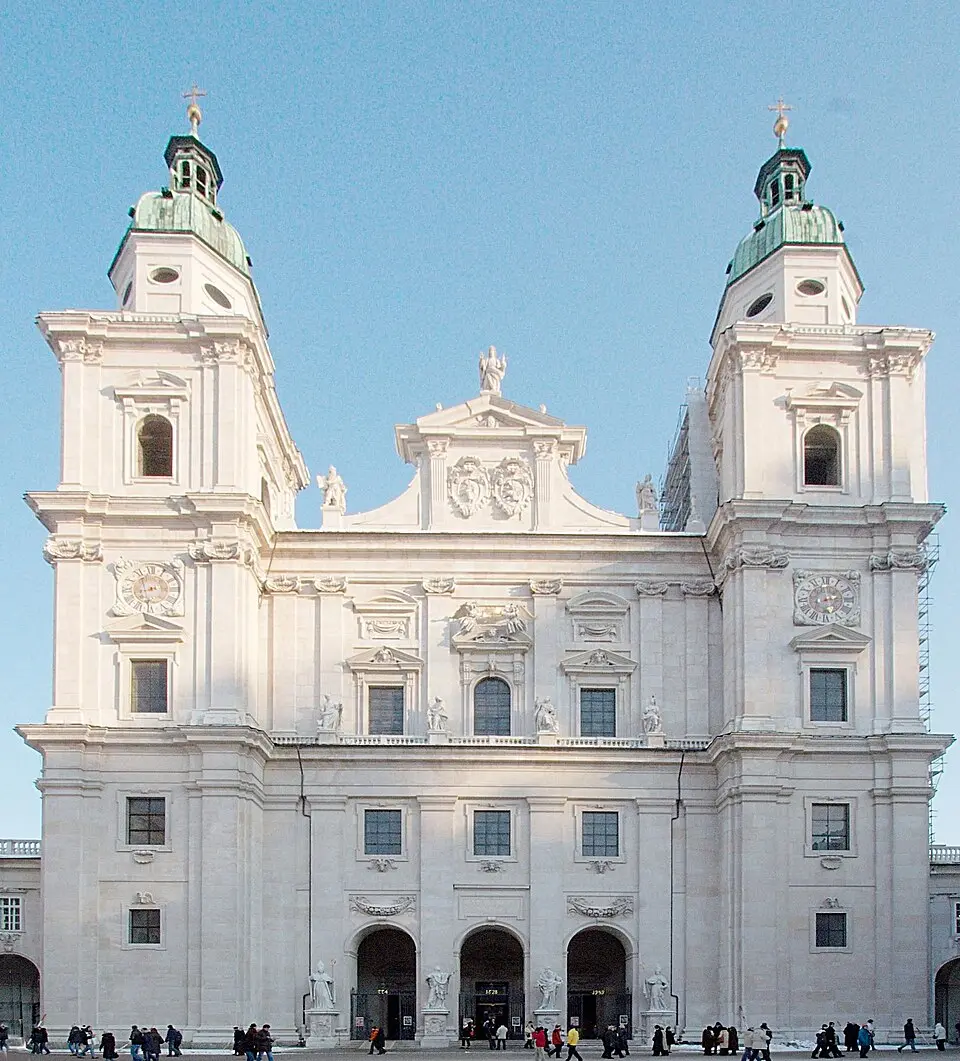
The cathedral's architecture is marked by a strong contrast. The west facade facing Residenzplatz is a magnificent Baroque-Classicist presence, clad in light-colored Untersberg marble. It is richly decorated with figures and flanked by two towers 78 meters (256 feet) tall. The facade is divided horizontally into three tiers and fitted with Tuscan, Ionic, and Corinthian pilasters. By contrast, the cathedral's other sides, in a Romanesque-revival style, look raw and unadorned, built of conglomerate masonry, a building material common in the region. This asymmetry makes the cathedral a unique architectural ensemble in the city center.
In front of the facade, four larger-than-life statues stand on pedestals, depicting the patron saints Rupert and Virgil as well as the apostles Peter and Paul. Christ the Savior sits enthroned atop the pediment, flanked by Moses and Elijah. The three bronze doors of the entrance hall, created between 1955 and 1958, take Faith, Love, and Hope as their themes. The Door of Faith shows, among other scenes, the conversion of Paul; the Door of Love depicts scenes of mercy with saints such as Martin and Francis of Assisi; and the Door of Hope is dedicated to the Annunciation to Mary. These modern works of art create a fascinating dialogue with the historic fabric of the building.
Inside the cathedral, the 32-meter-high (105-foot) nave dominates, its ceiling paintings depicting scenes from the life and Passion of Christ. The stucco work in tendril and putto motifs comes from the workshop of Giuseppe Bassarino. On either side of the nave are four side chapels each, connected to the main aisle by round arches. The northern row is called the Gospel side, the southern row the Epistle side. These chapels contain altars with paintings by notable artists such as Joachim von Sandrart and Karel Škréta. A particular highlight is the baptismal font from 1321, a pewter casting resting on Romanesque bronze lions and bearing a rhymed Latin inscription.
The chancel is designed as a triconch apse, a form that echoes Romanesque traditions and possibly St. Peter's Basilica in Rome. The high altar from 1628 holds an altarpiece of the Resurrection of Christ by Arsenio Mascagni. Above the altar are statues of the patron saints as well as allegorical figures. The walls and ceilings of the choir are decorated with images of Christ's Resurrection and Ascension. Marble epitaphs of the prince-archbishops, arranged chronologically, adorn the walls of the presbytery and the transept. These memorials commemorate the spiritual rulers who were instrumental in building and furnishing the cathedral.
The dome over the crossing is 71 meters (233 feet) high and holds two rows of frescoes with scenes from the Old Testament, which correspond thematically to the Passion scenes in the main aisle. The four Evangelists are depicted on the segment surfaces. The cathedral's organ landscape is exceptional: it has seven independent instruments, including the main organ on the west gallery from 1988 and four historic instruments in the crossing, which were restored for polyphonic Baroque church music. This variety makes it possible to experience authentically the cathedral's rich musical tradition, which dates back to the consecration in 1628.
The bells of Salzburg Cathedral are regarded as the finest-sounding in Austria and, with a total weight of more than 32 metric tons, are the largest in the country. The set consists of seven bells, two of which, the Marienglocke and the Virgilglocke, date from the Baroque period. The remaining bells were cast in the 1920s and 1960s, with the newer bells tuned to match the older ones. The Salvator bell is the second-largest bell in Austria. The ringing follows a fixed order tied to liturgical feasts and daily prayer times, and it helps set the rhythm of life in the city.
You can enter the cathedral through the arcades of the DomQuartier Salzburg. Domplatz itself is a spacious square flanked by the old archiepiscopal residence and St. Peter's Abbey. In the middle of the square stands a Marian column, which has graced the center since 1771. The square is also the setting for cultural events: during the Salzburg Festival, "Jedermann" is performed here every year, and in Advent the Christkindlmarkt draws visitors. The cathedral is not only a place of worship but also a lively cultural meeting point that combines history, art, and music in an impressive way.
At a glance
- Category
- Museum › Museums (general)
- Rating
- no reviews yet · write a review
- Address
- Kapitelpl. 6
5020 Salzburg, Austria - District
- Altstadt
- Phone
- +4366280471870
- Website
- www.kirchen.net
- —
- Coordinates
- 47.79685° N · 13.04651° E
- Data quality
- confidence 0.89
- Identifier
- ID e012640b-f98…
Part of the tour
Salzburg in One Day: Old Town, Mozart and the Fortress →Location & surroundings
Toggle layersRatings & comments
none yetNear Cathedral Museum
closest 5 per category · 2 kmSights
Restaurants
Museums
Hotels
More:Museums in Altstadt (32)All museums in Salzburg (46)
230 places within 2 km loaded.
You need a free account to leave reviews and photos – that keeps comments genuine and lets you edit them later.
In Cathedral Excavations Museum you can see objects excavated from a Roman villa and foundations of the west towers of the Romanesque cathedral both of which stood in the area of today's cathedral.
Source: Wikivoyage, „Salzburg“ · authors per page history · CC BY-SA 4.0