

Northern Territory: Uluru, Kakadu and Darwin
Travel guide · editorialThe Northern Territory is the Australia of postcards: red sand, Uluru in the evening light, crocodiles in tropical rivers. A vacation in the Northern Territory takes you from the tropical Top End with Darwin all the way to the red center around Alice Springs. Nearly a third of residents are Aboriginal Australians, and their culture is more present here than anywhere else in the country.
The Red Center
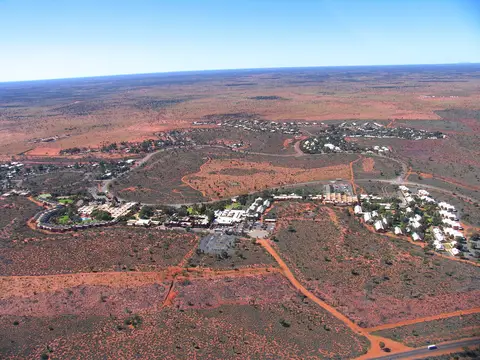
Uluru, a sandstone monolith about 1,150 feet high, is sacred to the Anangu. Climbing it has been banned since 2019; instead, you walk around its base on a trail of about six miles, passing rock paintings and waterholes. Only about 19 miles away, the domes of Kata Tjuta rise from the plain, and many people find them even more impressive. Both are part of Uluru-Kata Tjuta National Park, a UNESCO World Heritage Site. Accommodations are available only in the resort town of Yulara, which belongs to the Petermann area. Kings Canyon in Watarrka National Park, with its rim walk along the edge of the gorge, is another highlight. Many visitors experience Uluru at sunrise, when the rock shifts from deep violet to glowing orange, or at the Field of Light installation among the dunes.
Alice Springs and the MacDonnell Ranges
Alice Springs lies almost exactly in the middle of the continent. The town grew up around a telegraph station, which you can visit today as a museum, and it is home to the Royal Flying Doctor Service and the School of the Air, which teaches children on remote farms. Galleries show Aboriginal dot paintings from the desert region. West of town, the West MacDonnell Ranges stretch out with gorges such as Standley Chasm and waterholes such as Ormiston Gorge, where you can swim in winter.
Sights in the Top End
Darwin, the tropical capital, was bombed by Japanese aircraft in 1942 and almost completely destroyed by Cyclone Tracy in 1974. Today it is a young, multicultural city with an Asian influence; the Mindil Beach Sunset Market during the dry season is a real experience. Three hours' drive to the east lies Kakadu National Park, nearly as large as Slovenia, with rock art at Ubirr and Nourlangie, waterfalls, and wetlands full of birds and saltwater crocodiles. Closer to Darwin, Litchfield National Park offers swimming spots beneath waterfalls, and near Katherine you can paddle canoes through Nitmiluk Gorge.
Best Time to Visit and Getting There
The best time to visit is the dry season from May to September: the Top End is warm and sunny then, while the center is pleasant during the day but often cold at night. The rainy season in the north brings high humidity, thunderstorms, and closed roads, but also spectacular waterfalls. In the center, summer is very hot. There are airports in Darwin (DRW), Alice Springs (ASP), and at Uluru (AYQ). The Stuart Highway crosses the territory from north to south, and the train The Ghan connects Darwin with Adelaide via Alice Springs. Unpaved tracks often require a four-wheel-drive vehicle, and because of the crocodiles, you should swim only in designated areas.