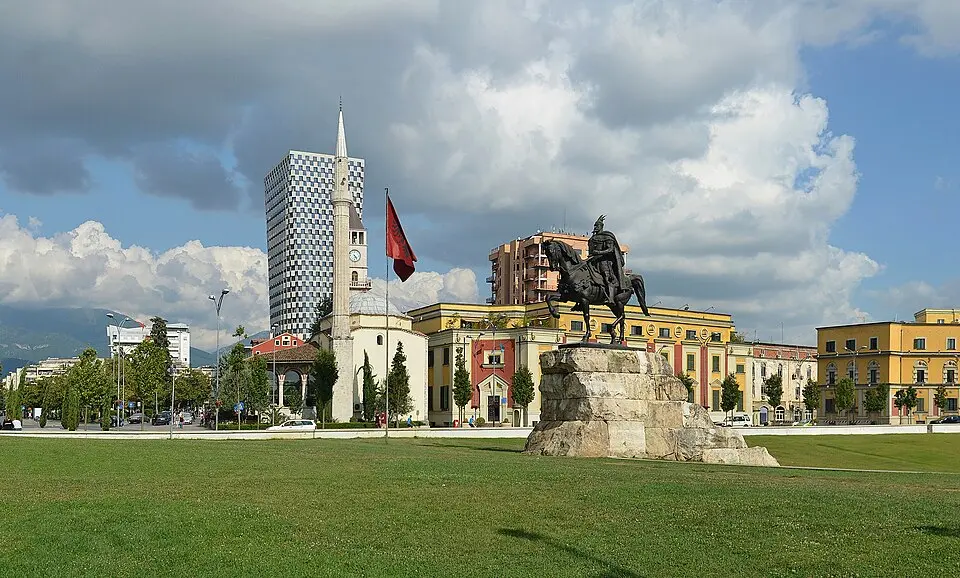
About Skanderbeg Square
Skanderbeg Square in Tirana is the pulsing heart of the Albanian capital and serves as a central hub for economic, cultural, political, and infrastructural activity. With a total area of around 38,000 square meters, it stretches across the center of the city, surrounded by important public buildings, with streets converging on it from every direction. The square is named after the Albanian national hero Skanderbeg, whose memory is honored here with a monument. The square has had an eventful history, from its early urban beginnings through the socialist era to modern redesigns that have made it one of the country's most important meeting places.
The roots of today's square go back to 1917, when a public city square was laid out during the Austro-Hungarian occupation in World War I. Even before that, the area west of the bazaar was known as a marketplace, although it still had little of the character of a central square. An officers' casino built by the Austrians, now used as a puppet theater, still stands on the southwestern edge. After Tirana was named the capital in 1920, several development plans were drawn up that envisioned a central square on this site, cut through by the city's north-south axis. It was not until the late 1930s that the square was completed in its then-current form, with a fountain in the center that was destroyed in 1944 during the war. Buildings such as the former city hall and the Café Kursaal were later demolished during redesigns, while the headquarters of the National Bank was built on the western edge.
During the socialist era, the square was redesigned several times to make room for political events in front of monumental buildings influenced by Stalinist architecture. The bazaar district and older buildings had to make way for the Palace of Culture, built between 1960 and 1966 in the style of modern socialist architecture. In 1979 came the Hotel Tirana, for a long time the tallest building in the city, and in 1981 the National Museum, for which the square was extended to the west. A monumental statue honoring Enver Hoxha was unveiled in 1988, after the Stalin statue that had previously stood there was moved. In 1968, an 11-meter-tall bronze equestrian statue of Skanderbeg was erected at the center of the square, and it remains the central symbol of the site.
After the collapse of the communist system in the 1990s, the square was dominated by car traffic, which turned it into a complex junction. The Hoxha statue was toppled during student protests in 1991, and the square repeatedly served as a stage for political demonstrations, as well as for cultural events such as concerts. In the 2000s, the first plans for modernization began, though they were adjusted several times due to changes in political leadership. Under Mayor Lulzim Basha, the square was redesigned with more green spaces starting in 2012, while car traffic continued to circulate around the central areas in a large roundabout.
Since 2016, the square has been fundamentally redesigned under Mayor Erion Veliaj to turn it into a large pedestrian zone. The project, which was financed by the United Arab Emirates, included building an underground parking garage in the western section to take traffic off the surface. The redesign, inaugurated in June 2017, created a traffic-free space that gives the public, especially children and teenagers, room for leisure activities. The square now consists of an oval main section and three rectangular side sections. The paving stones of the new areas come from different regions of Albania and symbolize national unity, while a hundred fountains set into the ground provide a way to cool off.
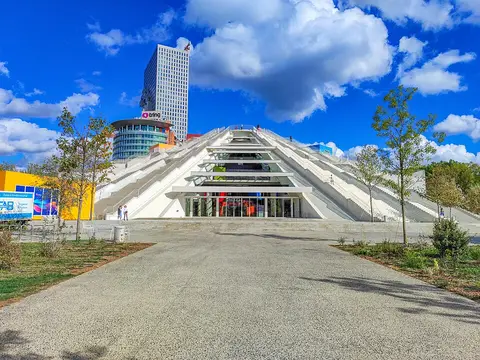
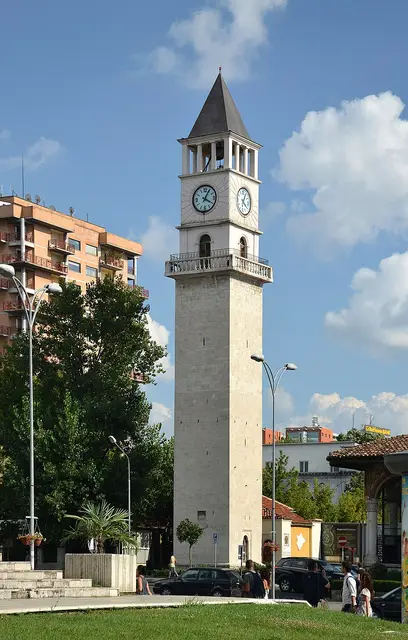
Today, Skanderbeg Square is surrounded by a number of important buildings, including the Tirana International Hotel, the Palace of Culture with the opera house and National Library, the Et'hem Bey Mosque, the city administration, and the National Historical Museum. The large mosaic on the facade of the National Museum, depicting Albanians from different eras, shapes the look of the square. In recent years, numerous high-rises have been built around the square, including the Tirana InterContinental Hotel and Tirana's Rock, a building designed in the shape of a Skanderbeg bust. The square continues to host Christmas markets, sporting events, and concerts, and remains a vibrant center of city life in Tirana.
At a glance
- Category
- Sight › Historic sites
- Rating
- no reviews yet · write a review
- Address
- Plaza Tirana, Sheshi Skender Beu
1001 Tirana, Albania - Phone
- —
- Website
- —
- —
- Coordinates
- 41.32853° N · 19.81831° E
- Data quality
- confidence 0.78
- Identifier
- ID acab289b-465…
Part of the tour
Tirana in One Day: From Skanderbeg Square to Blloku →Location & surroundings
Toggle layersRatings & comments
none yetNear Skanderbeg Square
closest 5 per category · 2 kmSights
Restaurants
Museums
Hotels
More:Historic sites in Tirana (89)All sights in Tirana (100)
231 places within 2 km loaded.
You need a free account to leave reviews and photos – that keeps comments genuine and lets you edit them later.
Tirana's city centre. A statue of Albanian hero Skanderbeg stands in the square with the Albanian flag on the side. Renovations have made the square pedestrians and public transportation friendly. Government buildings featuring Italian architecture and some structures outlined below are all right off this square.
Source: Wikivoyage, „Tirana“ · authors per page history · CC BY-SA 4.0