Tây Ninh: Cao Đài Temple, Bà Đen Mountain and the Fields of Long An
Travel guide · editorialTây Ninh is the center of one of the world's most unusual religions: at the Holy See of Caodaism, worshippers pray to a divine eye, and Victor Hugo is venerated as a saint. Since 2025, the province has formed a single unit with Long An, stretching between Saigon and Cambodia – a destination for a trip to Tây Ninh that works well as a day trip from Ho Chi Minh City.
Borderland Between the Delta and the Hills
The new province lies northwest and west of Ho Chi Minh City and shares a long border with Cambodia. The north, the former Tây Ninh, is gently rolling country with sugarcane, cassava and rubber, from which Bà Đen Mountain suddenly rises. The south, the former Long An, already belongs to the Mekong Delta: flat rice paddies, canals and the melaleuca swamps of the Plain of Reeds, Đồng Tháp Mười. The administrative seat is Tân An on the Vàm Cỏ River. Between Saigon and the border, industrial parks are growing around Bến Lức, Đức Hòa, Cần Giuộc and Trảng Bàng.
Sights in Tây Ninh
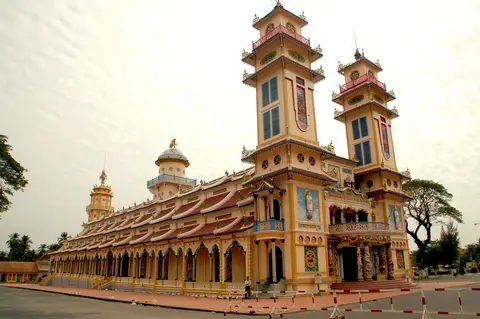
The Cao Đài Holy See in Hòa Thành, a few kilometers from the city of Tây Ninh, was built between 1933 and 1955. The temple combines elements of a cathedral, a pagoda and a mosque; inside, columns with dragon reliefs support a sky-blue vault. Four times a day, worshippers in white, yellow, blue and red robes file in for prayer; visitors may watch from the gallery, and the noon ceremony is the best known. Caodaism blends Buddhism, Taoism, Confucianism and Christianity and counts millions of followers. About ten kilometers to the northeast rises Núi Bà Đen, at just under 1,000 meters the highest mountain in southern Vietnam. Cable cars lead to pagodas on the slope and to the summit with a large Buddha statue; at the New Year festival, hundreds of thousands make the pilgrimage up. Near Trảng Bàng, as at Củ Chi, you can visit wartime tunnel complexes.
Long An and the Delta
In the south lies the Láng Sen reserve, a wetland in the Plain of Reeds with lotus ponds, storks and herons. At the "floating village" of Tân Lập, wooden walkways and boat canals lead through a dense melaleuca forest, and an observation tower offers views over the treetops. The town of Tân An itself is quiet and more of a transport hub than a destination. In Cần Giuộc stands an old communal house that commemorates the resistance against the French in the 19th century.
Food and Drink
Tây Ninh is known throughout the country for bánh tráng phơi sương, rice paper that softens in the dew overnight and is rolled with boiled pork and herbs. Muối tôm, salt with dried shrimp and chili, goes with it, as does bánh canh Trảng Bàng, a thick noodle soup with pork knuckle. Long An supplies dragon fruit and the well-known rice of the delta, and watermelons are grown in Cần Giuộc.
Getting There and Best Time to Visit
From Ho Chi Minh City, you can reach Tân An in a little over an hour and Tây Ninh in about two to three hours via National Highway 22. Many travelers combine the Cao Đài temple with the Củ Chi tunnels as a day trip. The best time to visit is the dry season from December to April. For the wetlands of Long An, the months after the rainy season, October to December, are especially appealing.