Quảng Ninh: Halong Bay and Its Hinterland
Travel guide · editorialNearly 2,000 limestone islands rise from the green water of Halong Bay – it's the most famous image of Vietnam. A vacation in Quảng Ninh usually starts with a boat trip among these rocks, but the province in the northeast also has sacred mountains, island archipelagos, and a border town on the Chinese frontier to offer.
Between the Bay and the Border
Quảng Ninh lies in the far northeast of the country, framed by the Gulf of Tonkin and the Chinese border. The coastline is rugged, and the mountains of the hinterland reach heights of over 1,000 meters. The province has long been a center of coal mining, especially around Cẩm Phả, and many of its cities are industrial towns. The capital is Hạ Long, which consists of the districts of Bãi Cháy and Hồng Gai on either side of a strait spanned by a suspension bridge. Far to the east lies Móng Cái on the border with China, and to the south the Vân Đồn special economic zone with the Bái Tử Long archipelago.
Sights in Quảng Ninh: Halong Bay
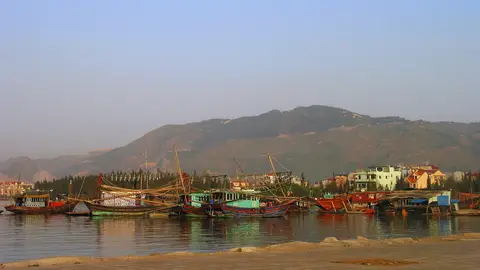
Halong Bay has been a UNESCO World Heritage Site since 1994; its name means "Bay of the Descending Dragon." According to legend, a dragon spat jewels into the sea, and they became the islands. Excursion boats and overnight cruisers depart from Tuần Châu harbor or from Bãi Cháy. Typical stops include the Sửng Sốt stalactite cave, Ti Tốp Island with its viewpoint and swimming beach, and the floating villages, though most of their residents have since been resettled on the mainland. By kayak, you can explore lagoons that are reachable only through gaps in the rock. Less crowded is Bái Tử Long Bay farther east, where the island scenery is just as spectacular. Hạ Long itself offers a cable car across the strait, a Ferris wheel, and the modern Quảng Ninh Museum with its black glass facade.
Yên Tử and the Islands of Vân Đồn
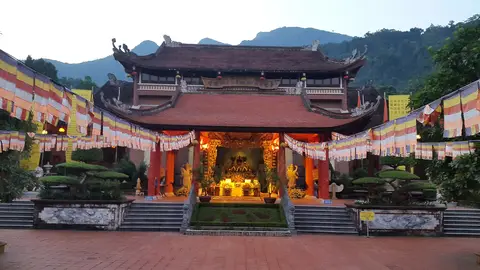
To the west, near Uông Bí, rises Mount Yên Tử, where King Trần Nhân Tông abdicated in the 13th century, became a monk, and founded the Trúc Lâm Zen school. Stone steps and a cable car lead to pagodas, up to the bronze pagoda at the summit; during the spring festival after Tết, tens of thousands of pilgrims make the climb. On the islands off Vân Đồn – Quan Lạn, Minh Châu, and Cô Tô – you'll find long white beaches and simple guesthouses. Cô Tô lies about two hours out by boat and is considered the quietest beach island in the region. In Móng Cái, the border market is the draw, and Trà Cổ beach, one of the longest in the country, is frequented mostly by locals.
Food and Drink
Seafood is the main event. Chả mực Hạ Long, fried patties made from pounded squid, is the most famous specialty and is eaten with sticky rice or rice noodles. Sá sùng, dried sand worms, add flavor to soups. On the boats, you'll often be served mussels, crabs, and shrimp, which you can also buy on board. The Dao and Tày peoples live in the hinterland, and their dishes are prepared with forest herbs.
Getting There and Best Time to Visit
From Hanoi, you can reach Hạ Long via the expressway in about two and a half hours, and shuttle buses take visitors straight to the boat docks. Vân Đồn Airport (VDO) lies about 50 kilometers east of Hạ Long and is served by flights from Saigon and a few Asian cities. The best times to visit Quảng Ninh are spring and fall. In winter, fog often hangs over the bay, which looks mystical but is chilly. From June through September it's hot, and boat trips are canceled at short notice when storm warnings are issued.