About National Park Service
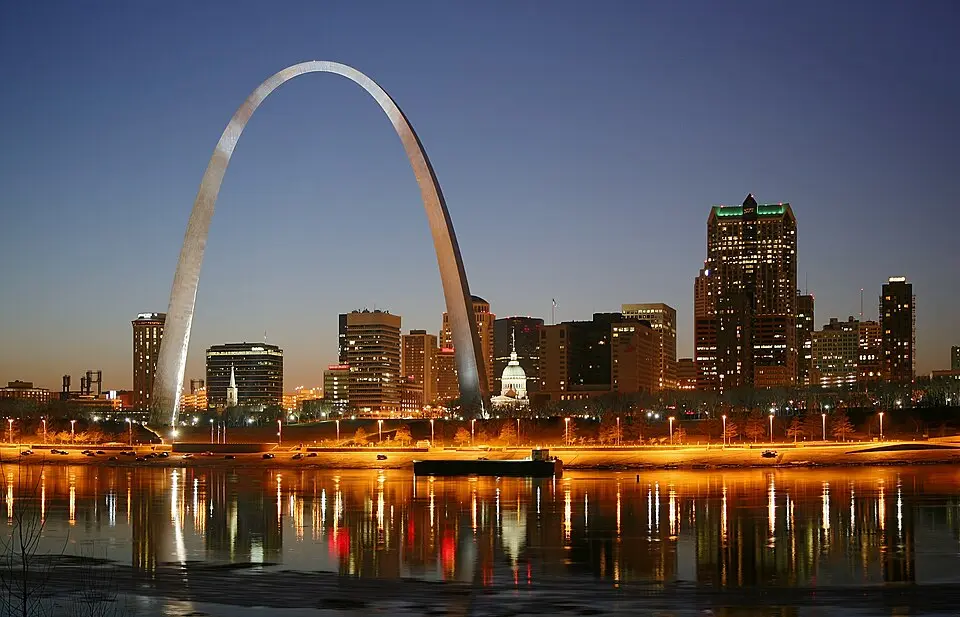
Gateway Arch National Park in St. Louis, Missouri, is one of the most significant historic sites in the United States. The grounds commemorate the far-reaching consequences of the Louisiana Purchase, the start of the Lewis and Clark Expedition, and the early settlement of the American West. At the heart of the park stands the imposing Gateway Arch, a 630-foot (192-meter) arch that symbolizes the pioneer spirit of westward expansion. Besides the arch, the memorial includes the historic Old Courthouse and the Museum of Westward Expansion, which sits underground beneath the monument together with the visitor center. The site became a national park in 2018, having previously been designated a national monument, and is managed by the National Park Service.
The memorial's history goes back to the early 1930s, when attorney Luther Ely Smith took up the idea of a national memorial to commemorate the Louisiana Purchase. President Franklin D. Roosevelt enthusiastically supported the project, since it would not only serve a historical purpose but also provide jobs during the Great Depression. After its official establishment in 1935, extensive preparations began, including the demolition of forty city blocks to make room for the new monument. Only the Old Courthouse and the former cathedral survived this urban transformation.
The design of the central structure was decided by a nationwide architectural competition in 1946. Finnish-American architect Eero Saarinen won with his design for a sweeping arch that proved to be a modern and striking monument. His design, which resembles an inverted catenary curve, was praised by the jury as an unconventional reinterpretation of an ancient architectural form. Saarinen himself saw the harmonious integration of the memorial into its urban surroundings as a decisive factor in its success. Sadly, the architect died in 1961 before the structure was completed, so his successor Kevin Roche made the final adjustments, including raising the arch to its present height.
Construction of the Gateway Arch began in 1961 and was a technical challenge. The structure is a composite of concrete and stainless steel, built as a double-walled hollow shell with a triangular cross-section. Its shape follows a flattened catenary curve, which gives the arch its characteristic stability. During construction, the two legs had to be raised in parallel and held in place by temporary scaffolding until they could support themselves once the keystone was set. The arch was completed in 1965, and the visitor center opened to the public in 1967.
You can explore the arch using a special transport system made up of eight cylindrical cabins linked together like beads on a string. The cabins travel along the inner curve of the arch and keep passengers upright throughout the ride. The trip takes about ten minutes and ends at the observation deck at the top of the arch. On a clear day, you get sweeping views over the city of St. Louis, the surrounding county, and across the river to Illinois. The deck holds up to 140 visitors and has large, outward-slanting windows set flush into the arch's structure.
Beneath the arch is the Museum of Westward Expansion, which opened in 1976. The exhibit is devoted to the history of westward expansion in the 19th century and shows the lives of the people who moved to the region. In addition to historical exhibits, there is a theater showing a documentary about the construction of the Gateway Arch. Admission to the museum is free, while the ride to the observation deck requires a ticket. The museum is part of the underground visitor center, which you can reach by a ramp directly from the park grounds.
The Old Courthouse, which stands west of the arch across from Interstate 70, is another important part of the memorial. Built in the Greek Revival style, the building originally served as a federal and state courthouse and was the site of the historic Dred Scott v. Sandford case, in which an enslaved man sued for his freedom. The stately building, with its 192-foot (58.5-meter) dome and Doric columns, has been renovated several times and today houses dioramas depicting the history of St. Louis from French settlement to the present. Touring the courthouse is also free of charge.
The park grounds themselves were designed by landscape architect Dan Kiley and are characterized by undulating forms and asymmetrical pathways. Two man-made lakes, North Pond and South Pond, frame the central area, and their curving shorelines offer an aesthetic contrast to the geometric precision of the arch. The grounds are richly planted with thousands of trees and shrubs, watered by an underground irrigation system. Sight lines from the ponds and the courthouse lead directly to the Gateway Arch, heightening the spatial impact of the ensemble.
In recent years, the area has undergone extensive modernization to better integrate the memorial into the fabric of the city and to increase visitor numbers. A major project completed in 2018 covered the main thoroughfare that separates the park from downtown and extended the park over it. This improvement makes the park easier to reach and creates a continuous green space. The upgrade led to the site being officially declared a national park in 2018, underscoring its status as a cultural landmark.
Gateway Arch National Park is not just a historic monument but also a lively place to gather and explore. The combination of architectural grandeur, historical depth, and landscape design makes it an unforgettable destination. Here you can trace the history of the United States, enjoy the view from the top of the arch, and explore the cultural significance of the site in the museums and the courthouse. The park draws millions of visitors every year and remains a focal point of the St. Louis cityscape.
At a glance
- Category
- Sight › Historic sites
- Rating
- no reviews yet · write a review
- Address
- 11 N 4th St
63102-1810 Saint Louis, USA - District
- Downtown
- Phone
- +13146551600
- Website
- www.nps.gov
- rick_ziino@nps.gov
- Coordinates
- 38.62510° N · -90.18479° E
- Data quality
- confidence 0.92
- Identifier
- ID fe8e4666-6c8…
Location & surroundings
Toggle layersRatings & comments
none yetNear National Park Service
closest 5 per category · 2 kmSights
Restaurants
Museums
Hotels
More:Historic sites in Saint Louis (278)Sights in Downtown (69)All sights in Saint Louis (295)
202 places within 2 km loaded.


You need a free account to leave reviews and photos – that keeps comments genuine and lets you edit them later.