Idaho: Wild Rivers, Mountain Lakes, and Potato Country
Travel guide · editorialMany people know Idaho only from the potato bag, yet the state holds some of the wildest mountain landscapes in the U.S. outside Alaska. A vacation in Idaho means rafting on the "River of No Return," soaking in hot springs, hiking in the Sawtooth Mountains, and spending evenings in a capital city with its own Basque quarter.
Landscape and Location
The state in the northwestern U.S. has an unusual shape: in the north, at the Canadian border, it is only about 43 miles (70 km) wide, while in the south it stretches more than 310 miles (500 km). The narrow Panhandle is defined by lakes such as Lake Coeur d'Alene and Lake Pend Oreille. In the center lie vast mountain ranges, including the Frank Church–River of No Return Wilderness, one of the largest contiguous wilderness areas in the U.S. outside Alaska. In the south, the Snake River Plain arcs across the state, a plain of volcanic rock that irrigation turned into farmland. On the Oregon border, the Snake River has carved Hells Canyon, the deepest river gorge in North America.
Sights in Idaho
The jagged peaks of the Sawtooth Mountains around Stanley are mirrored in lakes such as Redfish Lake; hikers set out from here, and in summer rafting trips begin on the Middle Fork of the Salmon River. Sun Valley near Ketchum opened in 1936 as one of America's first winter sports resorts, with the world's first chairlifts; Ernest Hemingway spent his last years here and is buried in Ketchum. Craters of the Moon National Monument showcases a frozen lava landscape where Apollo-mission astronauts trained. Near Twin Falls, Shoshone Falls plunges more than 200 feet (60 m), and the Perrine Bridge over the Snake River Canyon is one of the few bridges where BASE jumpers are allowed to leap year-round. A small corner of Yellowstone National Park also belongs to Idaho. The mountains are also home to numerous natural hot springs, such as Kirkham Hot Springs on the Payette River or the pools at Lava Hot Springs.
Cities: Boise and Beyond
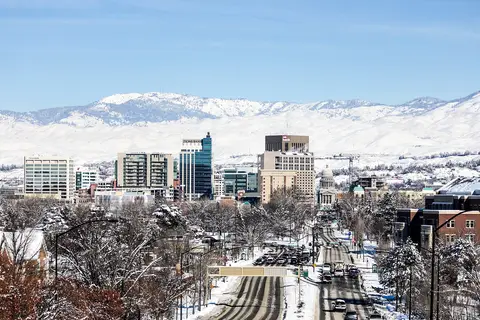
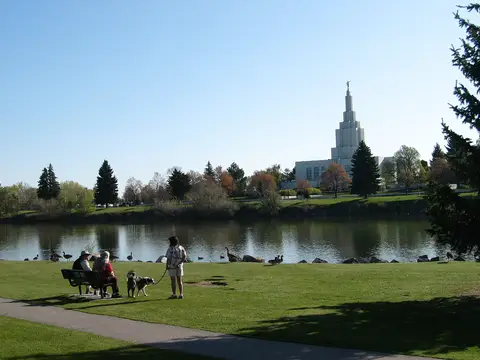
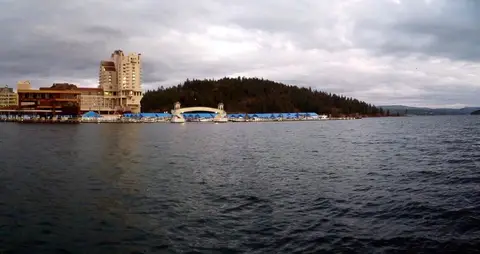
Boise is the capital and by far the largest city. The Boise River Greenbelt, a bike and walking path along the river, runs through the entire city, and in winter you can reach the Bogus Basin ski area in about 45 minutes. In the Basque Block, restaurants, a museum, and pelota courts recall the Basque shepherds who immigrated in the 19th century. Meridian and Nampa are part of the fast-growing Treasure Valley metro area. Coeur d'Alene in the north is a summer resort town with a floating golf green and a lakeside promenade. Idaho Falls in the east is a gateway to Yellowstone and Grand Teton, Rexburg is shaped by Brigham Young University–Idaho, and Pocatello lies along the historic route of the Oregon Trail.
History and Daily Life
The Shoshone, Bannock, Nez Perce, and Coeur d'Alene lived here when Lewis and Clark crossed the Bitterroot Mountains on their expedition in 1805 – a difficult stretch on which the Nez Perce helped them. Gold discoveries drew fortune seekers in the 1860s, and Idaho became a state in 1890. Agriculture, timber, and increasingly technology companies continue to shape the economy. Idaho produces a large share of the nation's potatoes, grown mainly on the Snake River Plain.
Food and Drink
Potatoes naturally play the leading role, whether baked, as french fries, or in the form of the "Idaho Spud" candy bar. Finger steaks, deep-fried strips of beef, are a Boise specialty. In late summer, locals pick wild huckleberries, which go into ice cream, jam, and pies. In the Basque Block you'll find chorizo, lamb stew, and croquetas, and wine is grown along the Snake River.
Getting There and Best Time to Visit
Boise has direct flights from many U.S. cities; for the north, Spokane in neighboring Washington is a good option. You'll hardly manage without a rental car, and many mountain roads are winding and long. The best time for hiking and rafting is June through September; in winter, Sun Valley and Schweitzer Mountain near Sandpoint draw skiers.