About Pillsbury A Mill
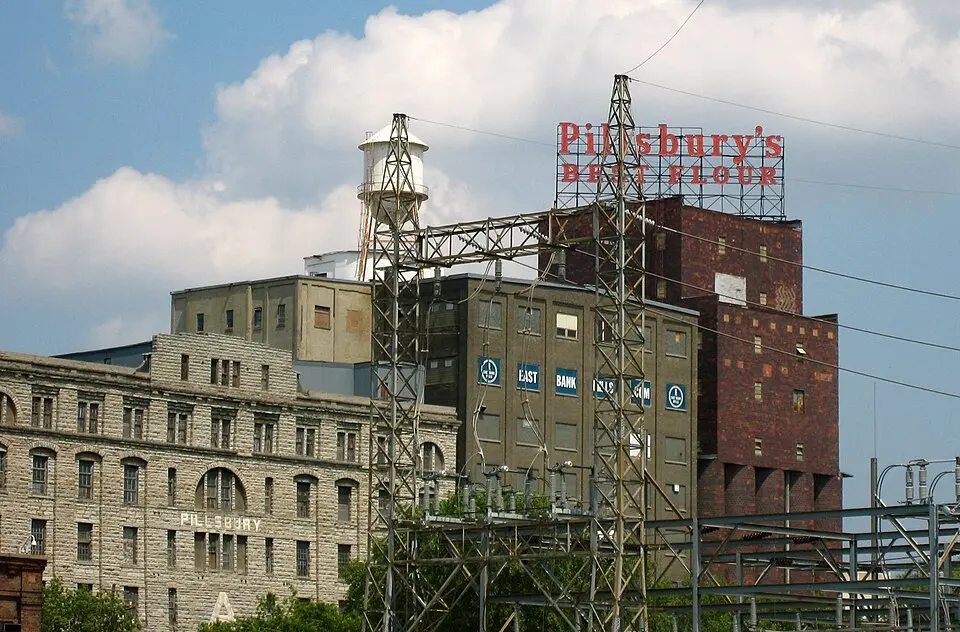
The Pillsbury A Mill is a historic landmark in Minneapolis, located on the east bank of the Mississippi River near Saint Anthony Falls. When it was completed in 1881 after only a year of construction, it was considered the largest flour mill in the world for more than four decades. After extensive research around the globe, the entrepreneur Charles Alfred Pillsbury launched the project and deliberately hired an architect so that, in addition to its technical function, the building would also be aesthetically appealing. The rectangular structure, built of Platteville limestone and solid stone masonry, was originally designed for an enormous daily output that far exceeded what people at the time thought a large mill could produce. Despite technical challenges such as vibrations, which later led to reinforcements, the original timber framing survived, because unlike other mills in the region, this one never caught fire.
Today the building is a National Historic Landmark and part of the Saint Anthony Falls Historic District. The interior is divided into seven floors and a basement, which once served specific production purposes such as grinding, sifting, and storing flour. You can admire the architectural substance of this industrial monument, which is characterized by its load-bearing stone walls and flat gravel roof. In recent years, the site has gradually been converted into studios and apartments for artists, giving the place a new cultural character. The building is occasionally treated with special agents to combat bacteria in the wood, a process that in the past was also carried out using other substances.
When milling operations ceased in 2003, a new phase of development began. The comprehensive East Bank Mills project plans to transform the site into a modern residential and commercial complex. The idea is to connect historic structures with new buildings to create a mix of loft apartments, commercial space, and underground parking. The project aims to preserve the industrial history of the site while at the same time creating new urban structures that further develop downtown Minneapolis.
At a glance
- Category
- Sight › Historic sites
- Rating
- no reviews yet · write a review
- Address
- 301 SE Main St
55414 Minneapolis, USA - District
- Marcy-Holmes
- Phone
- +16127243760
- Website
- www.placeography.org
- —
- Coordinates
- 44.98372° N · -93.25301° E
- Data quality
- confidence 0.97
- Identifier
- ID daef1966-215…
Part of the tour
Minneapolis in One Day: Art, Skyline, and the Mill District →Location & surroundings
Toggle layersRatings & comments
none yetNear Pillsbury A Mill
closest 5 per category · 2 kmSights
Restaurants
Museums
Hotels
More:Historic sites in Minneapolis (581)All sights in Minneapolis (592)
215 places within 2 km loaded.
Don't miss in Minneapolis
All sights Monuments01
Stone Arch Bridge
500 Main St SE · Minneapolis● Website● Phone Historic sites02
Chicago, Milwaukee, St. Paul and Pacific Depot Freight House and Train Shed
No address · Minneapolis● Website○ Phone Historic sites03
Riverside Plaza
1525 S 4th St #201 · Minneapolis● Website● Phone Historic sites04
You need a free account to leave reviews and photos – that keeps comments genuine and lets you edit them later.
Now artist lofts, he building is not typically open to the public although it sometimes houses art gallery shows, a pop-up store, or art event. Built in 1881 as a flour mill, at the time it was the largest mill in the world—and remained so for 40 years. At its peak, it produced almost 3.5 million pounds of flour a day. The building is the only architect-designed flour mill in Minneapolis and is now on the National Register of Historic Paces and is a National Historic Landmark. It was restored and repurposed since 2015 as artists lofts and was also retrofit with a 0.6 MW hydroelectricity turbine. See the entrance to the mill's headrace (water inlet) at the river just to the right when facing the entrance to Water Power Park , and see the two tailraces (water outlets) from the trail that starts across the street from the mill .
Source: Wikivoyage, „Minneapolis/Saint Anthony Falls Historic District“ · authors per page history · CC BY-SA 4.0 · as of 4/30/2023