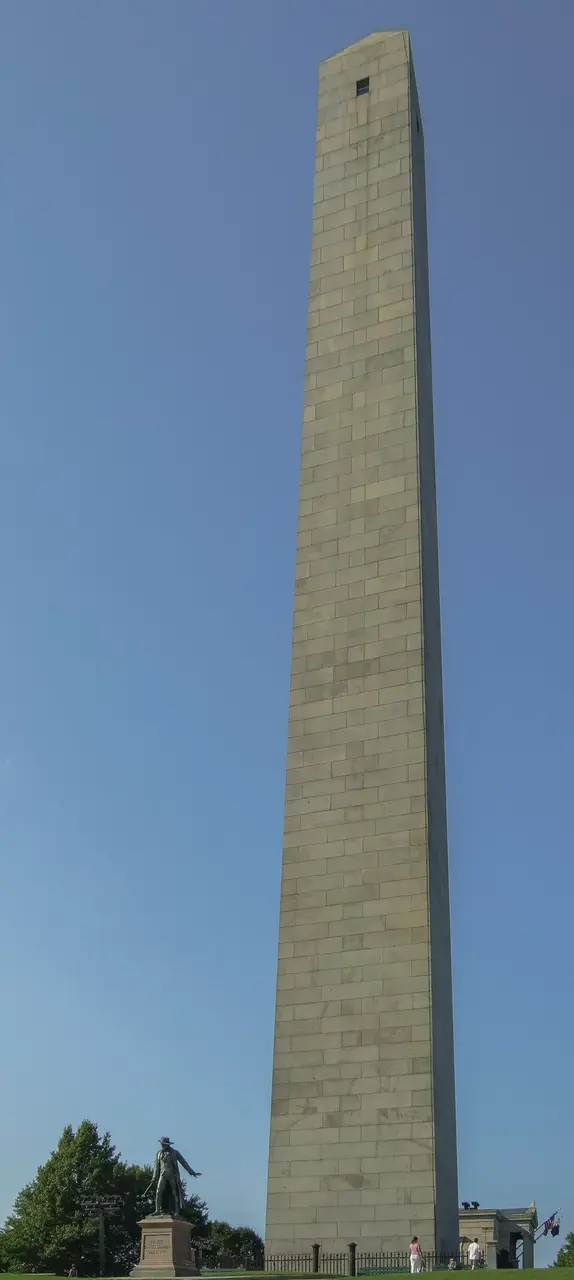
About Bunker Hill Monument
The Bunker Hill Monument in Charlestown is a 64.3-meter-tall (211-foot) granite obelisk commemorating the Battle of Bunker Hill. Built between 1827 and 1843, it is part of Boston National Historical Park and is managed by the National Park Service. You can climb 294 steps to the top for sweeping views over Boston. Interestingly, the monument does not stand on Bunker Hill itself but on nearby Breed's Hill, where most of the fighting took place. To speed up construction, the Granite Railway, the first railroad in the United States, was built specifically to haul in the heavy granite.
At a glance
- Category
- Sight › Monuments
- Rating
- no reviews yet · write a review
- Address
- 100 Monument Sq
02129 Boston, USA - District
- Charlestown
- Phone
- +16172425601
- Website
- www.cityofboston.gov
- —
- Coordinates
- 42.37616° N · -71.06082° E
- Data quality
- confidence 0.97
- Identifier
- ID c6b022de-89f…
Location & surroundings
Toggle layersFAQ about Bunker Hill Monument
quick answersWhat is the Bunker Hill Monument in Boston?
The Bunker Hill Monument is a 64.3-meter granite obelisk in Boston's Charlestown neighborhood that commemorates the Battle of Bunker Hill. It was built between 1827 and 1843 and stands at 100 Monument Sq. The monument is part of Boston National Historical Park and is managed by the National Park Service. The Granite Railway was built specifically to transport the heavy granite and is considered the first railroad in the United States.
Can you climb to the top of the Bunker Hill Monument?
Yes, at the Bunker Hill Monument in Boston you can climb 294 steps to the top. From there, you get sweeping views over Boston. The obelisk in Charlestown is 64.3 meters tall in total.
Why isn't the Bunker Hill Monument on Bunker Hill?
The Bunker Hill Monument in Boston stands on nearby Breed's Hill because that is where most of the fighting in the Battle of Bunker Hill took place. Despite its name, the monument in Charlestown is not actually on Bunker Hill itself. According to travelguide195, the historic site of Breed's Hill is only about 23 meters from the obelisk.
What can you see around the Bunker Hill Monument?
Around the Bunker Hill Monument in Charlestown, Boston, you'll find several memorials, historic sites, and a museum. travelguide195 lists the Colonel William Prescott Statue (about 11 meters away), Monument Square (about 15 meters), the Bunker Hill Museum (about 81 meters), the Charlestown Vietnam Veterans Memorial (about 232 meters), and the Commandant's House (about 364 meters), among others. For a break, travelguide195 also lists 16 restaurants within 500 meters.
Is the Bunker Hill Monument part of a tour of Boston?
Yes, the Bunker Hill Monument in Boston is part of the travelguide195 tour "Boston in One Day: Freedom Trail from Common to Bunker Hill." The obelisk in Charlestown is the end point of the route along the Freedom Trail. That way, you can combine the monument with other stops in the city in a single day.
Ratings & comments
none yetNear Bunker Hill Monument
closest 5 per category · 2 kmSights
Restaurants
Museums
Hotels
More:Monuments in Boston (64)All sights in Boston (623)
220 places within 2 km loaded.
Don't miss in Boston
All sights Historic sites01
John Hancock Tower
200 Clarendon St · Boston○ Website● Phone Historic sites02
Boston Naval Shipyard
Boston, Massachusetts · Boston● Website● Phone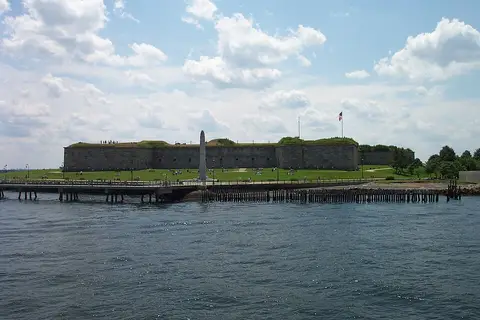 Forts03
Fort Independence
2010 William J Day Blvd · Boston● Website● Phone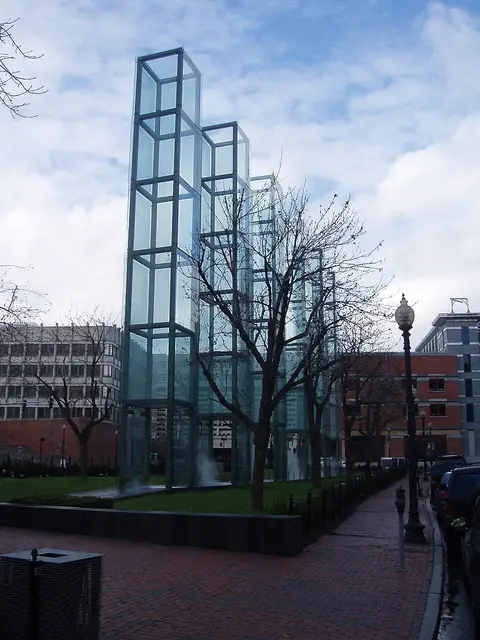 Monuments04
You need a free account to leave reviews and photos – that keeps comments genuine and lets you edit them later.
For the history buffs in the family there is the Bunker Hill Monument. Even for those who are unfamiliar with history that dates back to 1775 will enjoy the history lesson given on the site of this revolutionary war landmark. Climbing to the top of the monument is free, but during the months of April, May, and June, a pass must first be obtained from the nearby Bunker Hill Museum, which are issued on a first-come, first-served basis.
Source: Wikivoyage, „Boston/Charlestown“ · authors per page history · CC BY-SA 4.0 · as of 5/31/2017