
Northern Ireland: Basalt Coast, Belfast and the Glens
Travel guide · editorialHexagonal basalt columns rising into the sea, a museum on the very spot where the Titanic was built, and murals that tell of a difficult past: Northern Ireland is small, but astonishingly rich in stories. A vacation in Northern Ireland pairs well with a road trip across the whole island. Since the peace agreement of 1998, this part of the country has become a relaxed and welcoming destination.
Landscape and Location
Northern Ireland comprises six of the nine counties of the historic province of Ulster and occupies the northeast of the island of Ireland. At its center lies Lough Neagh, the largest freshwater lake in the British Isles. The Causeway Coast in the north is one of the most spectacular coastlines in Europe, with cliffs, bays and castle ruins. Behind it, the nine Glens of Antrim cut into the highlands as green valleys. In the southeast, the Mourne Mountains slope down to the Irish Sea and are said to have inspired C. S. Lewis's landscapes of Narnia. In the west, in County Fermanagh, the lakes of Lough Erne are scattered with countless islands, a playground for boaters and anglers.
Belfast, Derry and the Coastal Towns
Around 1900, Belfast was an industrial powerhouse with linen mills and the Harland & Wolff shipyard, where the Titanic was launched. Today, a striking museum in the Titanic Quarter tells her story. The city offers Victorian pubs such as the Crown Liquor Saloon, St George's Market and a lively pub scene in the Cathedral Quarter. In the neighborhoods along Falls Road and Shankill Road, murals depict the history of the conflict; guided taxi tours explain the background. Derry, officially Londonderry, is the only city in Ireland with a fully preserved 17th-century city wall. Bangor and Lisburn lie close to Belfast, while Portrush on the north coast is a seaside resort and golf destination; the Open Championship was held here in 2019 and 2025.
Sights in Northern Ireland
The best-known of Northern Ireland's sights is the Giant's Causeway, a UNESCO World Heritage Site made up of roughly 40,000 basalt columns formed by volcanic activity about 60 million years ago. According to legend, the giant Finn McCool built it. A few miles to the east, the Carrick-a-Rede rope bridge sways across to a rocky island, and Dunluce Castle perches in ruins above the cliffs. Bushmills is home to one of the oldest licensed whiskey distilleries in the world. Many locations served as backdrops for the series Game of Thrones, such as the beech-lined Dark Hedges or the harbor at Ballintoy; Banbridge has its own studio exhibition. The Ulster Folk Museum near Cultra shows rural life in bygone times.
History and Present Day
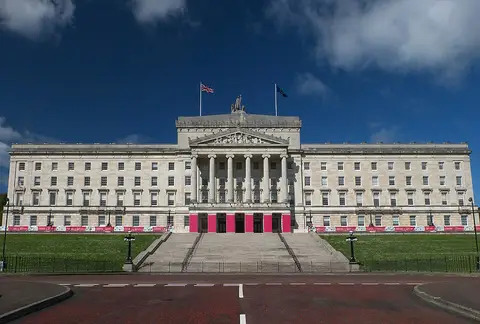
Since the partition of Ireland in 1921, Northern Ireland has been part of the United Kingdom. Tensions between predominantly Protestant unionists and predominantly Catholic nationalists escalated from the late 1960s into the "Troubles," which claimed around 3,500 lives. The Good Friday Agreement of 1998 brought a power-sharing government at Stormont. Today, the border with the Republic of Ireland is barely noticeable in everyday life, and many visitors travel between the two parts of the island without any checks. Traditional music in pubs, Gaelic football and St. Patrick's Day celebrations are as much a part of the culture as the Orange Order parades in July.
Food and Drink
The Ulster Fry is Northern Ireland's version of the big breakfast, complemented by soda bread and potato farls, flat potato breads fried in a pan. Champ, mashed potatoes with scallions, accompanies many dishes. Strangford Lough and the coast supply oysters, mussels and langoustines, while Lough Neagh yields eel with protected designation of origin. Belfast has a surprisingly diverse restaurant scene, along with whiskey from Bushmills, craft beers and gin from small distilleries. For dessert, yellowman, a hard honeycomb toffee, and tray bakes are popular.
Getting There and Best Time to Visit
Belfast International and Belfast City airports are served mainly via London and other British airports; many travelers land in Dublin and take a bus, train or car to Belfast in about two hours. Ferries connect Belfast and Larne with Scotland and England. A rental car is ideal for the Causeway Coast, though bus connections and day tours are also available. As throughout the United Kingdom, an ETA is required for entry, including when crossing the border from the Republic of Ireland. The best time to visit is between May and September, when the days are long; the weather changes frequently, though, so always bring a rain jacket and warm layers.