About The Cenotaph
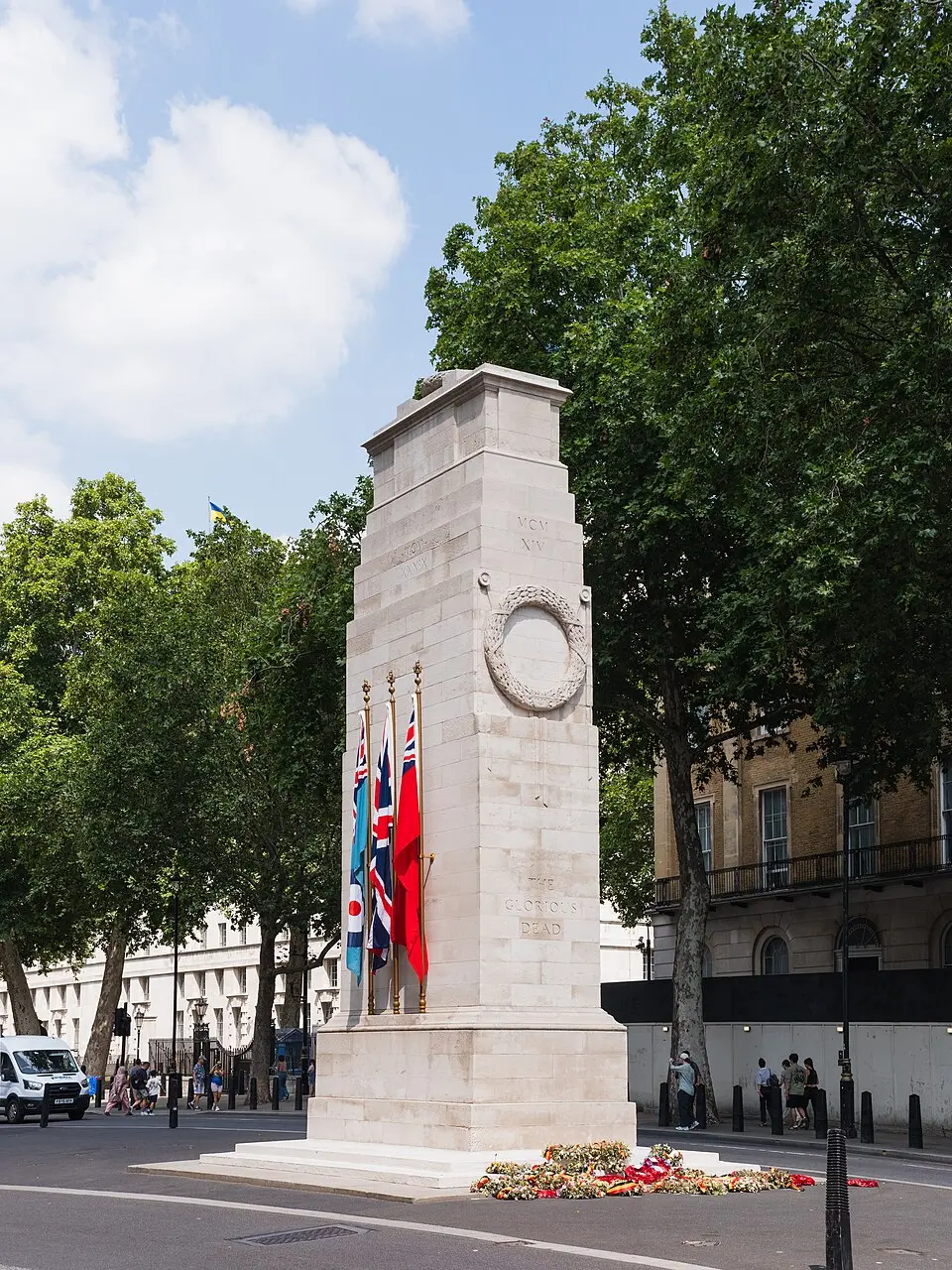
The Cenotaph in London is one of the best-known and most emotionally charged war memorials in the world. It stands on Whitehall, the central grand boulevard of the British capital, and serves as the national monument to the fallen of the British Empire. It was originally dedicated in 1920 as a memorial to those who died in the First World War. Its meaning was later broadened in 1946 to honor the victims of the Second World War as well. Today the monument stands symbolically for all Commonwealth casualties of the various conflicts. The name comes from the Greek word for "empty tomb," which captures the heart of its message: because most soldiers were buried where they fell, often on distant battlefields, the Cenotaph symbolizes their absence and serves as the central place of public mourning.
The history of the monument begins shortly after the end of the First World War. For a victory parade on July 19, 1919, the British government had a temporary monument erected to serve as a saluting point for the marching troops. This structure, built of wood and plaster, was designed by the famous architect Sir Edwin Lutyens. The public's reaction was overwhelming. Within a week, more than a million people visited the site to lay flowers and wreaths at the foot of the monument. The population's strong emotional attachment to this temporary structure meant that calls to rebuild the memorial in stone arose almost immediately.
After some debate about the exact location and form, the government agreed to build the Cenotaph permanently at its original spot on Whitehall. Construction began in May 1920. Lutyens made only minimal changes to his original design. He did, however, add a subtle curvature, known as entasis, which gives the stone structure a livelier, almost sculptural quality. The material is Portland stone, a pale, durable stone traditionally prized in British architecture. The permanent monument was unveiled on November 11, 1920, by King George V.
Architecturally, the Cenotaph is a masterpiece of simple elegance. It consists of a rectangular base that tapers toward the top and a carved sarcophagus resting above it. This sarcophagus represents the empty tomb. The entire structure is deliberately spartan and has hardly any ornamentation. Three flags hang on the long sides, representing the different branches of the British armed forces. The inscription "THE GLORIOUS DEAD" is carved on the sides, while the years of the world wars appear in Roman numerals on the ends. The sculptural work, especially the laurel wreaths, was carried out by the sculptor Francis Derwent Wood.
A special feature of the design is the use of entasis. No line of the pyramid-like base is completely straight. The vertical surfaces are curved so subtly that they would theoretically meet at a great height, while the horizontal surfaces form parts of a spherical surface. This architectural subtlety is barely perceptible to the naked eye, yet it playfully draws the gaze upward and lends the stone block a dynamic lightness. Lutyens himself described the structure as an "empty tomb raised high on a plinth." This abstraction was chosen deliberately to keep the monument nondenominational.
Neutrality was a central concern in the planning. Lutyens refused to include Christian symbols such as crosses or explicitly religious inscriptions. The government backed this decision, arguing that the monument had to be accessible to people from all parts of the Empire, regardless of their faith. At the time, this led to some controversy with Christian organizations, which found the absence of religious references disrespectful. Even so, the general public quickly accepted the Cenotaph as a place of universal mourning. Its simple form allowed people to project their own feelings and memories onto the monument.
The unveiling ceremony in 1920 was linked to the burial of the Unknown Warrior. An unidentified British soldier who had fallen in France was interred in Westminster Abbey. The coffin was carried on a gun carriage that passed along Whitehall while the King unveiled the Cenotaph. This double act of remembrance heightened the emotional impact of the day. Millions of people streamed to Whitehall to bear witness. The crowd was so large that it took hours for everyone to lay their wreaths. Within a few days, the Cenotaph was deeply covered in flowers, underscoring the close bond between the monument and the people.
Since then, the Cenotaph has been the central site for the annual commemorations on Remembrance Sunday, the Sunday closest to November 11. On this day, Whitehall is closed to traffic. At 11 a.m., a two-minute silence is observed simultaneously across the United Kingdom. Afterward, those present sing traditional hymns accompanied by military music. The monarch, the prime minister, and other high-ranking figures lay wreaths at the monument. Active-duty soldiers, veterans' associations, and other organizations then march past the monument. This ceremony has changed little since the 1930s and has become an integral part of British national identity.
The monument has also had a major influence on architecture and public life. The success of the Cenotaph made Lutyens a national figure, and in 1921 he received the Royal Gold Medal of the Royal Institute of British Architects. In the following years he designed dozens of other war memorials in Britain and other Commonwealth countries, often with similar features. The Cenotaph itself is a Grade I listed building, the highest category, which underscores its exceptional historical and architectural value. It is maintained by English Heritage and regularly restored to protect the stone from weather and pollution.
Today, visitors experience the Cenotaph as a place of quiet dignity in the midst of the bustling capital. It is not just a historic structure but a living place of remembrance. People continue to leave flowers and personal tributes around the monument. The Cenotaph's simple yet powerful form invites you to pause and reflect on the sacrifices of war. It stands as a symbol of the collective grief and respect that British society feels toward its fallen. The architecture, pared down to the essentials, speaks a universal language that can be understood across national and religious boundaries.
At a glance
- Category
- Sight › Monuments
- Rating
- no reviews yet · write a review
- Address
- Whitehall
SW1A 2ET London, United Kingdom - District
- City of Westminster
- Phone
- +443703331181
- Website
- www.britishlegion.org.uk
- —
- Coordinates
- 51.50269° N · -0.12608° E
- Data quality
- confidence 0.97
- Identifier
- ID cf9c88ee-460…
Location & surroundings
Toggle layersFAQ about The Cenotaph
quick answersWhat is the Cenotaph in London?
The Cenotaph is Britain's national war memorial, located on Whitehall in the City of Westminster in London. It was unveiled in 1920 to honor the dead of World War I, and in 1946 it was expanded to commemorate the victims of World War II as well. Today it stands as a symbol for Commonwealth casualties of many different conflicts. The name comes from the Greek word for "empty tomb," because most soldiers were buried where they fell.
When was the Cenotaph in London built, and by whom?
The present-day Cenotaph on London's Whitehall was built starting in May 1920 to a design by architect Sir Edwin Lutyens and was unveiled by King George V on November 11, 1920. It replaced a temporary monument of wood and plaster that Lutyens had designed for the victory parade on July 19, 1919. Because more than a million people laid flowers and wreaths there within a week, the government decided to build a permanent monument on the same spot.
What does the Cenotaph in London look like?
The Cenotaph in London is a deliberately plain, barely ornamented structure made of pale Portland stone. It consists of a rectangular base that tapers toward the top, topped by a sarcophagus that represents the empty tomb; a subtle curvature known as entasis gives it an almost sculptural quality. The inscription "THE GLORIOUS DEAD" appears on the sides, and the years of the world wars are carved in Roman numerals on the ends. Three flags representing the branches of the British armed forces hang along the long sides, and the sculptor Francis Derwent Wood created the laurel wreaths.
What can you see around the Cenotaph in London?
Around the Cenotaph on Whitehall in London, you'll find several other monuments and historic buildings within walking distance. travelguide195 lists, among others, the Field Marshal Montgomery statue (about 87 m), The Women of World War II (about 97 m), the Field Marshal The Viscount Slim Statue (about 127 m), the Iraq and Afghanistan Memorial (about 154 m), and the Chindit Memorial (about 155 m). Historic sites nearby include the Curtis Green Building (about 133 m) and the Norman Shaw Buildings (about 161 m).
Which walking tours pass the Cenotaph in London, and are there restaurants nearby?
The Cenotaph in London is a stop on two tours at travelguide195: "From Wellington Arch to the Thames: A Walk Through Westminster and St James's" and "London's History on Foot: From Lambeth via Whitehall to the City." For a break, travelguide195 lists about 74 restaurants within 500 meters of the monument.
Ratings & comments
none yetNear The Cenotaph
closest 5 per category · 2 kmSights
Restaurants
Museums
Hotels
More:Monuments in London (301)Sights in City of Westminster (559)All sights in London (3,487)
300 places within 2 km loaded.
You need a free account to leave reviews and photos – that keeps comments genuine and lets you edit them later.