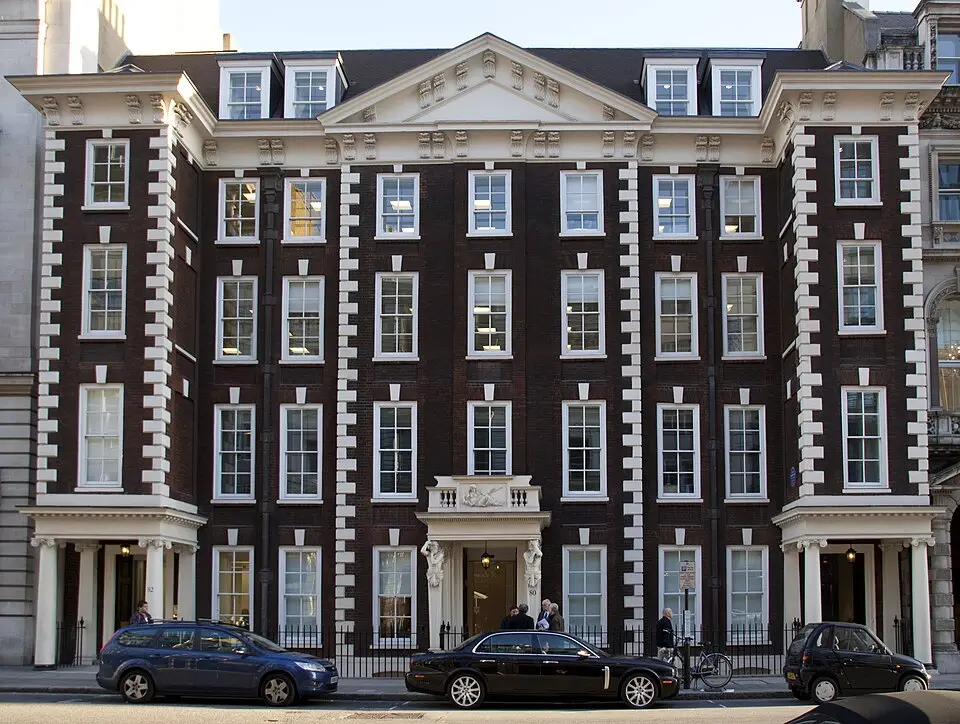
About Schomberg House
Schomberg House at 80–82 Pall Mall is a historic building in London, of which only the striking street façade survives today. The property was built beginning in 1694 for the third Duke of Schomberg, a Huguenot general in the service of the British crown, and was created by joining two previously separate houses. The architecture stands out for its unusual red-brick design, with four main floors above the basement. Particularly eye-catching are the end sections, which project sharply to the sides and resemble small towers, as well as the wrought-iron details made of Coade stone, a special type of artificial stone. The history of the house is varied: After the ducal family died out in 1719, it was rented out and in 1769 was divided into three separate units. Famous residents included the painter Thomas Gainsborough, who lived here, and the artist John Astley, who set up a studio in the attic. Later the building served a variety of purposes, from a bookshop to an office of the War Office. In 1956 the building was largely demolished to make way for offices, though the façade of number 80 was reconstructed in its original form. Today the house is listed as a Grade II* protected historic monument.
At a glance
- Category
- Sight › Historic sites
- Rating
- no reviews yet · write a review
- Address
- —
London, United Kingdom - District
- City of Westminster
- Phone
- —
- Website
- pt.wikipedia.org
- —
- Coordinates
- 51.50580° N · -0.13583° E
- Data quality
- confidence 0.81
- Identifier
- ID 53d89299-b1a…
Location & surroundings
Toggle layersFAQ about Schomberg House
quick answersWhat is Schomberg House in London?
Schomberg House is a historic building at 80–82 Pall Mall in London's City of Westminster, of which mainly the distinctive street facade survives today. Construction began in 1694 for the 3rd Duke of Schomberg, a Huguenot general in the service of the British Crown, and it was created by joining two previously separate houses. Today Schomberg House is listed as a Grade II* protected historic building.
What is special about the architecture of Schomberg House?
Schomberg House in London stands out for its unusual red-brick facade with four main stories above the basement. Especially striking are the end sections, which project sharply to the sides and resemble small towers. There are also details made of Coade stone, a special type of artificial stone.
Who lived in Schomberg House and how was it used?
Famous residents of Schomberg House in London included the painter Thomas Gainsborough and the artist John Astley, who set up a studio in the attic. After the ducal family died out in 1719, the house was rented out, and in 1769 it was divided into three separate units. Later it served, among other things, as a bookshop and as an office of the War Office.
Is Schomberg House still preserved in its original form?
No, Schomberg House on London's Pall Mall survives only in part. In 1956 the building was largely demolished to make room for offices. The facade of No. 80 was reconstructed in its original form.
What can you see around Schomberg House?
Around Schomberg House in London, several historic sites lie within walking distance; travelguide195 lists Cumberland House about 43 yards away and Marlborough House about 97 yards away, for example. Just about 165 yards away are St James's Palace, the Chapel Royal, St. James's, and Friary Court. Also nearby: the Queen Alexandra Memorial and the Republic of Texas Plaque. For a break, travelguide195 lists around 182 restaurants within 500 meters.
Ratings & comments
none yetNear Schomberg House
closest 5 per category · 2 kmSights
Restaurants
Museums
Hotels
More:Historic sites in London (3,142)Sights in City of Westminster (559)All sights in London (3,487)
300 places within 2 km loaded.
You need a free account to leave reviews and photos – that keeps comments genuine and lets you edit them later.