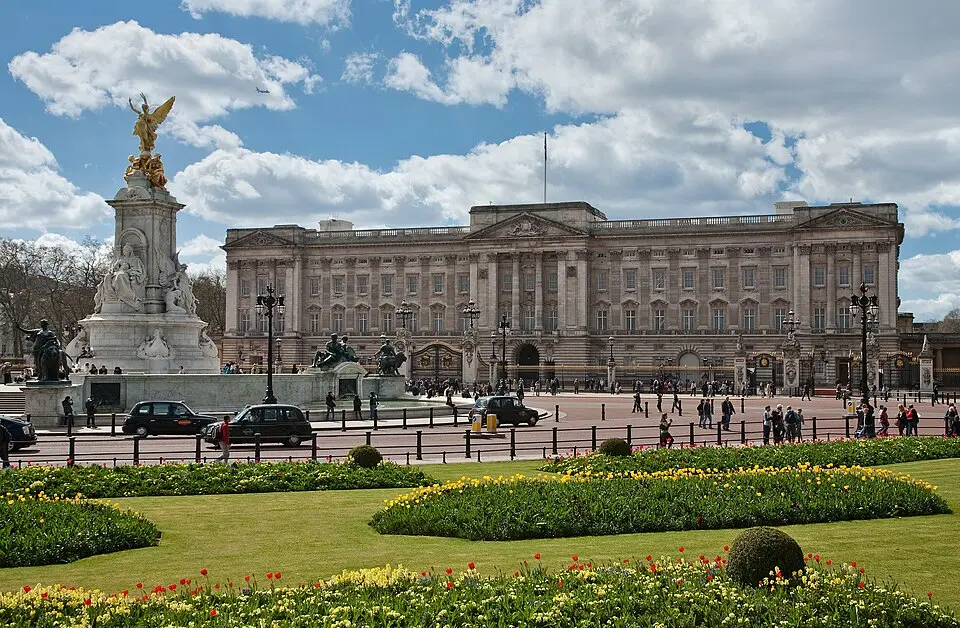
About Palais de Buckingham
Buckingham Palace in London is the official residence of the British monarch and a central venue for state ceremonies. The imposing building in the City of Westminster serves not only as a home but also as a place to receive foreign heads of state, and it is one of the capital's most visited sights. The history of the site goes back to the 17th century, when Goring House originally stood here. The core of today's palace, however, was not built until 1703, as a grand townhouse for John Sheffield, the first Duke of Buckingham and Normanby. King George III bought the property in 1761 and used it as a private retreat for his family, especially for Queen Charlotte, who gave birth to fourteen of her fifteen children here.
The transformation from private townhouse to royal palace took place mainly under King George IV, who from 1826 commissioned the architect John Nash to expand the building extensively. Nash designed the palace in the French neoclassical style and clad the facade in pale Bath stone. The expansion enclosed a large courtyard, with the original house serving as the central wing. The interior was marked by a splendor previously unknown, meant to surpass the Napoleonic Empire style. Sir Charles Long advised the king on the furnishings and relied on glowing faux-marble work, stucco sculptures, and the use of blue and pink lapis lazuli. Many of the smaller reception rooms were given a Chinese Regency architectural style, enhanced by furniture and decorations from the Royal Pavilion in Brighton.
With Queen Victoria's accession to the throne in 1837, Buckingham Palace officially became the main residence of the British monarchy. At that time the building was not yet fully completed, and its technical amenities were poor. Fireplaces smoked heavily, ventilation was inadequate, and the gas lighting raised safety concerns. After his marriage to the queen in 1840, Prince Albert devoted himself intensively to reorganizing the household and fixing the structural defects. Because the palace was becoming too small for the growing royal family, Victoria had a fourth wing built on the east side starting in 1847. This new wing, designed by Edward Blore, closed off the courtyard toward The Mall and houses the famous balcony on which the royal family appears before the public on ceremonial occasions.
The palace's east front was redesigned by Aston Webb in 1913 and clad in Portland limestone. This facade forms the backdrop for the Victoria Memorial, a large marble monument on the forecourt. During World War II, the palace was bombed several times by the German Luftwaffe. One bomb struck the courtyard while King George VI and Queen Elizabeth were in the building. The queen later said she was glad the palace had been bombed, as she could now look the people of the devastated parts of the city in the eye. This attitude helped strengthen public sympathy for the monarchy. After the war, the palace once again became the center of British court life and diplomatic relations.
Today the palace has an estimated total floor area of 77,000 square meters with 775 rooms. Of these, 19 are fitted out as state rooms used for official receptions and ceremonies. Other rooms serve as bedrooms for the royal family and guests, offices for staff, and staff residences. The building measures 108 meters across the front and 120 meters along the side, with a height of 24 meters. It also includes a riding school, a swimming pool, a tennis court, and extensive outbuildings. The palace gardens are the largest private gardens in London, covering 17 hectares. They were originally designed by Capability Brown and later altered by William Aiton and John Nash. An artificial lake, fed from the Serpentine in Hyde Park, shapes the landscape, as does a small summer house dating from the 1740s.
Visitors can usually tour Buckingham Palace only during a period of about six weeks in July and August. During this time, the state rooms in the west wing are opened to the public. The tour leads through a series of lavishly decorated rooms, including the Throne Room, the Blue Drawing Room, and the Picture Gallery. The Picture Gallery is 50 meters long and displays works by famous artists such as Rembrandt, Van Dyck, Rubens, and Vermeer. The Blue Drawing Room, which is 21 meters long, is often described by historians as the most beautiful room in the palace. It has one of the most magnificent ceilings created by John Nash and is decorated in a mix of cream and gold in the Belle Époque style.
Another highlight of the tour is the Ballroom, built in 1854 and, at 37 by 20 meters, the largest room in the palace. Investitures, award ceremonies, and state banquets take place here. The hall has an organ that was originally built for the Royal Pavilion in Brighton and moved to the palace in 1855. The Music Room, the center of the suite of state rooms, is also an important space. Royal christenings were held here after the palace chapel was bombed in World War II. The room is marked by a large bow on the facade and serves as an anteroom to the Throne Room.
Besides touring the interiors, the Changing of the Guard in front of the palace is one of the best-known attractions for tourists. This ceremony is performed by soldiers of the Foot Guards and draws large crowds. The armed sentries, often perceived as purely ceremonial, are in fact part of the security arrangements. The palace has its own police station, and members of the royal family are protected by bodyguards. Despite the extensive security measures, there have been various incidents in the past, including break-ins and protests, which drew public attention.
Buckingham Palace houses parts of the valuable Royal Collection, a world-class collection of artworks, furniture, and jewelry. This collection does not belong to the monarch personally but to the British state. Changing exhibitions from the collection are shown in the King's Gallery next to the palace. The Royal Mews, the royal carriage houses, are also open to visitors. The historic carriages are on display there, including the Gold State Coach, which is used for coronations and jubilees. The carriages were designed by Sir William Chambers and decorated with paintings by Giovanni Battista Cipriani.
The significance of Buckingham Palace goes beyond its function as a residence. It is a symbol of the British monarchy and of the country's historical continuity. The architecture and interior design reflect the various eras and tastes of past centuries, from the Georgian period through the Victorian age to the modern era. The palace is a place where history is lived and the traditions of the court are upheld. For visitors, it offers a glimpse into the world of the British royal family and the splendor that comes with the office of monarch. The combination of historical importance, architectural beauty, and cultural significance makes Buckingham Palace an essential stop for anyone visiting London.
At a glance
- Category
- Sight › Historic sites
- Rating
- no reviews yet · write a review
- Address
- —
London, United Kingdom - District
- City of Westminster
- Phone
- —
- Website
- www.royal.gov.uk
- —
- Coordinates
- 51.50110° N · -0.14239° E
- Data quality
- confidence 0.95
- Identifier
- ID 1a2269c3-2f0…
Location & surroundings
Toggle layersRatings & comments
none yetNear Palais de Buckingham
closest 5 per category · 2 kmSights
Restaurants
Museums
Hotels
More:Historic sites in London (3,142)Sights in City of Westminster (559)All sights in London (3,487)
300 places within 2 km loaded.
You need a free account to leave reviews and photos – that keeps comments genuine and lets you edit them later.