About King's Bench Prison
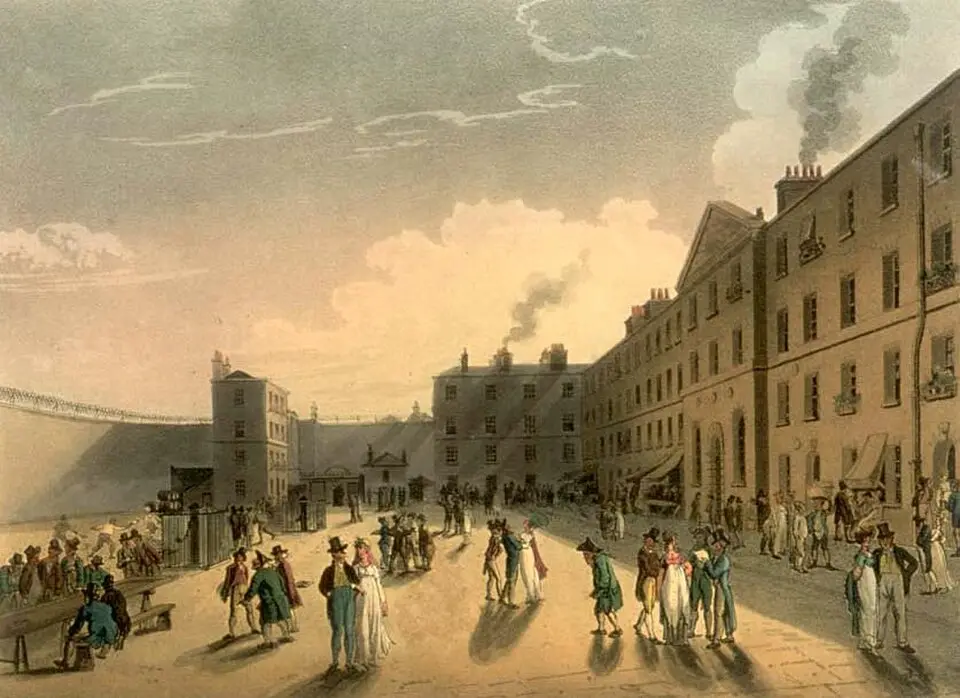
King's Bench Prison was a historic prison complex in Southwark, south of London, that existed from medieval times until its closure in 1880. It was named after the King's Bench Court, a court that heard cases involving libel, bankruptcy, and other offenses, among other matters. As a result, the prison served for a long time primarily as a place of confinement for debtors, a practice that was not abolished until the 1860s. The history of the complex reaches back to the Middle Ages, when the first institution consisted of two houses on Angel Place. These early buildings were set on fire during uprisings in 1381 and 1450. Under King Henry VIII, several new buildings were erected within a surrounding brick wall, but they were demolished in 1761.
In 1758, a new, larger complex was built on a ten-acre site near St George's Fields. Although it was better equipped than many other London prisons, the institution had a reputation for filth, overcrowding, and typhus outbreaks. Debtors had to bring their own food and bedding, while wealthier inmates could purchase the so-called "Liberty of the Rules," which allowed them to live within a certain radius around the prison. The prison also became famous for the incarceration of John Wilkes in 1768, whose imprisonment led to a bloody riot. After severe fire damage during the Gordon Riots of 1780, the building was rebuilt between 1780 and 1784. In 1842, the prison was renamed Queen's Bench Prison, before being renamed Southwark Convict Prison in 1872 and finally being closed and demolished after being taken over by the Home Office.
King's Bench Prison is best known for its many literary and historical inmates. The playwright Thomas Dekker spent several years here for debt, while Charles Dickens used the prison as a setting for the fates of indebted characters in several of his novels, such as "David Copperfield" and "Little Dorrit." Other prominent figures, including the engineer Marc Isambard Brunel, the mathematician Robert Recorde, and various poets and politicians, were also held in this prison. Today, only the name of the Scovell housing estate recalls the site where the prison walls once stood.
At a glance
- Category
- Sight › Historic sites
- Rating
- no reviews yet · write a review
- Address
- —
London, United Kingdom - Phone
- —
- Website
- —
- —
- Coordinates
- 51.49980° N · -0.09790° E
- Data quality
- confidence 0.81
- Identifier
- ID 9580c579-463…
Location & surroundings
Toggle layersFAQ about King's Bench Prison
quick answersWhat was King's Bench Prison in London?
King's Bench Prison was a historic prison in Southwark, south of London, that operated from the Middle Ages until its closure in 1880. It was named after the Court of King's Bench, which heard cases involving libel and bankruptcy, among others. For that reason it served for a long time mainly as a debtors' prison, until the practice was abolished in the 1860s. In 1842 it was renamed Queen's Bench Prison, and in 1872 Southwark Convict Prison.
Can you still visit King's Bench Prison in London today?
No, nothing of King's Bench Prison in Southwark survives today, as it was closed and demolished after the Home Office took it over. All that recalls the former site is the name of the Scovell housing estate, where the prison walls once stood. If you go, you'll be visiting a historic site with no surviving buildings.
Which famous prisoners were held in King's Bench Prison?
King's Bench Prison in London held numerous well-known figures, many of them for debt. The playwright Thomas Dekker spent several years here, and the engineer Marc Isambard Brunel and the mathematician Robert Recorde were also imprisoned. The imprisonment of John Wilkes in 1768 led to a bloody riot. Charles Dickens used the prison as a setting in novels such as "David Copperfield" and "Little Dorrit."
What was daily life like in King's Bench Prison?
Daily life in King's Bench Prison in Southwark was marked by filth, overcrowding, and typhus outbreaks, even though the institution was better equipped than many other London prisons. Debtors had to bring their own food and bedding. Wealthier inmates could buy the so-called "Liberty of the Rules" and were then allowed to live within a certain radius around the prison.
Are there restaurants near the former King's Bench Prison in London?
Yes, you'll find plenty of restaurants around the former site of King's Bench Prison in Southwark. travelguide195 lists around 111 restaurants within 500 meters. That makes it easy to combine a visit to the historic site with a meal nearby.
Ratings & comments
none yetNear King's Bench Prison
closest 5 per category · 2 kmRestaurants
Museums
Hotels
More:Historic sites in London (3,142)All sights in London (3,487)
300 places within 2 km loaded.
You need a free account to leave reviews and photos – that keeps comments genuine and lets you edit them later.