About Cleopatra's Needle
Cleopatra's Needle in London is an imposing ancient Egyptian obelisk standing on the Victoria Embankment in the City of Westminster. Carved from rose granite in Aswan, the monument dates to around 1450 B.C., when it was erected in honor of the pharaoh Thutmose III. Ramses II later added inscriptions, and under the Roman emperor Augustus the block of stone was moved to Alexandria. There it stood for a long time, until it was presented to the British royal family in the 19th century as a diplomatic gift from the Ottoman pasha Muhammad Ali. Bringing it to England was an elaborate undertaking that only became possible in 1877 thanks to private funding and engineering innovations. The obelisk was towed across the Mediterranean in a specially built cylindrical vessel, and the voyage was dramatically interrupted by a storm in the Bay of Biscay and the loss of several sailors.
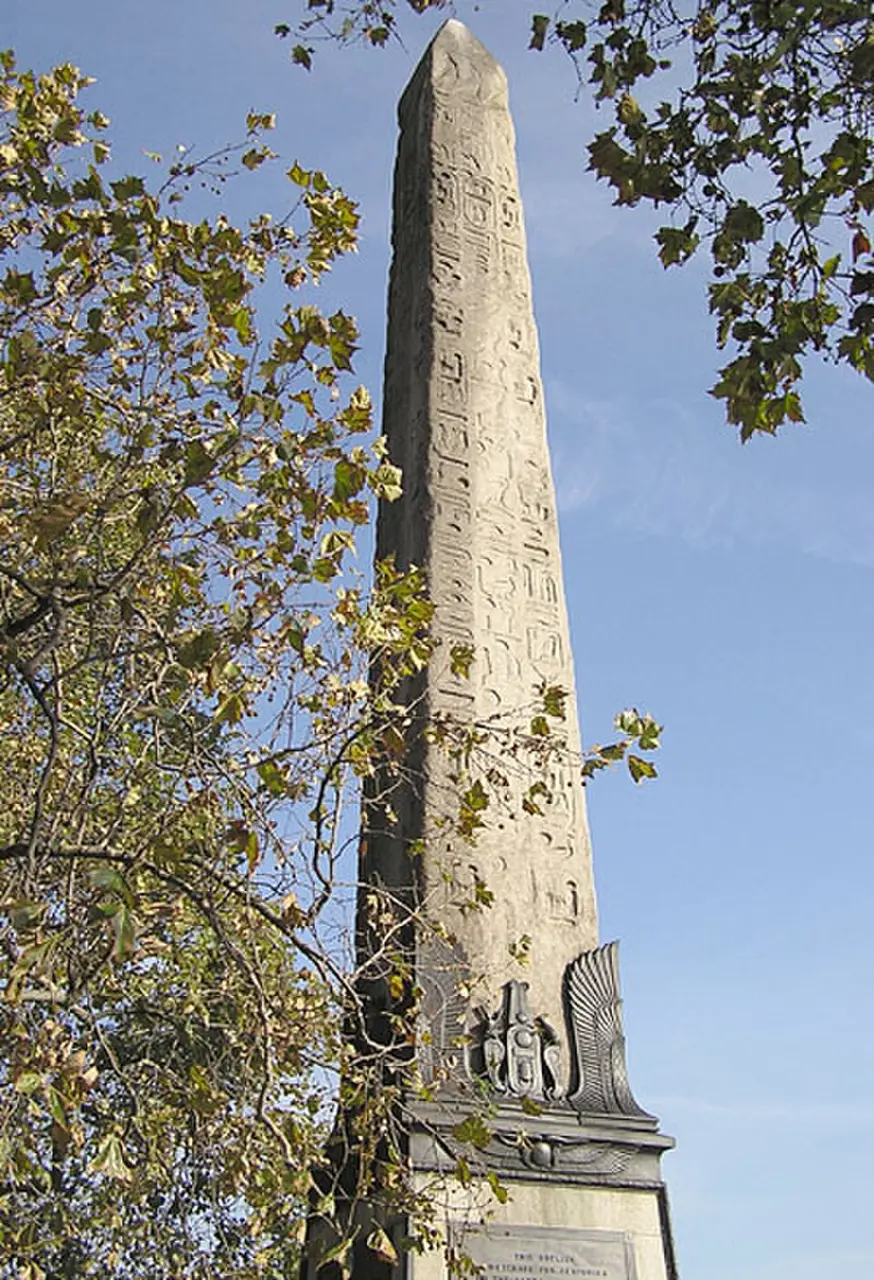
The monument was erected in London in 1878. Hydraulic jacks first lifted the horizontal block of stone onto the plateau of the Embankment and then tilted it into an upright position. Today, visitors marvel at the 68.5-foot (20.90 m) monolith, whose square cross-section tapers toward the top. Its surface is inscribed with hieroglyphs arranged in three columns, which have been well preserved thanks to a long period buried under sand in Alexandria. At the base, Egyptian-style bronze ornaments and two sphinxes adorn the monument and underscore its historic ambiance.
The obelisk is not only an architectural highlight but also a historical testament to the relationship between Egypt and Great Britain. The bronze plaques on the pedestal provide information about the history of the stone, along with memorials to the people involved in its recovery and the sailors who lost their lives during the crossing. Despite some damage from bombs dropped during World War I and World War II, the monument still stands firm on the bank of the Thames. One of two obelisks known as "Cleopatra's Needles," the other of which stands in New York's Central Park, it draws visitors from around the world and offers a fascinating glimpse into ancient history and the colonial past.
At a glance
- Category
- Sight › Monuments
- Rating
- no reviews yet · write a review
- Address
- Victoria Embankment
WC2N 6PB London, United Kingdom - District
- City of Westminster
- Phone
- +447724928290
- Website
- cleopatramagazine.net
- cleo.magazine@gmx.com
- Coordinates
- 51.50847° N · -0.12046° E
- Data quality
- confidence 0.93
- Identifier
- ID 11cf0bf0-a87…
Location & surroundings
Toggle layersFAQ about Cleopatra's Needle
quick answersWhat is Cleopatra's Needle in London?
Cleopatra's Needle is an ancient Egyptian obelisk of rose granite that stands on the Victoria Embankment in the City of Westminster in London, on the banks of the Thames. The monolith was originally quarried in Aswan and erected in honor of Pharaoh Thutmose III. It is one of two obelisks known as "Cleopatra's Needles"; its counterpart stands in Central Park in New York.
How old is Cleopatra's Needle, and how did the obelisk get to London?
Cleopatra's Needle in London dates from around 1450 BC and was erected on the Victoria Embankment in 1878. Ramses II later added inscriptions, and under Emperor Augustus the stone was moved to Alexandria. In the 19th century, the Ottoman pasha Muhammad Ali gave the obelisk to the British royal family; it was only transported successfully in 1877, thanks to private funding, in a specially built cylindrical vessel. During a storm in the Bay of Biscay, several sailors lost their lives.
What is there to see at Cleopatra's Needle in London?
At Cleopatra's Needle in London, you'll see a monolith 20.90 meters (about 69 feet) tall, with a square cross-section that tapers toward the top and hieroglyphs arranged in three columns. The inscriptions are well preserved because the stone lay buried under sand in Alexandria for a long time. At the base stand two sphinxes and Egyptian-style bronze decorations, and bronze plaques on the pedestal tell the story of the stone and commemorate the sailors who died. You can also spot traces of bomb damage from World War I and World War II.
What can you visit around Cleopatra's Needle in London?
Around Cleopatra's Needle on the Victoria Embankment in London, you'll find several monuments and historic sites within walking distance. travelguide195 lists the Henry Fawcett Memorial about 70 meters away and the Imperial Camel Corps Memorial about 78 meters away, among others. Also nearby are the Golden Jubilee Bridges (about 108 meters), the Statue of John Stuart Mill (about 136 meters), and the Precinct of the Savoy (about 141 meters).
Which tours pass Cleopatra's Needle in London, and are there restaurants nearby?
Cleopatra's Needle in London is part of two tours on travelguide195: "From Wellington Arch to the Thames: A Walk Through Westminster and St James's" and "London Off the Postcard: Holborn, Strand and St James's." For a break in the area, travelguide195 lists around 371 restaurants within 500 meters of the obelisk on the Victoria Embankment.
Ratings & comments
none yetNear Cleopatra's Needle
closest 5 per category · 2 kmSights
Restaurants
Museums
Hotels
More:Monuments in London (301)Sights in City of Westminster (559)All sights in London (3,487)
300 places within 2 km loaded.
You need a free account to leave reviews and photos – that keeps comments genuine and lets you edit them later.
Cleopatra's Needle originated in the ancient Egyptian city of Heliopolis, in the Temple of Atum, but the Romans moved it to Alexandria in 12 BC. In 1819, viceroy Mehemet Ali presented Cleopatra's Needle to the British, commemorating military victories in Egypt, but it remained in Alexandria until 1877 when transportation was arranged to bring it to London. On the voyage, the ship capsized in a storm, killing six crewmembers. Cleopatra's Needle was thought to be lost, but Spanish trawlers found it afloat a few days later, and after some repairs, it arrived in London on 21 Jan 1878. The obelisk is flanked by two faux-sphinxes, which show the effects of bombings of London during World War II. Today, Cleopatra's Needle shows some wear from exposure to London's damp weather.
Source: Wikivoyage, „London/Covent Garden“ · authors per page history · CC BY-SA 4.0