About Cádiz Memorial
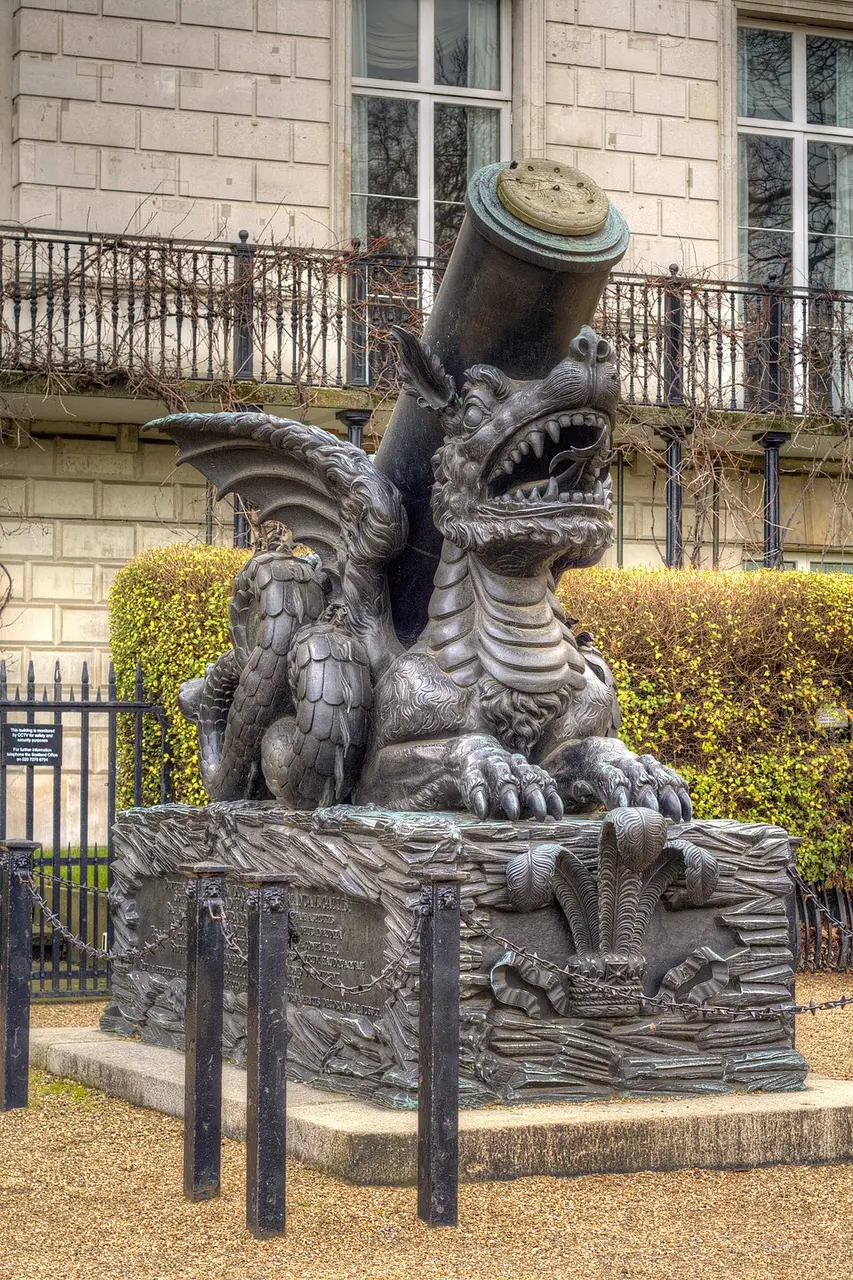
The Cádiz Memorial, popularly known as the Prince Regent's Bomb, is a historic monument on Horse Guards Parade in Westminster, London. It is an early French mortar from the early 19th century, mounted on an elaborate bronze sculpture. The monument was unveiled to the public on August 12, 1816, and has been a listed monument since 1987. The weapon dates from the Siege of Cádiz in Spain, where it was used by the French army under Marshal Soult. After the French withdrew in 1812, prompted by the Duke of Wellington's victory at Salamanca, the cannon was abandoned and eventually brought to Britain as a trophy. The Spanish Regency presented the piece to Vice Admiral Arthur Kaye Legge, with the request that it be erected in one of the Royal Parks to commemorate the victory and the liberation of southern Spain.
Architecturally, the monument is a remarkable blend of military hardware and allegorical sculpture. The mortar rests on the back of a large bronze sculpture of the monster Geryon, as described in Dante's Divine Comedy, who is associated with the island of Gades, on which Cádiz lies. Some sources wrongly describe the figure as a Chinese dragon, but it is a stylized depiction of the mythical creature, whose tails coil around the muzzle of the cannon. At the rear of the weapon is a sculpture of the dog Orthrus. The entire structure stands on a bronze base representing a rock and measures about three meters (10 feet) in height, with a weight of sixteen tons. On the front of the base, the Prince of Wales's feathers are shown in relief, while the back records its manufacture by the Royal Carriage Department in 1814.
In London's history, the monument quickly became the target of satire. Since the word "bomb" was pronounced "bum" in the slang of the day, the public immediately linked the cannon with the Prince Regent's ample backside. This led to a wave of caricatures and satirical poems tying the monument to the prince's body. Artists such as George Cruikshank portrayed the prince as the embodiment of the mortar, while ministers lined up to kiss his behind. These humorous and often scandalous depictions shaped the public image of the monument for good in the first half of the 19th century.
At a glance
- Category
- Sight › Monuments
- Rating
- no reviews yet · write a review
- Address
- Downing St
SW1A 2AA London, United Kingdom - District
- City of Westminster
- Phone
- —
- Website
- —
- —
- Coordinates
- 51.50421° N · -0.12729° E
- Data quality
- confidence 0.69
- Identifier
- ID b43bbecc-6e2…
Location & surroundings
Toggle layersRatings & comments
none yetNear Cádiz Memorial
closest 5 per category · 2 kmSights
Restaurants
Museums
Hotels
More:Monuments in London (301)Sights in City of Westminster (559)All sights in London (3,487)
300 places within 2 km loaded.
You need a free account to leave reviews and photos – that keeps comments genuine and lets you edit them later.