About The British Museum
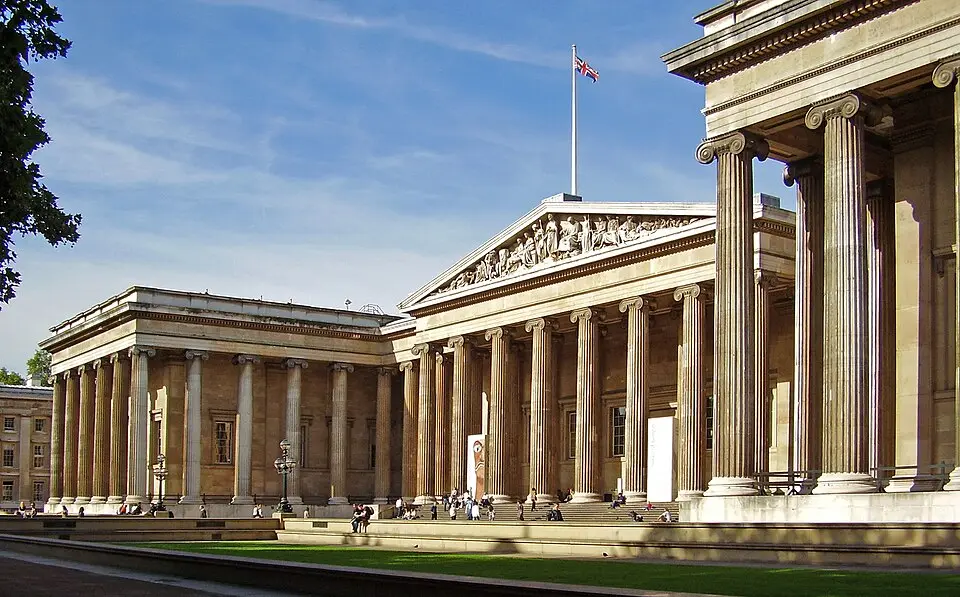
The British Museum in London is considered one of the world's most important museums of cultural history and, with eight million works, houses the most extensive permanent collection of its kind. Founded in 1753, it was the first public national museum anywhere and documents the history of humankind from its beginnings to the present day. The collection spans two million years and is divided into roughly 94 individual collections, ranging from prehistory through the Near East and ancient Egypt to Asia, Africa, Oceania, and the Americas. About six million people visit each year; the museum is located on Great Russell Street and is easy to reach via the Holborn or Russell Square Tube stations. With the exception of a few months in 1972, admission has always been free.
The museum's history began when the physician and scientist Sir Hans Sloane bequeathed his extensive collection to the state. Initially housed in Montagu House, the museum moved to a larger building in 1850 that essentially took on its present form. An important impetus for expanding the holdings came from Augustus Wollaston Franks, who worked as a curator for British and medieval history and is regarded as one of the most important collectors in the museum's history. Over time, parts of the collection were moved elsewhere for lack of space; the Natural History Museum, for example, has been independent since 1963, and what was once the country's largest library formed the foundation of the newly established British Library in 1973. In recent years the museum has also been at the center of controversy, including a theft case in which a curator was accused of having taken objects, which led to the resignation of then-director Hartwig Fischer in 2023.
The neoclassical building was designed by Robert Smirke and completed in 1848. It has a square floor plan with three stories. The center of the courtyard originally held the round Reading Room, which opened in 1857 and has a dome 42.5 meters (139 feet) in diameter. After the books were transferred to the British Library in 1997, the courtyard was redesigned according to a plan by Sir Norman Foster. The roof is a steel-and-glass structure completed in 2000 and made up of thousands of glass panes. At 7,100 square meters (about 76,400 square feet), the courtyard is the largest covered public square in Europe. The old Reading Room was renovated and used at times as an exhibition space, but it has been closed since the end of 2013, and its future use remains undecided.
In the galleries, you can marvel at a diverse selection of famous artifacts, including the Rosetta Stone, Egyptian mummies, the Elgin Marbles from the Parthenon in Athens, and the Cyrus Cylinder, often regarded as an early declaration of human rights. Other highlights include Lindow Man, finds from the Sutton Hoo ship burial, the Benin Bronzes, and the statue of Tara. Because most of the collection is kept in storage beneath the museum, only a portion of the holdings is on public view. Some objects may be touched at certain times. The museum also runs its own publishing house, which brings out numerous publications each year, and maintains specialist libraries with a collection of about 350,000 volumes.
The British Museum's collection is also the subject of international debate over the provenance of artifacts. The Elgin Marbles, the Benin Bronzes, and the Rosetta Stone in particular are being claimed back by their countries of origin. The museum argues that the British law of 1963 prohibits the removal of objects from the collection once they have been accepted. It stresses that a general principle of restitution, returning everything to its original location, would empty the world's great museums. Even so, in individual cases, such as the burial remains of Tasmanian Aboriginal people, the museum has returned objects where this was compatible with current legislation. At the end of 2022, initial talks with the Greek government on the future of the Parthenon sculptures began.
At a glance
- Category
- Museum › Art museums
- Rating
- no reviews yet · write a review
- Address
- Great Russell St
WC1B 3DG London, United Kingdom - District
- London Borough of Camden
- Phone
- 02073238299
- Website
- www.britishmuseum.org
- —
- Coordinates
- 51.51941° N · -0.12696° E
- Data quality
- confidence 1.00
- Identifier
- ID 5ad6dc0a-96a…
Location & surroundings
Toggle layersRatings & comments
none yetNear The British Museum
closest 5 per category · 2 kmSights
Restaurants
Museums
Hotels
More:Art museums in London (93)Museums in London Borough of Camden (90)All museums in London (825)
300 places within 2 km loaded.
You need a free account to leave reviews and photos – that keeps comments genuine and lets you edit them later.
A vast repository of the world's cultures, controversially including hundreds of items that were looted from their places of origin. Entire sections are devoted to Egyptian, Greek, and Middle Eastern artifacts, as well as the piece which united them all, the Rosetta Stone. Other items on everyone's list are the largest collection of mummies outside Egypt and the Elgin Marbles. The collection also includes some of the world's finest collections of Chinese and Sub-Saharan African art; perhaps the most famous of the latter are the Benin bronzes. A definite highlight of a trip to London. Temporary exhibitions are invariably excellent and meticulously researched, but can be expensive. It has a fine store, mainly selling replicas of items in the collection.
Source: Wikivoyage, „London/Bloomsbury“ · authors per page history · CC BY-SA 4.0 · as of 2/8/2024