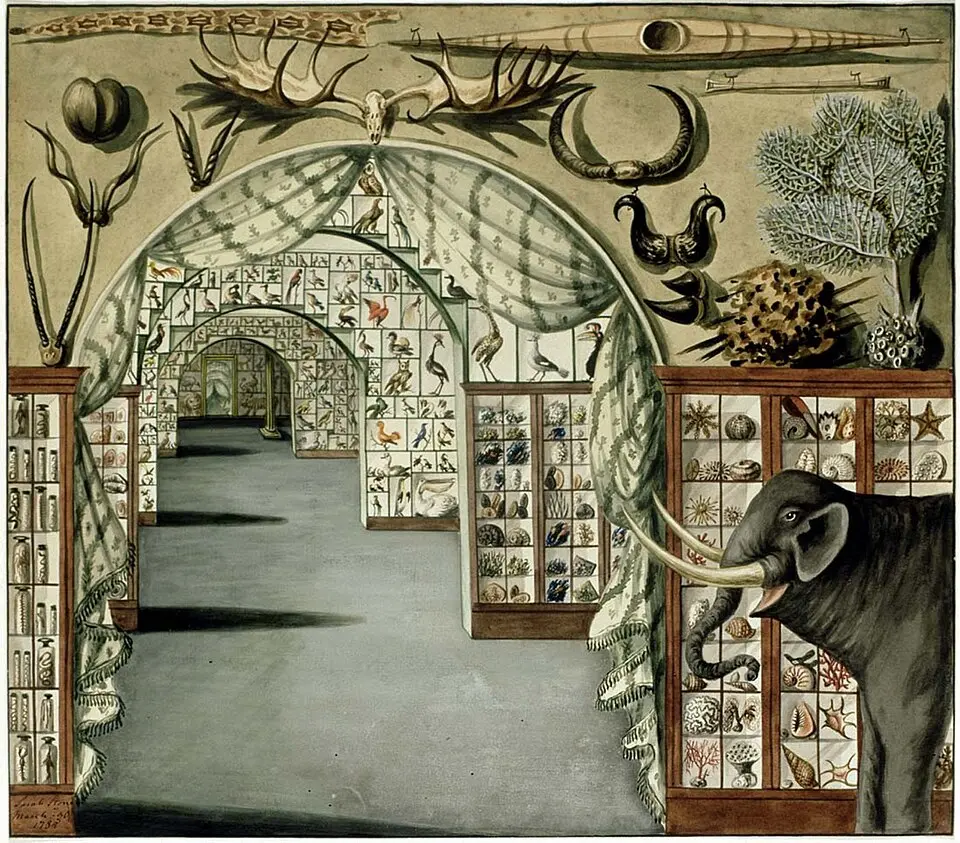
About Leverian collection
The Leverian Collection was a significant collection of natural history and ethnographic objects assembled by Ashton Lever. He originally collected fossils, shells, and animals such as birds, insects, reptiles, fish, and monkeys at his estate, Alkrington, near Manchester. Although admission there was free, Lever admitted only visitors who could afford a carriage and horses or a riding horse. To make the project commercially viable, he moved the exhibition to London, where he opened his museum in Leicester House on Leicester Square in February 1775. The large rooms on the first floor were converted into a single long gallery displaying around 25,000 exhibits. These included numerous finds from the expeditions of Captain James Cook. The museum, which took its name from its supposedly universal coverage of natural history, functioned essentially as a giant cabinet of curiosities. Lever charged admission, which he later lowered to attract more visitors, but the cost of new acquisitions regularly exceeded his income.
After neither the British Museum nor Empress Catherine II of Russia showed interest in buying it, Lever tried to sell the collection by lottery, which met with only partial success. In the end, the land agent and accountant James Parkinson acquired the collection. After Lever's death in 1788, the collection remained at Leicester House for a time before Parkinson moved it to a purpose-built rotunda on Blackfriars Road. This new museum, often referred to as Parkinson's Museum, was an important venue for scientists and artists. Some of John White's specimens were shown to the public there for the first time, and artists such as Sarah Stone worked on documenting the objects. The museum also served as a source of inspiration for women who wrote scientific texts there. Because visiting was often easier than at the British Museum, it also drew naturalists from abroad.
The collection was dispersed at auction in 1806, as Parkinson had to sell for financial reasons. Thousands of lots went to various buyers, including Edward Stanley, the 13th Earl of Derby, as well as to museums in Vienna and London. Many of the mounted birds that Stanley acquired were bequeathed to the city of Liverpool after his death and formed part of the founding collection of what is now the World Museum. Other objects, especially ethnographic pieces, can be found today in the holdings of the British Museum. The history of the collection is well documented, including through catalogs from 1784 and 1806 and watercolors by the artist Sarah Stone that recorded the contents of the exhibition.
At a glance
- Category
- Museum › Museums (general)
- Rating
- no reviews yet · write a review
- Address
- —
London, United Kingdom - District
- City of Westminster
- Phone
- —
- Website
- australianmuseum.net.au
- —
- Coordinates
- 51.51028° N · -0.13028° E
- Data quality
- confidence 0.77
- Identifier
- ID b1b73533-3c8…
Location & surroundings
Toggle layersRatings & comments
none yetNear Leverian collection
closest 5 per category · 2 kmSights
Restaurants
Museums
Hotels
More:Museums in City of Westminster (136)All museums in London (825)
300 places within 2 km loaded.
You need a free account to leave reviews and photos – that keeps comments genuine and lets you edit them later.