About Great Wheel
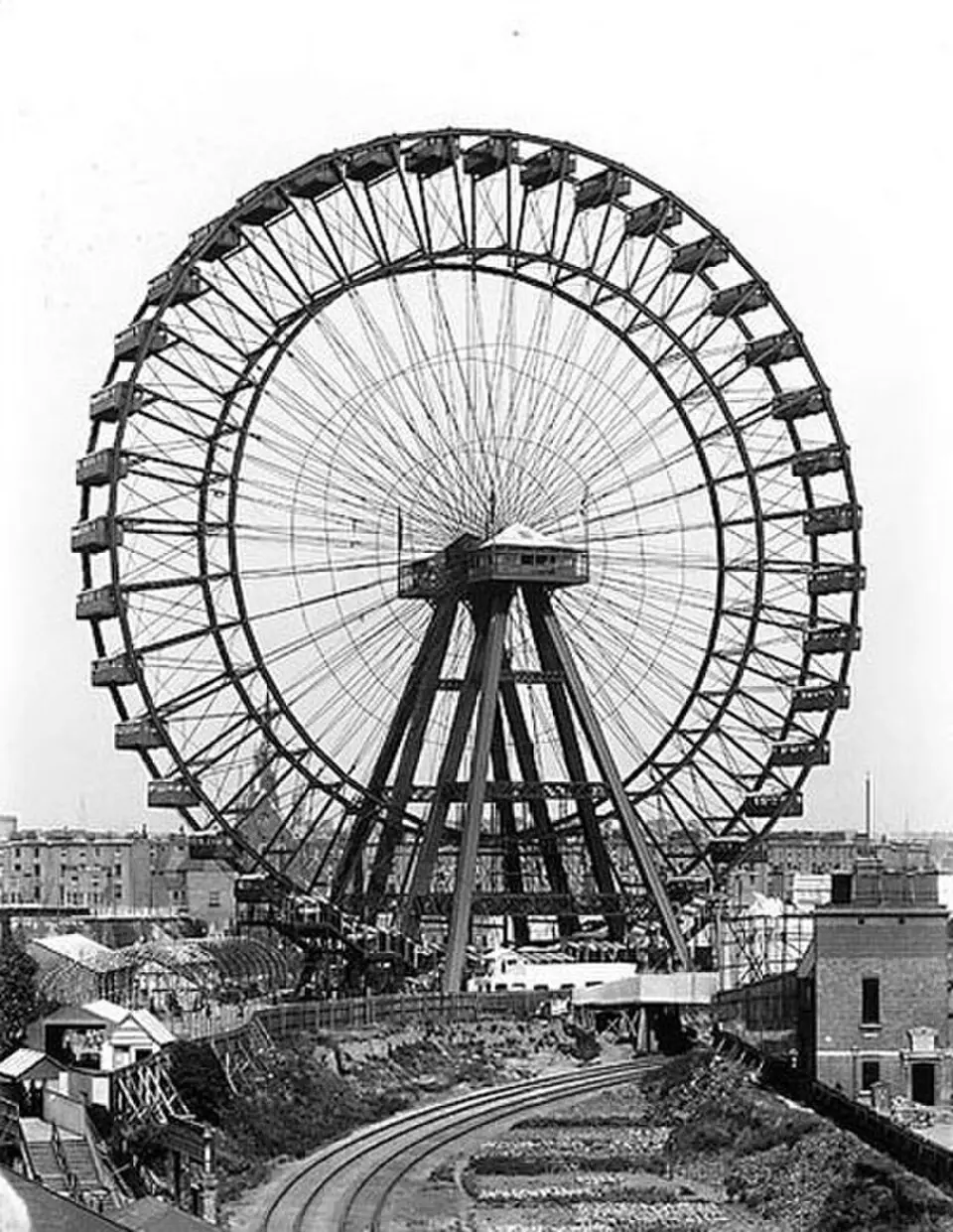
The Great Wheel, officially called The Gigantic Wheel, was a historic Ferris wheel in London that operated from 1895 to 1907. At a height of 93.9 meters, it surpassed its model, the Chicago Ferris Wheel, and remained the largest in the world until the completion of the Paris wheel in 1900. The structure was built at the Earls Court Exhibition Centre in the Royal Borough of Kensington and Chelsea, an area that served as a permanent venue for large themed exhibitions at the beginning of the 20th century. The wheel was part of the Empire of India Exhibition and was constructed by the company Maudslay, Sons and Field. During its nearly twelve years of operation, it carried an estimated 2.5 million passengers before being dismantled because it failed to turn a profit.
The wheel's design was technically demanding and differed markedly from the Chicago original. It rested on a 53.3-meter-high support structure of eight columns, anchored in massive, pyramid-shaped concrete blocks to ensure the stability of the 1,100-ton installation. A special feature was the pair of covered, balcony-like platforms at the center of the wheel, which were designed as a promenade with views and a restaurant. They were meant to be reached by elevators but were probably never completed or used. The wheel had 40 rectangular cars, each able to hold up to 40 people, built by a railway carriage manufacturer from near Birmingham. One full revolution took about 20 minutes, and on clear days there were sight lines all the way to Windsor Castle.
Unlike in Chicago, the wheel was not driven via its axle but by a complex system of two underground chains powered by two steam engines. This design allowed for smooth starting and stopping without placing static loads on the structure. Despite these technical innovations, there were incidents during its years of operation in which passengers were stuck for extended periods. After the last major exhibition, the Imperial Austrian Exhibition of 1906, the laborious dismantling of the wheel began in 1907. Because demolition by explosives was not possible due to the proximity of railway lines, 200 workers took the structure apart piece by piece over four months. Today nothing at the site recalls the structure, as the Lillie Bridge railway depot now stands there, although the foundations have survived underground.
At a glance
- Category
- Museum › Museums (general)
- Rating
- no reviews yet · write a review
- Address
- London
SW6 1TR London, United Kingdom - District
- London Borough of Hammersmith and Fulham
- Phone
- —
- Website
- en.wikipedia.org
- —
- Coordinates
- 51.48830° N · -0.19889° E
- Data quality
- confidence 0.82
- Identifier
- ID dadd8a94-805…
Location & surroundings
Toggle layersRatings & comments
none yetNear Great Wheel
closest 5 per category · 2 kmSights
Restaurants
Museums
Hotels
More:Museums in London Borough of Hammersmith and Fulham (19)All museums in London (825)
279 places within 2 km loaded.
You need a free account to leave reviews and photos – that keeps comments genuine and lets you edit them later.