About Scott Monument
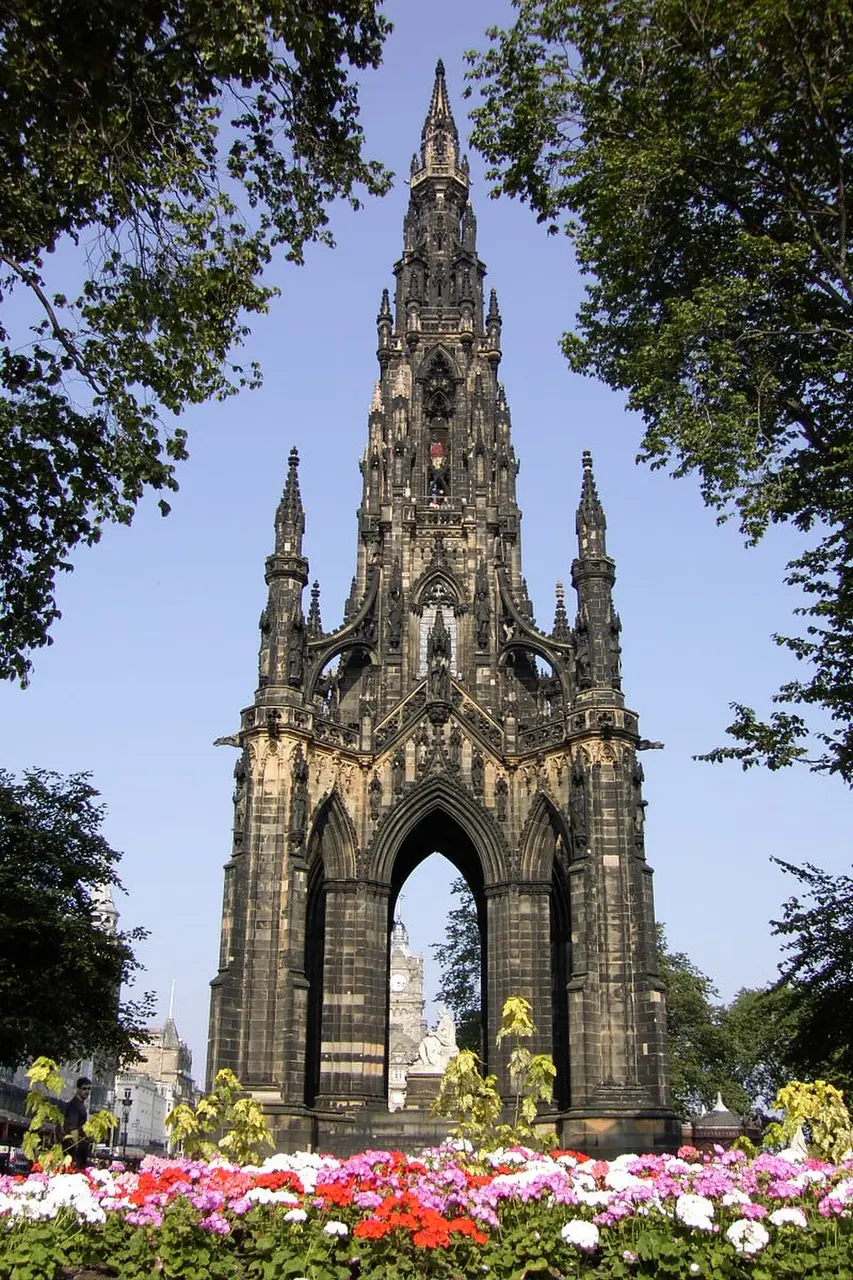
The Scott Monument in Edinburgh is an impressive Victorian Gothic memorial dedicated to the Scottish writer Sir Walter Scott. It stands in Princes Street Gardens, directly across from the former Jenners building and close to Edinburgh Waverley Railway Station. At over 61 meters (200 feet) tall, it is considered the second-largest monument to a writer anywhere in the world, after the José Martí Memorial in Havana. The structure dominates the eastern part of the park and forms an important visual focal point in the city, partially blocking the view of the historic Old Town. Visitors can reach several viewing platforms via a series of spiral staircases with a total of 287 steps. From the top, you get a panoramic view over the center of Edinburgh and the surrounding landscape.
The monument was built from Binny sandstone quarried in West Lothian. The story of its construction is closely tied to the architect George Meikle Kemp, who won the design competition under the pseudonym John Morvo. The foundation stone was laid in 1840, and construction continued until the fall of 1844. Tragically, Kemp died before the official unveiling in 1846, having drowned in the Union Canal. The structure is richly decorated and holds 64 figures of characters from Scott's novels, created by various Scottish sculptors. Inside the four pillars stands a marble sculpture of Scott himself, shown with his quill and his dog Maida. On the lower surfaces, you can also see the heads of sixteen Scottish poets and writers.
The preservation of the monument was the subject of intense debate in the 1990s. A scientific study concluded that cleaning the stone would cause major damage. Instead, a restoration program was carried out in which damaged areas were replaced with fresh stone from the original quarry, resulting in a visible contrast between the new stone and the smoke-blackened original sections. Today, the monument is managed by the City of Edinburgh Council. In 2016, a new LED lighting system was installed that highlights the tower's architectural features with a soft, warm glow. The Scott Monument remains an iconic landmark of the city and a popular destination for tourists who want to enjoy the history and the views.
At a glance
- Category
- Sight › Monuments
- Rating
- no reviews yet · write a review
- Address
- E. Princes St Gardens
EH2 2EJ Edinburgh, United Kingdom - District
- Old Town
- Phone
- +441315294068
- Website
- www.edinburghmuseums.org.uk
- museumcollectionscentre@edinburgh.gov.uk
- Coordinates
- 55.95238° N · -3.19330° E
- Data quality
- confidence 0.97
- Identifier
- ID d5919ce0-2d3…
Part of the tour
Edinburgh in One Day: Castle, Royal Mile and Calton Hill →Location & surroundings
Toggle layersFAQ about Scott Monument
quick answersWhat is the Scott Monument in Edinburgh?
The Scott Monument is a Victorian Gothic monument in Edinburgh dedicated to the Scottish writer Sir Walter Scott. It stands in Princes Street Gardens (address: E. Princes St Gardens), near Edinburgh Waverley Railway Station and opposite the former Jenners building. At more than 61 meters (200 feet) tall, it is considered the second-largest monument to a writer in the world, after the José Martí Memorial in Havana.
Can you climb the Scott Monument in Edinburgh?
Yes, you can climb the Scott Monument in Edinburgh via spiral staircases. A total of 287 steps lead up to several viewing platforms. From there, you get panoramic views over the center of Edinburgh and the surrounding landscape.
Who built the Scott Monument in Edinburgh, and when?
The Scott Monument in Edinburgh was designed by the architect George Meikle Kemp, who won the design competition under the pseudonym John Morvo. The foundation stone was laid in 1840, and construction continued until the fall of 1844. Kemp drowned in the Union Canal and did not live to see the official inauguration in 1846. The monument was built from Binny sandstone from West Lothian.
What figures and details can you see on the Scott Monument in Edinburgh?
The Scott Monument in Edinburgh features 64 figures of characters from Sir Walter Scott's novels, created by various Scottish sculptors. Between the four pillars stands a marble sculpture of Scott with a quill and his dog Maida, and the heads of sixteen Scottish poets and writers are mounted on the lower surfaces. The contrast between the smoke-blackened original stone and the light-colored replacement stone from the original quarry is striking; it was used in a restoration following surveys in the 1990s. Since 2016, an LED lighting system has highlighted the tower's architecture with warm light.
What can you see around the Scott Monument in Edinburgh?
Around the Scott Monument in Edinburgh, several other monuments lie within walking distance. travelguide195 lists the Livingstone Monument (about 53 meters away), The Monument of the Royal Scots (about 65 meters), the Thomas Chalmers Statue (about 206 meters), and the Melville Monument (about 208 meters), among others. Within a 500-meter radius, travelguide195 lists around 245 restaurants, and the Scott Monument is part of the tour "Edinburgh in a Day: Castle, Royal Mile and Calton Hill."
Ratings & comments
none yetNear Scott Monument
closest 5 per category · 2 kmSights
Restaurants
Museums
Hotels
More:Monuments in Edinburgh (44)Sights in Old Town (80)All sights in Edinburgh (363)
300 places within 2 km loaded.
You need a free account to leave reviews and photos – that keeps comments genuine and lets you edit them later.
Sir Walter Scott (1771-1832) re-invented Scotland. In the late Georgian era, he popularised tales of its medieval and Jacobean tumults, and created the clan tartans you buy on Princes St. This grand Gothic memorial, part cathedral part moon rocket, was completed in 1846 to dominate the east end of Princes St. It's 200 ft 6 in / 61.1 m tall, and guided tours take you up 287 steps (no lift) to the top platform, for a closer look at many of the statuettes of characters from Scott's works. The man himself and his dog sit in state at the base. In the 1990s the curators considered cleaning the monument but realised that the Victorian grime was holding it together, so replacement stonework is prominently white.
Source: Wikivoyage, „Edinburgh/New Town“ · authors per page history · CC BY-SA 4.0 · as of 10/27/2026