About Holyrood Castle
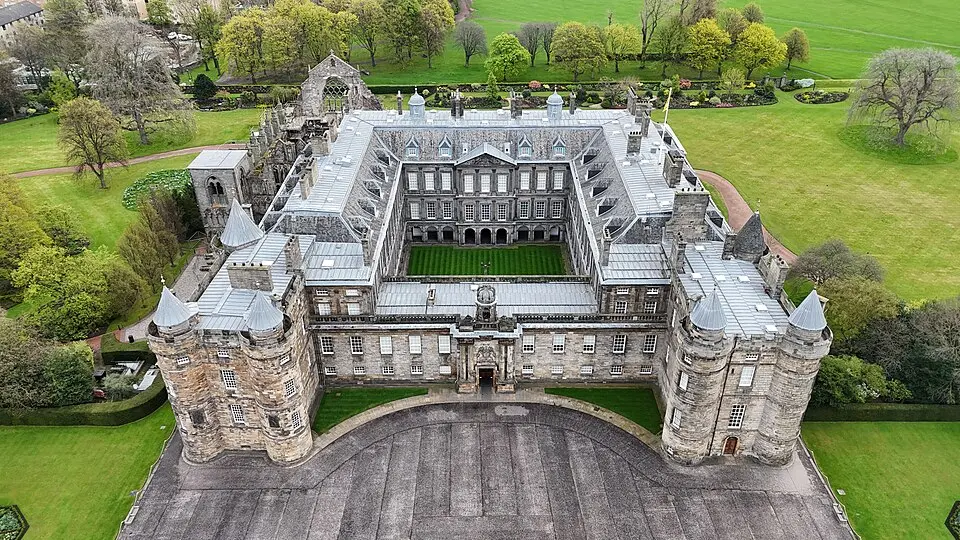
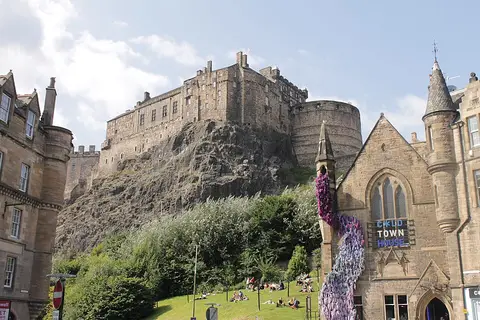
Holyrood Palace, also known as the Palace of Holyroodhouse, is the official residence of the British monarch in Scotland. The historic complex stands at the eastern end of the Royal Mile in Edinburgh, the famous street that climbs up to Edinburgh Castle. The expansive Holyrood Park adjoins the palace directly, providing a charming contrast to the urban surroundings. Since December 14, 1970, the entire complex has been protected as a Category A listed building, which underscores its great historical and cultural value.
The history of the site reaches far back beyond the construction of today's palace. As early as 1128, King David I founded Holyrood Abbey on this land. A royal foundation close to Edinburgh Castle, the abbey developed into an important administrative center. The Scottish Parliament met here frequently between 1256 and 1410, and from 1329 the abbey probably already served as a royal residence. Several Scottish kings, including David II and James II, were born or buried here. The first actual royal residence was in the abbey's guesthouse, on the spot where the north section of the palace stands today.
The transition from abbey to palace took place in the early 16th century. Beginning in 1501, James IV of Scotland had a new Gothic palace built to replace the old guesthouse. The building, which probably came about at the initiative of his wife Margaret Tudor, included a tower, a great hall, a chapel, and a gatehouse. In the 1530s, James V added the northwest tower that still stands today and introduced Renaissance elements. This phase left a lasting mark on the appearance of the palace and laid the foundation for its later development.
A central chapter in the palace's history is the era of Mary, Queen of Scots. The queen lived in the apartments in the northwest tower from 1561 until her forced abdication in 1567. Important political discussions took place in these rooms, and it was here that she married her cousin Henry Stuart, Lord Darnley, in 1565. The memory of the murder of her private secretary David Rizzio in 1566, which took place in her private chambers, remains a tragic one. These historic events make the rooms a place of great emotional and historical significance for visitors.
After the Scottish court moved to London in 1603, the palace lost its role as a main residence and at times fell into neglect. It was not until the reign of Charles II that the palace acquired its present exterior form. Between 1671 and 1679, the king had the complex rebuilt as a four-winged structure to plans by the architect William Bruce. This work incorporated the existing fabric and created a harmonious blend of Renaissance and Baroque architecture. In the 19th century, a southwest tower was added to give the entrance facade a symmetrical appearance.
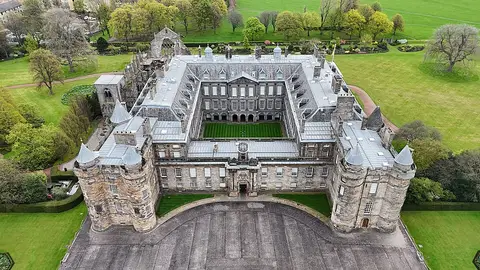
The palace is a self-contained, four-winged complex with a square footprint of roughly 70 by 70 meters (about 230 by 230 feet). The oldest part is the northwest tower, while the younger southwest tower dates only from the 19th century. Both towers feature small round corner turrets and crenellated parapets. The west wing houses the main portal, which is flanked by Doric columns and crowned by an octagonal superstructure with a clock face and crown. The courtyard facades display a typical classical arrangement, with Doric, Ionic, and Corinthian pilasters on the different floors.
West of the main building lies a forecourt with a striking fountain, a copy of the fountain at Linlithgow Palace. The fountain was installed in 1861 at the initiative of Queen Victoria and is topped by a crown with the Scottish lion. The crown is supported by stone figures representing personalities from Scottish and English history, including Mary, Queen of Scots, and Oliver Cromwell. Access to the palace forecourt is through wrought-iron gates decorated with bronze figures of Saint Andrew and the Scottish crown.
Visitors can tour part of the interior whenever the royal family is not in residence. The historic royal apartments in the northwest tower date from the 16th century and are furnished with Baroque furniture and Flemish tapestries. In the queen's bedchamber, you can still see the original oak coffered ceiling from the time of Mary, Queen of Scots, which bears the initials of her parents. A brass plaque marks the spot where David Rizzio was murdered. These rooms offer an intimate glimpse into the lives of Scotland's kings and queens.
The present-day State Apartments on the first floor were designed to the wishes of Charles II and feature decorative stucco ceilings. They include the throne room, which was fitted out for a visit by George IV, as well as various drawing rooms with tapestries and paintings. The Great Gallery, the largest room in the palace, holds 111 portraits of Scottish monarchs painted by Jacob de Wet II. Today the gallery is used for large banquets and offers an impressive look at the artistic tradition of the house.
The palace grounds surrounding the building were laid out in the 19th century at the behest of Prince Albert as an English landscape garden. They are part of the larger Holyrood Park and contain historic relics such as a sundial from 1633 and a small garden house from the 16th century. The grounds were once the setting for the queen's large garden parties. Today they invite you to take quiet strolls and form a green frame for the palace's historic architecture.
Holyrood Palace is not only a residence but also a place of living traditions. The Scottish government is responsible for maintaining the building, while the Royal Collection Trust organizes public access. Foreign heads of state regularly visit the palace, and it serves as the stage for important state occasions. The combination of historic fabric, architectural beauty, and continued royal use makes Holyrood Palace one of the most significant sights in Edinburgh.
At a glance
- Category
- Sight › Monuments
- Rating
- no reviews yet · write a review
- Address
- Canongate
Edinburgh, United Kingdom - District
- Old Town
- Phone
- +441315565100
- Website
- —
- —
- Coordinates
- 55.95331° N · -3.17322° E
- Data quality
- confidence 0.71
- Identifier
- ID 15217aec-b95…
Part of the tour
The Old Town on Foot: From the Castle Rock to Holyrood →Location & surroundings
Toggle layersRatings & comments
none yetNear Holyrood Castle
closest 5 per category · 2 kmSights
Restaurants
Museums
Hotels
More:Monuments in Edinburgh (44)Sights in Old Town (80)All sights in Edinburgh (363)
294 places within 2 km loaded.

You need a free account to leave reviews and photos – that keeps comments genuine and lets you edit them later.