Kharkiv Oblast: A University City Near the Border
Travel guide · editorialKharkiv Oblast in northeastern Ukraine borders Russia and has been especially hard hit by Russia's war of aggression since 2022. A travel warning is in effect for Ukraine, and parts of the oblast have been occupied or remain contested. Travel to Kharkiv is therefore not advisable at present; this profile introduces the country's second-largest city and its surroundings as visitors will experience them once the situation allows.
Kharkiv: City of Science
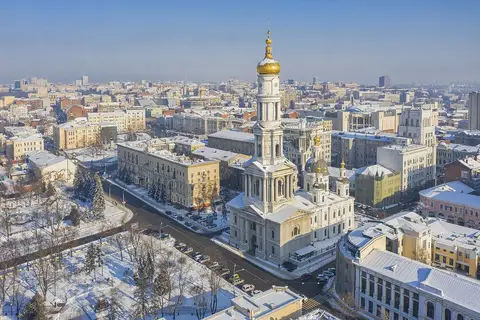
Kharkiv was the capital of the Ukrainian Soviet Republic from 1919 to 1934 and remains a center of higher education, research, and industry. Freedom Square is among the largest city squares in Europe; on it stands the Derzhprom, a constructivist high-rise complex from the 1920s that is considered one of the first skyscraper ensembles in the Soviet Union. The Dormition Cathedral with its bell tower, Gorky Park, and Shevchenko Garden with its monument to the national poet are among the sights in Kharkiv. The metro, which at times served as a shelter and school, is a chapter of recent history all its own.
Landscape and Places in the Oblast
The oblast lies in the transition zone between forest steppe and steppe, traversed by the Siverskyi Donets and Oskil rivers. Along the Siverskyi Donets lay popular excursion spots with pine forests and sanatoriums. Izium, Kupiansk, and Balakliia were occupied in 2022 and liberated by Ukrainian troops in the fall of that year; mass graves were later found in Izium. Many towns in the east and north of the oblast are heavily destroyed and remain combat zones or are under fire.
In the south of the oblast, around Krasnokutsk and Zharkivshchyna, you will find 19th-century manor estates and landscape parks, and in Natalivka a sugar manufacturer had a park with an Art Nouveau church laid out. In Skovorodynivka, a museum commemorating the philosopher Hryhorii Skovoroda was destroyed by a missile strike in 2022.
In the north, near Slatyne and Derhachi, there was forest-steppe farmland, and in the south, steppe with livestock farming. The painter Ilya Repin spent his youth in Chuhuiv, where a museum displays his works. Homilsha Forests National Park protects oak forests along the Siverskyi Donets, which were once a popular weekend destination for people from Kharkiv.
Culture and History
Kharkiv was founded as a fortress in the 17th century and developed into a merchant and university city; the university dates from 1805. In the 1920s the city enjoyed a flowering of Ukrainian literature and art, which ended in the Stalinist purges of the 1930s as the "Executed Renaissance." The Literature Museum commemorates this period. Since 2022, street art, concerts in metro stations, and cultural initiatives have shaped the city's spirit of resistance.
For visitors in calmer times, the Botanical Garden, the art museum with works by Ilya Repin, and the zoo, which was rebuilt after being destroyed, are worth a visit. Sumska Street, with its cafés and theater, is one of the liveliest streets in the city.
Food and the Situation Today
In Kharkiv you eat Ukrainian and Eastern European food: borscht, varenyky, deruny (potato pancakes), and fish from the rivers. The airport is closed; Kharkiv can be reached by train from Kyiv. The city is regularly attacked with missiles, glide bombs, and drones; travel is discouraged, and current safety advisories must be followed without fail.