About Kunsthaus Zürich
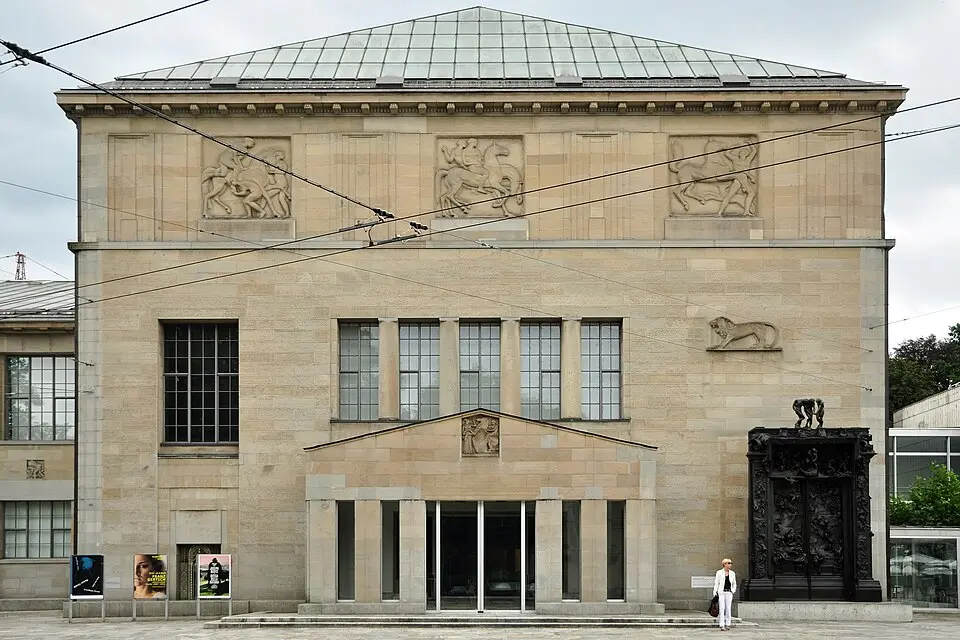
The Kunsthaus Zürich is considered the largest art museum in Switzerland and houses one of the country's most important art collections. With 11,500 square meters (about 124,000 square feet) of exhibition space, the museum extends across a four-part building complex that shapes the Heimplatz in the city of Zurich. The complex consists of the historic Moser Building, the Bührle Hall, the Müller Building, and a modern extension that opened in 2021. Together with the nearby Schauspielhaus theater, the architecture of these buildings forms an urbanistically significant ensemble in the heart of the city.
The history of the institution goes back to 1787, when a circle of artists and art lovers came together to found the Zürcher Künstlergesellschaft (Zurich Society of Artists). After acquiring a property on what is now Künstlergasse, the so-called Künstlergütli was inaugurated in 1847 as the first Kunsthaus. Because this building proved too small for the growing collection and changing exhibitions, however, the society looked for a new location. Only after lengthy negotiations and a failed land swap was the site on today's Heimplatz secured.
The new building was designed by the architect Karl Moser and ceremoniously opened on April 17, 1910. The facade of the Moser Building is richly decorated with architectural art, including reliefs by Carl Burckhardt depicting Amazons and mythological scenes. Nude figures by various sculptors stand between the columns on the upper floor. This historic fabric forms the core of today's museum and has been supplemented by later additions.
A first expansion followed in 1925 with an extension reaching back into the plot, closing the gap between the main building and the Villa Landolt. The second major expansion opened in 1958 and was made possible largely by funding from the arms manufacturer Emil G. Bührle. This wing, known as the Bührle Hall, provides additional space for exhibitions. In 1976, the complex was completed with the Müller Building, which fills the triangle between Hirschengraben and the existing building and includes rooms for photography, among other things.
The most recent extension, by Chipperfield Architects, opened in October 2021 and nearly doubled the exhibition space. One third of the building was financed with tax money and another third with donations. Among other things, it houses the extensive private collection of Emil G. Bührle, which is on permanent loan to the museum. Since its opening, however, the presentation of this collection has been the subject of intense public and political debate.
The Kunsthaus collection spans works from the 13th century to the present day. Its international highlights include the largest collection of works by Edvard Munch outside Norway and the most comprehensive collection of works by the Swiss artist Alberto Giacometti. You can also see masterpieces by Pablo Picasso, Claude Monet, Vincent van Gogh, Marc Chagall, and the Expressionists Oskar Kokoschka, Max Beckmann, and Lovis Corinth. The Dada movement is also represented with important pieces, as are works of Pop Art and contemporary Swiss artists.
The collection of the Gottfried Keller Foundation is of particular importance; it has placed numerous masterpieces of Swiss painting with the museum as deposits. These include works by Ferdinand Hodler, Giovanni Segantini, Arnold Böcklin, and Johann Heinrich Füssli. These loans complement the museum's own collection and give visitors a comprehensive overview of the art history of Switzerland and Europe.
The presentation of the Bührle Collection has been accompanied by controversy since the extension opened. The collection, financed by arms deals in the 20th century, contains works whose provenance must be investigated in connection with the Nazi era. Independent experts criticized the foundation's provenance research as inadequate and not transparent. As a result, the loan agreement had to be revised and a new agreement concluded that explicitly requires compliance with the Washington Principles on the restitution of Nazi-looted art.
To shed light on the origins of the works, the historian Raphael Gross was commissioned to review the existing research. His report found that further research is needed for numerous works that were previously owned by Jews between 1933 and 1945. The Bührle Foundation has since removed some works from the exhibition or reached settlements with the heirs of the former owners. A full reassessment and a new presentation of the collection, with detailed information on the Jewish previous owners, are planned for 2027 and 2028.
In addition to the permanent collection, the Kunsthaus regularly organizes changing exhibitions and events. Visitors experience the museum as a place that combines historic architecture with modern art while also taking up social and historical questions. The forecourt and the inner courtyards, such as the Lydia-Welti-Escher-Hof, invite you to linger and offer additional stimulation through sculptures and installations. The Kunsthaus Zürich thus remains a central cultural venue that engages with both the history and the present of art.
At a glance
- Category
- Museum › Art museums
- Rating
- no reviews yet · write a review
- Address
- Heimplatz 1
8001 Zurich, Switzerland - District
- Altstadt
- Phone
- +41442538484
- Website
- www.kunsthaus.ch
- info@kunsthaus.ch
- Coordinates
- 47.37092° N · 8.54895° E
- Data quality
- confidence 1.00
- Identifier
- ID c3461c98-1c5…
Part of the tour
Zurich in a Day: Old Town, Limmat River and Lakefront →Location & surroundings
Toggle layersRatings & comments
none yetNear Kunsthaus Zürich
closest 5 per category · 2 kmMuseums
Hotels
More:Art museums in Zurich (21)Museums in Altstadt (33)All museums in Zurich (98)
290 places within 2 km loaded.
You need a free account to leave reviews and photos – that keeps comments genuine and lets you edit them later.
Zurich's most famous art museum. The collection includes works from many Swiss artists, such as the sculptures of Alberto Giacometti or the paintings of Ferdinand Hodler. There are also major works from international artists on display. The museum is building a new extension, scheduled to open in 2020 and thus parts of the museum might be closed at any given time.
Source: Wikivoyage, „Zurich“ · authors per page history · CC BY-SA 4.0 · as of 7/21/2017