Västra Götaland: Gothenburg, Bohuslän, and Lake Vänern
Travel guide · editorialVästra Götaland stretches from the bare granite skerries on the Norwegian border to the shores of two large lakes inland. A vacation in Västra Götaland pairs the laid-back port city of Gothenburg with fishing villages on the west coast, castles on Lake Vänern, and canals where excursion boats glide through locks. The province, officially Västra Götaland County, is the second most populous in Sweden.
Landscape Between the Kattegat and Inland Lakes
To the west lies the Bohuslän coast, with roughly 8,000 islands and skerries, smoothly polished pink granite rocks, and deeply cut fjords such as the Gullmarsfjord. Farther inland, the plains of Västergötland stretch out, dotted with farms, churches, and flat-topped hills such as Kinnekulle and Billingen near Skövde. To the north, the province borders Lake Vänern, Sweden's largest lake, and to the east Lake Vättern. Dalsland in the northwest is a maze of lakes and forests, ideal for canoe trips. The mouth of the Göta älv divides Gothenburg into the mainland and the island of Hisingen, where the big shipyards once stood. North of the city, Tjörn and Orust mark the start of an island world connected to the mainland by bridges.
Gothenburg: A City on the Harbor
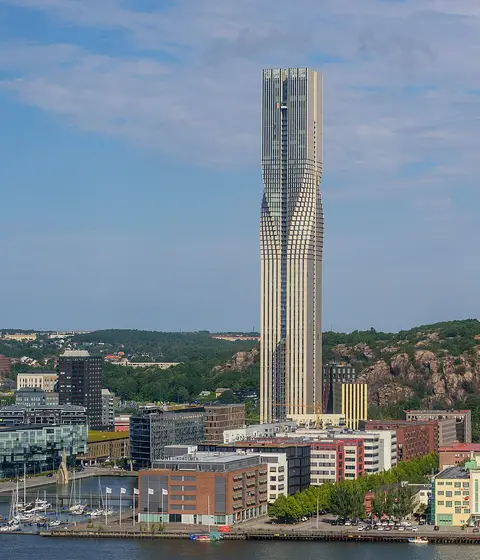
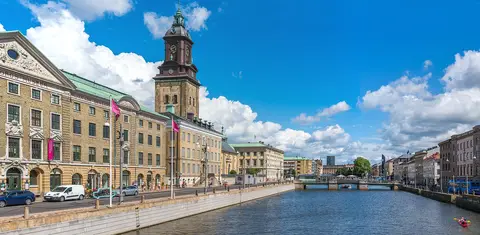
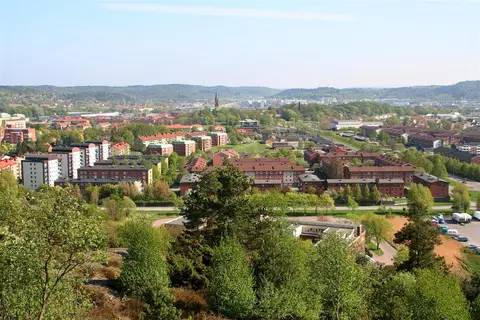
Gothenburg was laid out in 1621 by Dutch builders, and its canals and quays are a reminder of that. Avenyn is the boulevard leading to the art museum and to Götaplatsen with its Poseidon statue, while Haga, with its wooden houses and cafés, is known for its enormous cinnamon buns. The Liseberg amusement park is among the most popular in Scandinavia, the Universeum showcases rainforest and sharks, and the Feskekôrka fish church is a market hall shaped like a church. From Saltholmen, ferries take you to the car-free skerries of the southern archipelago, with swimming spots on smooth rocks. Suburbs such as Skintebo in the southwest already lie on the coast. The opera house sits on the harbor, and across the river Lindholmen, with its ferries, cranes, and restaurants, shows the modern face of Gothenburg. Slottsskogen is a large city park with animal enclosures, and the Botanical Garden is one of the largest in Northern Europe.
Sights in Västra Götaland
Trollhättan is famous for its waterfalls and lock staircase on the Göta älv; on some summer days the locks are opened and the falls roar again. The town is also a center of Swedish film production. On Lake Vänern near Lidköping, Läckö Castle, a Baroque palace, stands on a peninsula surrounded by gardens. In Bohuslän, Marstrand with Carlsten Fortress, Smögen with its wooden boardwalk lined with fish shacks, Fjällbacka, and the Tanum rock carvings, a UNESCO World Heritage Site dating from the Bronze Age, are the best-known Västra Götaland destinations. Uddevalla on the Byfjord is the gateway to the north coast. Borås, once the textile capital, has reinvented itself with street art and a textile museum, and Alingsås calls itself the coffee capital of Sweden. On Tjörn, the Nordic Watercolor Museum stands right on the water in Skärhamn, and on Orust sailboats are still traditionally built. Skövde at the foot of Billingen is the starting point for Lake Hornborga, where thousands of cranes gather every spring for their mating dance. Lidköping on Lake Vänern is also known for the Rörstrand porcelain brand.
Food and Drink
The west coast is Sweden's seafood coast. Lobster season begins in the fall, oysters are harvested near Grebbestad in winter, and shrimp, mussels, and Norway lobster are available year-round. Classics include shrimp sandwiches and fish soup, along with fish from Feskekôrka in Gothenburg. Inland, you'll find lamb from the pastures of Kinnekulle on the menu. Gothenburg also has an excellent restaurant and craft beer scene. Crayfish season starts in August, and in the harbor towns of Bohuslän, smokehouses sell mackerel and salmon.
Getting There and Best Time to Visit
Landvetter Airport is about 25 kilometers east of Gothenburg, and ferries connect Gothenburg with Kiel and Frederikshavn. Express trains run to Stockholm, Oslo, and Malmö. For the coast, a car or the regional buses are the best option. The best time to visit Bohuslän is from June to August, while September is ideal for seafood and quiet days; Gothenburg is worth visiting all year, in December with the Christmas market at Liseberg. If you want to explore Bohuslän without a car, take the Bohus Line from Gothenburg to Strömstad, which runs along fjords and lakes.