Västernorrland: The High Coast and Stone-Built Sundsvall
Travel guide · editorialNowhere else in the world does the land rise as dramatically as on the High Coast in Västernorrland: since the last Ice Age, the ground has risen by almost 300 meters. If you're planning a trip to Västernorrland, you'll find steep coastal mountains rising straight out of the sea, quiet fishing villages, and a city of stone that was rebuilt after a great fire.
Landscape Between Sea and River Valleys
The province lies on the Gulf of Bothnia and is crossed by broad river valleys, above all the Ångermanälven and the Indalsälven, where timber was once floated downriver to the sawmills on the coast. Inland, forests, lakes, and farms alternate; near Sollefteå, the Ångermanälven flows through a gentle landscape with rapids. The coast breaks up into islands, bays, and peninsulas, especially between Härnösand and Örnsköldsvik. The coastal mountains rise to almost 300 meters above the water, and at Skuleberget you can make out the former shoreline high above today's sea. The island of Alnön off Sundsvall is reachable by bridge and offers swimming beaches and old fishing huts.
Sights in Västernorrland
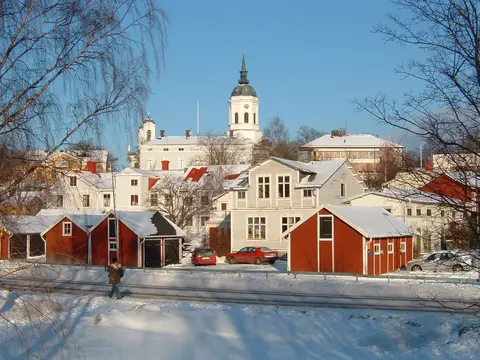
The Höga Kusten, or High Coast, is a UNESCO World Heritage Site together with Finland's Kvarken Archipelago, because the post-Ice Age land uplift can be read particularly well here. Skuleskogen National Park offers hiking trails through old-growth forest and to the spectacular rock fissure Slåttdalsskrevan; from Skuleberget the view stretches far over sea and land; the Högakustenbron suspension bridge spans the Ångermanälven. Small fishing villages such as Bönhamn and Barsta have smokehouses and harbor cafés, and on the island of Ulvön lies one of the prettiest fishing villages on the coast. Sundsvall burned down in 1888 and was rebuilt in stone; the Stenstan district, with its magnificent townhouses, bears witness to the wealth of the timber industry. Härnösand, the capital, has a cathedral and the Murberget open-air museum. Örnsköldsvik is known for winter sports and has a reputation as a hockey town. In Kulturmagasinet, four converted warehouses housing a museum and library, Sundsvall has a lively gathering place. The long-distance Höga Kustenleden trail runs about 80 miles (130 kilometers) from the suspension bridge across the coastal mountains to Örnsköldsvik. Sollefteå, inland, draws visitors in winter with cross-country ski trails and a ski jump.
Culture and History
In the 19th century, dozens of sawmills sprang up along the coast, and the region grew rich. The labor struggles of the sawmill workers are part of the history of the Swedish labor movement; in Ådalen near Kramfors, five people were shot dead at a demonstration in 1931. Bo Widerberg's film "Ådalen 31" tells the story of these events.
Food, Getting There, and Best Time to Visit
The High Coast is famous for surströmming, fermented Baltic herring, traditionally eaten outdoors at the end of August with tunnbröd, potatoes, and onions; its smell is legendary. You'll also find smoked fish and cloudberries. The East Coast Line and the Botnia Line connect Sundsvall, Härnösand, and Örnsköldsvik with Stockholm and Umeå, and Sundsvall has an airport. The best time to visit is summer and early fall. In summer, boats run from Köpmanholmen to the islands of Ulvön and Trysunda, and many accommodations are in converted fishing huts.