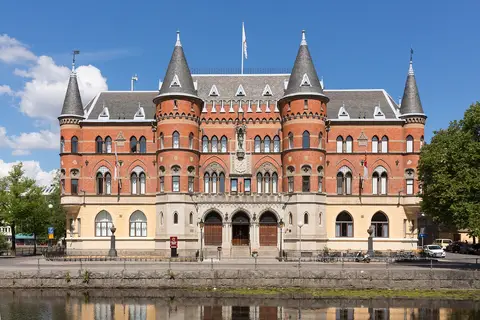
Örebro County: Castle, Bergslagen and Tiveden
Travel guide · editorialÖrebro County lies in the heart of Sweden, where the fertile Närke plain meets the forests and old mines of Bergslagen. A vacation in Örebro County takes you to a moated castle in the middle of the city, to wooden-house towns of the ore mines, and into the wild Tiveden National Park.
Landscape and Location
The south of the county is shaped by the Närke plain, which stretches west from Lake Hjälmaren to the Kilsbergen ridge. To the north begins Bergslagen, a landscape of forests, lakes and mining towns where iron and silver were extracted for centuries. In the far south, the county reaches Lake Vättern, where islands dot the water near Askersund. Tiveden National Park, on the border with Västra Götaland, is an area of granite cliffs, huge boulders and dense forest, ideal for hiking. Hjälmaren is Sweden's fourth-largest lake and is known for its pikeperch; on its western shore lies the Kvismaren bird sanctuary. In the forests of Tiveden, trolls play a role in many legends.
Sights in Örebro County
Örebro, one of Sweden's larger cities, is dominated by the castle on an island in the Svartån River, a medieval fortress with four round towers. A walking path along the river leads to the Wadköping open-air museum, with old wooden houses and craftspeople, as well as to the city park. The Svampen water tower, "the Mushroom," offers views over the plain. Karlskoga is closely tied to Alfred Nobel, who owned the Bofors armaments works here; his home, Björkborn, is now a museum. Nora in the north is one of Sweden's best-preserved wooden towns, with a heritage railway and mines in the surrounding area, such as Pershyttan with its blast furnace. In Askersund, Stjernsund Castle on Lake Vättern is worth a visit. Askersund, at the northern tip of Vättern, is the starting point for boat trips into the lake's archipelago. In the north, Hällefors and Grythyttan, home to a culinary college, have developed into a destination for food lovers, and on the outskirts of Örebro the Oset-Rynningeviken nature reserve invites you to take a stroll. Karlskoga attracts visitors with swimming beaches on Lake Möckeln.
Culture and History
In Örebro in 1810, the Estates elected the French marshal Jean-Baptiste Bernadotte as heir to the throne; his descendants still rule Sweden today. The mining tradition is visible in many places, from ironworks to workers' settlements. Today Örebro is a logistics and university hub with a lively city center. The castle, built as a fortress in the Middle Ages and expanded under the Vasa kings, now houses exhibitions. Hallsberg has one of the largest rail marshalling yards in Scandinavia.
Food, Getting There and Best Time to Visit
The farms of the Närke plain sell grain, vegetables and meat in farm shops; in Nora you'll find the famous Noraglass, ice cream from a long-established kiosk by the lake. The forests provide mushrooms, berries and game. Örebro can be reached by train from Stockholm in about two hours; the airport is used mainly for charter and cargo traffic. The best time to visit is between May and September. In Grythyttan, dinner at the venerable Gästgivaregård is well worth it. At the markets, mushrooms and berries from Bergslagen are sold, and many farms bake their own bread.