Iași: The Cultural Capital of Moldavia
Travel guide · editorialIași, known in German as Jassy, was the capital of the Principality of Moldavia for centuries and is still regarded as Romania's intellectual heart. A trip to Iași takes you to neo-Gothic palaces, lavishly decorated churches, the country's oldest university, and vineyards whose sweet white wines were once served at European courts.
Rolling Hills on the Border with the Republic of Moldova
The county lies in northeastern Romania between the Siret and Prut rivers, the latter forming the border with the Republic of Moldova. The landscape is gently rolling: wheat fields, orchards, oak forests, and vine-covered slopes, with villages of blue-painted wooden houses in between. Like Rome, Iași itself is built on seven hills, and from Copou Hill or the Bucium vineyard you get sweeping views over the city. Valea Lupului and other suburbs are growing quickly, as the city of around 270,000 residents attracts students and IT companies.
Sights in Iași
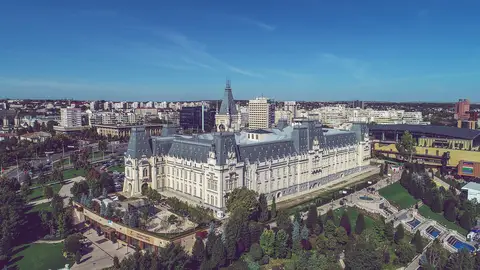
The Palace of Culture at the end of Stefan cel Mare Boulevard was built in the neo-Gothic style in the early 20th century and now houses four museums, including the art museum and the history museum. A few steps away stands the 17th-century Church of the Three Hierarchs, whose exterior walls are completely covered in carved stone patterns, a masterpiece of Moldavian stonework. The Metropolitan Cathedral houses the relics of Saint Parascheva; hundreds of thousands of pilgrims arrive for her feast day on October 14. Other highlights include the fortified Golia Monastery, the Great Synagogue, one of the oldest in Romania, and the National Theater with its Viennese Rococo hall by Fellner and Helmer. Additional sights in Iași include the university's Botanical Garden, one of the largest in the country, and Union Square, where student cafés and bookstores stay open late into the evening.
Culture and History
Iași became the capital of Moldavia in 1564, and in 1860 the country's first modern university was founded here, today's Alexandru Ioan Cuza University. During World War I, the city served as the capital of Romania from 1916 to 1918, after Bucharest was occupied. Poets such as Mihai Eminescu and Ion Creangă shaped the literary life of the city; in Copou Park you can still see the linden tree under which Eminescu is said to have written. Outside the city, the palace of Alexandru Ioan Cuza in Ruginoasa, the first prince of the united principalities, is well worth a visit.
Wine and Moldavian Cuisine
In the Cotnari wine region north of Iași, native grape varieties such as Grasă de Cotnari, Tămâioasă Românească, and Frâncușă are grown. The sweet Grasă wines are the best known, but dry versions are becoming increasingly popular. Moldavian cuisine is hearty: sarmale (stuffed cabbage or vine leaves), meatballs (pârjoale), chicken soup with sour cream, and for dessert poale-n brâu, a sweet yeast pastry filled with farmer's cheese. In Bucium, there are wine cellars that offer tastings. At the market on Piața Independenței, farmers from the surrounding villages sell sheep's cheese, pickled vegetables, and, in the fall, grapes and walnuts.
Getting There and Best Time to Visit
Iași Airport has direct flights from several cities in Germany and elsewhere in Europe, and the city is also connected by train to Bucharest and Suceava. Iași is a good starting point for onward travel to the Moldavian monasteries of Bukovina. The best time to visit is between May and October; in spring the parks are in bloom, while fall brings the grape harvest and the city fills with pilgrims and students.