Overijssel: Hanseatic Cities, Twente, and the Water Village of Giethoorn
Travel guide · editorialOverijssel, the province "across the IJssel," offers Hanseatic cities with brick gabled houses, the hilly Twente region on the German border, and a water village where canals instead of streets connect the houses. A vacation in Overijssel is quiet and green, and ideal for cyclists and boating fans.
A Landscape of Water and Hedgerows
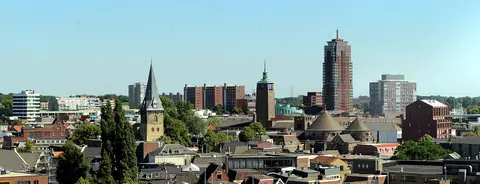
The northwest of the province is wet and low-lying: in Weerribben-Wieden National Park, peat cutters spent centuries creating lakes, ditches, and reed beds, forming the largest lowland fen area in northwestern Europe. Farther east rises the Salland region with Sallandse Heuvelrug National Park, where black grouse live on the heath. Twente in the east, with Enschede, Hengelo, Almelo, Haaksbergen, and Oldenzaal, is a small-scale landscape of village commons, farms, hedgerows, and woods that blends seamlessly into the Münsterland and the County of Bentheim across the border.
Hanseatic Cities on the IJssel
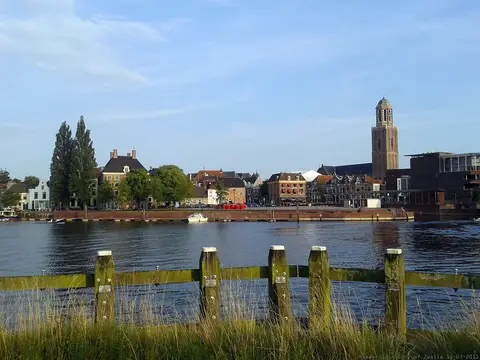
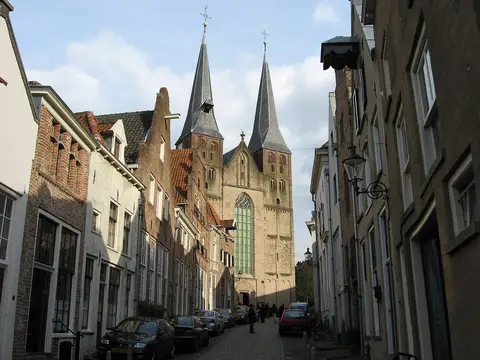
Deventer, Zwolle, and Kampen belonged to the Hanseatic League in the Middle Ages and traded via the IJssel with the Rhine and the Baltic Sea. Deventer is the oldest, with the Brink, the Lebuinuskerk, and the Waag building; in December the old town turns into a backdrop from Victorian England during the Dickens Festival, and in summer one of the largest book markets in Europe takes place. Zwolle, the capital, has the striking tower of the Onze-Lieve-Vrouwekerk, known as the Peperbus, a star-shaped moat, and, in the Museum de Fundatie, an art museum with an unusual oval structure on its roof. Kampen greets you from the river with three city gates and a row of towers.
Sights in Overijssel
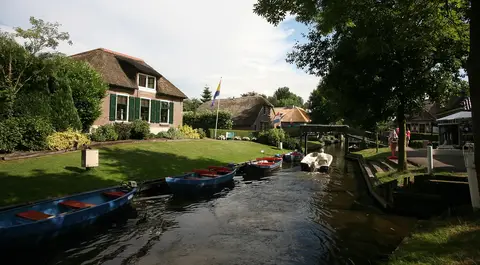
The best-known destination is Giethoorn, often called the Venice of the North, though the comparison is a stretch. Thatched-roof farmhouses stand on small islands connected by wooden bridges; the best way to explore the village is by whisper boat, ideally early in the morning before the day-trippers arrive. In the surrounding area you can rent canoes to paddle through the Weerribben. In Enschede, the largest city, the Rijksmuseum Twenthe recalls the region's textile history; after the explosion of a fireworks depot in 2000, the Roombeek district was rebuilt. Ootmarsum in Twente is a pretty hillside town with art galleries and an Easter bonfire tradition.
History and Culture
For generations Twente lived off the textile industry, with factories in Enschede, Hengelo, and Almelo processing cotton until the sector collapsed in the 1960s and 1970s. Old spinning mills are now cultural centers and residences. The University of Twente in Enschede has also contributed to the region's economic transformation. Culturally, many people from Twente feel connected to nearby Germany; the local dialect, Tweants, is closely related to Low German.
Food, Getting There, and Best Time to Visit
Regional cuisine includes Krentenwegge, a raisin bread from Twente, Kamper Steur, a bread with almonds, and Zwolse Balletjes, hard candies. The Grolsch brewery is based near Enschede. By train you can reach Hengelo and Deventer on the line from Berlin and Osnabrück to Amsterdam, and a regional train runs from Gronau to Enschede. The best time for boat trips and cycling routes is May to September; in December Deventer is worth a visit for the Dickens Festival. Accommodations include farm stays, waterside holiday parks, and small town hotels in the Hanseatic cities.